





The Quebec government’s environmental review and public consultation agency (BAPE) has announced that the public information period for the Samonix fish farm proposed for the Pontiac Industrial Park in Litchfield will be from May 27 to June 26.
During this 30-day period, all project-related documents and impact studies are available to be reviewed by the public, and any member of the public may request the ministry hold public hearings for the project. At some point in this period there will also be a public information session on the project.
The public information period is BAPE’s first involvement with a proposed project, and only occurs once the Ministry of Environment has accepted the environmental impact study produced by the proponent.
Samonix is a Chelsea-based company led by president Mathieu Fleury, director of development Remi Bertrand (also a former director general of MRC Pontiac) and technical director Fred Brisco.
The company is proposing to build a facility that would raise a maximum of 12,000 tonnes of Atlantic salmon annually in land-based tanks filled with water from the Ottawa River, rather than in traditional ocean pens.
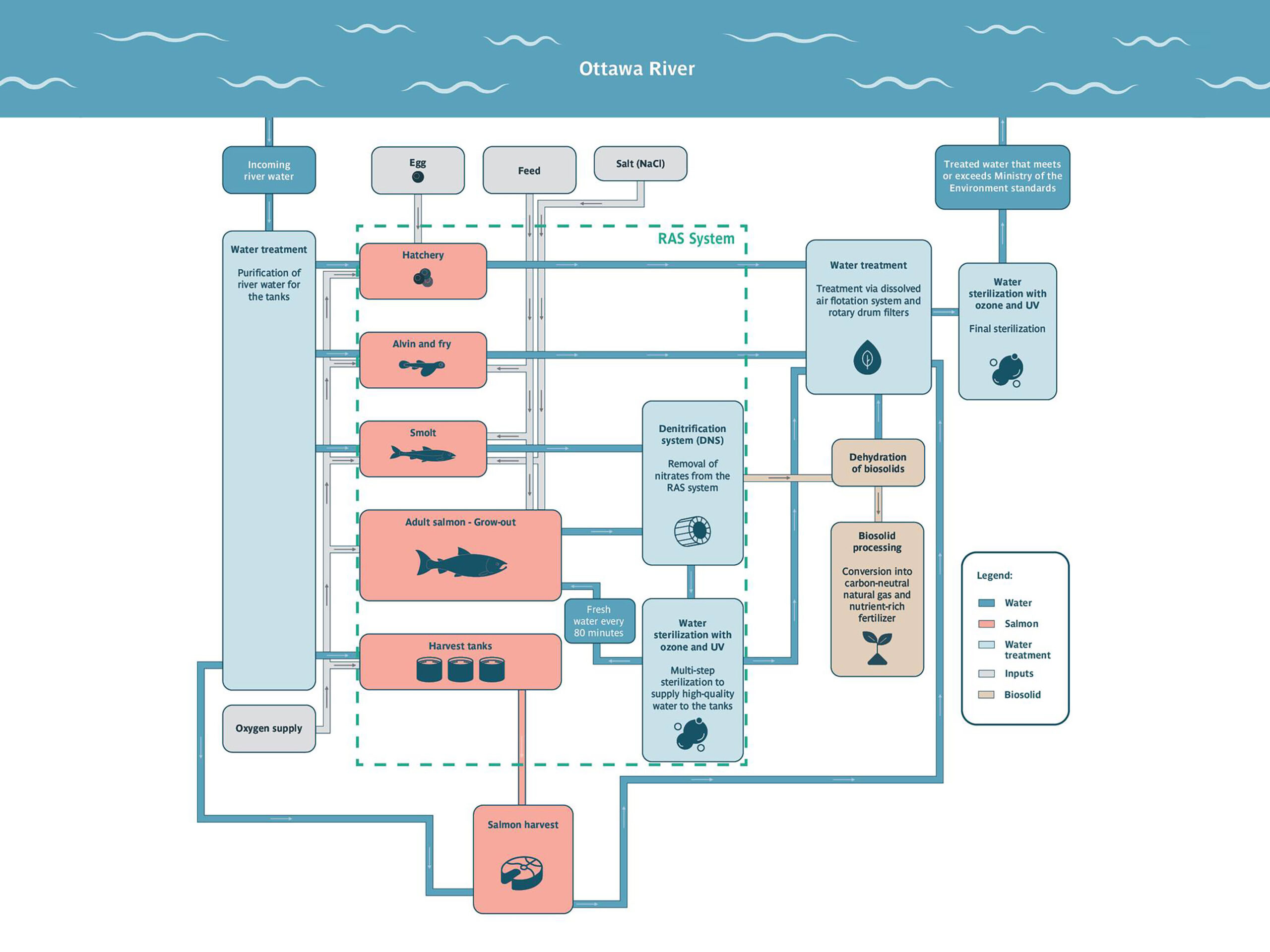
The company plans to use a method called RAS (Recirculating Aquaculture System) to treat and reuse water inside the facility, which it says will almost eliminate environmental discharge by recirculating 99 per cent of the water in the system.
In total, the facility will take up about six hectares of land at the Pontiac Industrial Park, on the banks of the Ottawa River, including facilities necessary for processing and transformation of the fish. The site is a vacant lot already designated for industrial use.
Samonix claims the project would create 500 jobs in the Pontiac during the construction phase and 100 permanent jobs to operate the facility once it’s built.
For several years, Samonix has been working to complete its environmental impact study so that it can get the permit it needs from the Ministry of Environment to start building and meet its target of completing its first harvest in 2029.
Now, hundreds of pages of documents tracking the environmental impact assessment process are available online, including the impact study produced by the proponent, comments from previous public consultations, expert opinions on the admissibility of the impact study, and Samonix’s responses to questions from the environment ministry concerning various details of the proposal.
The 186-page environmental impact study submitted to the ministry was conducted by consulting firm Groupe Conseil UDA inc.
It assesses the possible impacts the project could have on the environment, including local species at risk, wetlands, and water quality, as well as on local communities, and details how the company plans to mitigate these impacts.
Addressing concerns related to the disturbance of local aquatic ecosystems, the study explains water will be drawn from the Ottawa River using an intake pipeline which will be installed under the riverbed using a process called directional drilling. This method is supposed to minimize the impact on the riverbed and its habitats, including certain sensitive mussel species.
Addressing concerns about the water that is released back into the Ottawa River, the impact study explains all processes that will be used to remove toxic ammonia produced by fish waste, kill any bacteria, viruses, fungi, or parasites in the water, and desalinate it before releasing it back into the river. The study notes this process will achieve a maximum chloride concentration of approximately 554 mg/L, which is below the acute toxicity threshold of 640 mg/L established by the Canadian Council of Ministers of the Environment (CCME).
The study says all sludge left over from the various water treatment systems will be dewatered, stored in containers, and transported to Montérégie where it will be processed at a biomethanation plant.
The study notes that rigorous monitoring of contaminants discharged in the effluent will be conducted to ensure they do not exceed the environmental discharge objectives established by the environment ministry.
All documents can be found at https://www.bape.gouv.qc.ca/fr/dossiers/ferme-aquacole-pontiac/.
Also on that website is an option to subscribe to receive all information regarding this public information period via email.
L’organisme d’évaluation environnementale et de consultation publique du gouvernement du Québec (BAPE) a annoncé que la période d’information publique concernant le projet de ferme piscicole Samonix, proposé pour le Parc industriel du Pontiac à Litchfield, se déroulera du 27 mai au 26 juin.
Durant cette période de 30 jours, tous les documents relatifs au projet et les études d’impact sont mis à la disposition du public, et tout citoyen peut demander au ministère de tenir des audiences publiques sur le projet. Une séance d’information publique sur le projet aura également lieu à un moment donné durant cette période.
La période d’information publique constitue la première étape de l’implication du BAPE dans un projet proposé, et elle n’a lieu qu’une fois que le ministère de l’Environnement a accepté l’étude d’impact environnemental produite par le promoteur.
Samonix est une entreprise basée à Chelsea, dirigée par son président Mathieu Fleury, son directeur du développement Remi Bertrand (également ancien directeur général de la MRC de Pontiac) et son directeur technique Fred Brisco.
L’entreprise propose de construire une installation qui élèverait un maximum de 12 000 tonnes de saumon atlantique par an, dans des bassins terrestres remplis d’eau de la rivière des Outaouais, plutôt que dans des cages océaniques traditionnelles.
L’entreprise prévoit d’utiliser une méthode appelée SAR (Système d’Aquaculture en Recirculation) pour traiter et réutiliser l’eau à l’intérieur de l’installation, ce qui, selon elle, éliminera presque entièrement les rejets environnementaux en recirculant 99 % de l’eau du système.
Au total, l’installation occupera environ six hectares de terrain dans le Parc industriel du Pontiac, sur les rives de la rivière des Outaouais, y compris les installations nécessaires à la transformation du poisson. Le site est un terrain vacant déjà désigné à usage industriel.
Samonix affirme que le projet créerait 500 emplois dans le Pontiac pendant la phase de construction et 100 emplois permanents pour exploiter l’installation une fois construite.
Depuis plusieurs années, Samonix travaille à achever son étude d’impact environnemental afin d’obtenir le permis nécessaire du ministère de l’Environnement pour débuter la construction et atteindre son objectif de réaliser sa première récolte en 2029.
Désormais, des centaines de pages de documents retraçant le processus d’évaluation d’impact environnemental sont disponibles en ligne, y compris l’étude d’impact produite par le promoteur, les commentaires des consultations publiques précédentes, les avis d’experts sur l’admissibilité de l’étude d’impact et les réponses de Samonix aux questions du ministère de l’Environnement concernant divers détails de la proposition.
L’étude d’impact environnemental de 186 pages soumise au ministère a été menée par la firme de consultation Groupe Conseil UDA inc.
Elle évalue les impacts possibles du projet sur l’environnement, y compris les espèces locales en péril, les milieux humides et la qualité de l’eau, ainsi que sur les communautés locales, et détaille comment l’entreprise prévoit d’atténuer ces impacts.
Abordant les préoccupations liées à la perturbation des écosystèmes aquatiques locaux, l’étude explique que l’eau sera puisée dans la rivière des Outaouais à l’aide d’un pipeline d’admission qui sera installé sous le lit de la rivière par un processus appelé forage dirigé. Cette méthode est censée minimiser l’impact sur le lit de la rivière et ses habitats, y compris certaines espèces de moules sensibles.
Concernant l’eau rejetée dans la rivière des Outaouais, l’étude d’impact explique tous les processus qui seront utilisés pour éliminer l’ammoniac toxique produit par les déjections de poisson, tuer les bactéries, virus, champignons ou parasites présents dans l’eau, et la dessaler avant de la rejeter dans la rivière. L’étude note que ce processus permettra d’atteindre une concentration maximale de chlorure d’environ 554 mg/L, ce qui est inférieur au seuil de toxicité aiguë de 640 mg/L établi par le Conseil canadien des ministres de l’environnement (CCME).
L’étude indique que toutes les boues résiduelles des divers systèmes de traitement de l’eau seront déshydratées, stockées dans des conteneurs et transportées en Montérégie où elles seront traitées dans une usine de biométhanisation.
L’étude souligne qu’un suivi rigoureux des contaminants rejetés dans l’effluent sera effectué pour s’assurer qu’ils ne dépassent pas les objectifs de rejet environnemental établis par le ministère de l’Environnement.
Tous les documents peuvent être consultés à l’adresse https://www.bape.gouv.qc.ca/fr/dossiers/ferme-aquacole-pontiac/.
Une option sur ce site web permet également de s’abonner pour recevoir toutes les informations concernant cette période d’information publique par courriel.