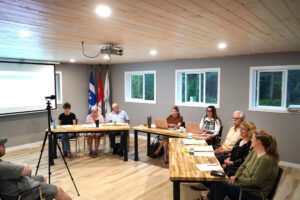






I once attended a series of land use planning meetings across the Pontiac which finished at our MRC with the Quebec Land Use Planning Committee hosting the meeting.
With only about three per cent of Canada’s total land base suitable for crop production, our province decided that some direction should be developed to reduce the skyrocketing use of farmland for buildings and roads. One of Pontiac’s best mayors wanted to have a strip on both sides of our main highway released from the agricultural zone so it could be developed. The Land Protection Commissioner replied, “You want to turn the highway into Main Street, don’t you?” That mayor was then very upset and muttered, “How much land do the farmers need for the next 50 years?” That was 25 years ago. That mayor has passed on and his family has moved away but we will need land to produce food on for as long as the human race survives.
More than half of Canada’s number one farmland is visible from the top of the CN Tower on a clear day and a large percentage of that class one farmland is now under buildings, roads and parking lots.
The price paid for farmland has been increasing rapidly and some farmland in Quebec and Ontario is now selling for more than $30,000 per acre.
One of the reasons that Canadian farmland values are increasing is pressure from outside buyers like Chinese investors. The Chinese are buying land in Africa, South America, Australia, the USA and Canada to name a few.
The Chinese realize that in the future China will have to grow food in other countries to feed their ever growing population.
Every time that more farmland is used for other uses like buildings, roads and parking lots the price of food increases incrementally. For decades, construction has taken place in farmland because the cost of construction there was much less than in fringe areas where rock had to be blasted, forest cleared, and infrastructure would be more expensive to build.
Roads and highways were also built right through some of Canada’s best farmland because it was more economical. The price of farmland was minimal compared to the cost of construction. Municipalities always looking to increase their tax base have allowed building along highways because the road was already there.
The thousands of commuters who travel our highway to jobs in the city or travel from urban areas to jobs in our communities have noticed the gradual slowing down of Pontiac’s main highway. The speed limit used to be 60 miles per hour. Now it is 90 kilometres per hour. We now see many houses and businesses along the highway, followed by pressure to reduce speed limits to 70, 60 or 50 kilometres per hour. There are now several caution and stop lights to make the trip safer but slower.
Every time that another reduced speed zone, caution light, stop light or cross walk is put on our highway, the voyage to work takes a little longer. For residents living in the upper parts of our county it is now quicker and less stressful to take an exit to the province west of Pontiac – meaning our county looses out on gas, grocery, and many other sales that were the lifeblood of our county.
Those who travel by Ontario to work may also think about moving to that province and cut even more off their commute time. For those who commute by Ontario, they may also notice that the towns beside the four lane or with a cloverleaf convenient to access the town will get the most visits and eventual growth.
Before any new highway is constructed it will go through planning stages that may take more than a decade and several changes in governments. I have personally been involved in a proposed highway plan that was relocated five times before it was constructed 20 years after it was first planned. This highway was eventually constructed away from most good farmland and away from several towns where the old highway passed. The towns that negotiated to have an overpass close to their town are still viable and growing. Some towns are several miles from the new highway and even farther away from a highway access. Those towns are slowly diminishing in businesses and residents.
The best leaders in any business, either private or public, bring out the best in their employees and colleagues. “Hope”, “change”, “sunny ways” and “let’s make our country great again,” have won elections in the past, but it’s time for some long term vision and a long term plan that everyone can understand.
Chris Judd is a farmer in Clarendon on land that has been in his family for generations.
gladcrest@gmail.com