


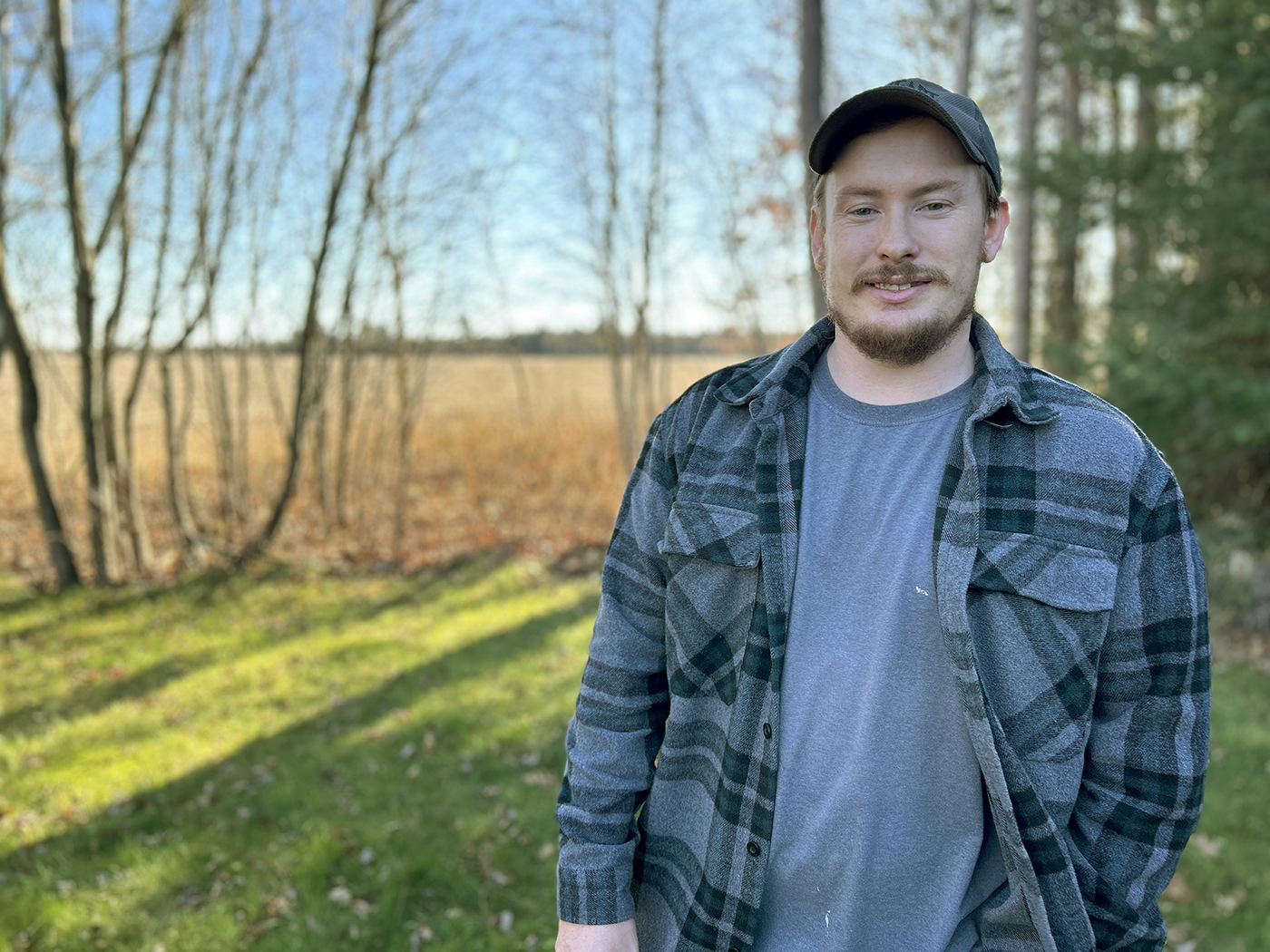



There’s a new artist on the Pontiac country music scene.
Quyon native Danny Dolan has released 12 songs since the beginning of this year, many of which tell the story of the town and region that shaped him.
One of his most recent songs, The Back Roads of Pontiac, is a love letter to his home county. From Gavans Hotel to the pine tree-lined shores of Norway Bay to the Mansfield covered bridge, the tune gives listeners a nostalgic tour of Pontiac days gone by. Anthemic vocals, twangy country guitar, and soft piano give the song an old-time feel.
But Dolan’s instrument of choice isn’t the guitar, piano or even his voice — he composes the songs entirely using artificial intelligence (AI).
Growing up, Dolan never really paid attention to music. Sure, he had seen local legend Gail Gavan perform from time to time — she’s a family friend — but he just never seemed to relate to music like others did.
Excelling in math and science, he was always more of a “left-brain” thinker. He went on to pursue a career in tech, eventually landing a job with DNS Networks, an IT security company in Ottawa, where he works now.
But a few years ago he happened to pick up an album by Ottawa Valley country icon Mac Beattie, and was surprised to find a connection with the old-time country style, especially its storytelling.
“His songs included all of the Ottawa Valley. It related to my life,” he said, adding that hearing Beattie’s music inspired him to write his own.
He started out by writing lyrics, but he quickly realized there was a problem: he didn’t know how to sing, and neither could he play an instrument. So he tackled this problem the only way he knew how — by using his technological talents.
He wrote a computer program specifically for composing music. The inner workings are complex, he said, but basically he types the lyrics into his computer, then tells it to create a song with a specific sound, style and beat.
For The Back Roads of Pontiac, it was the singing style of Alan Jackson or George Strait — one he chose because it would be nostalgic and familiar to the listener.
The program works by scanning the internet for all singers that match that style, copying the sound of their voices, then spitting out a computer-generated voice that is a mix of them all. Next, the program adds parts for guitar and drums, and spits out a completed song.
It’s not always that smooth, though. Dolan said sometimes the computer doesn’t get it right the first time. Or the second, or even the third. Dialoguing with the program is a process that takes time as he tells it to tweak a riff or a rhythm until it sounds just right.
“It takes weeks or months at a time to actually make the song because I wanted it to sound right. [ . . . ]
There’s plenty of songs where I still have the lyrics and I haven’t even published anything because I can’t get the right beat to the song.”
Authentic or not? Quyon country legends weigh in
THE EQUITY shared Dolan’s song The Back Roads of Pontiac with Pontiac country icons Gail Gavan and Lorne Daley to get their reaction.
Daley enjoyed the beat of the song, and was surprised to hear the song was made by AI. “I was thinking that kid should be going to Nashville!” he said, adding that he enjoyed the storytelling of the lyrics.
But he was disappointed to hear the song wasn’t made in what he called the “traditional” way, in a recording studio.
“I’d much rather personally have the musician and the creativity come from a musician, a live person,” he said.
Daley is aware the use of AI is gaining popularity in music circles, but he doesn’t want it to remove the human element from music — the emotion.
“Music comes from the soul, from the heart. Like anything that I’ve written [ . . . ] when you perform and you sing, you’re singing from the heart with feeling. I don’t want that to ever get lost,” he said.
Gavan, who was able to tell the song was made with AI, could tell Dolan put heart and passion into the lyrics. “I appreciate his love for everything he’s put into these songs. I love that he cares and that he feels it too,” she said, admitting the music felt slightly synthetic.
Gavan, who grew up on artists like the Ottawa Valley’s Mac Beattie, said an AI song about a region so rich in country music tradition as the Ottawa Valley just doesn’t sit right with her.
“I have such a passion for the people and places of the Ottawa Valley that I don’t feel a computer voice can give the authenticity it deserves,” she said, explaining she feels that a computer creating music about the region could threaten real, living artists who make a living telling the place’s story through song.
“When it can create a song like that [ . . . ], it’s kind of scary because it puts real people who live here, who write poetry, or write stories, or write songs, and it takes that authenticity and originality and authority away.”
Gavan said she is aware of the trend of AI in music, and that for her it will take some getting used to. “As Bob Dylan once sang, ‘The times, they are a-changin’,” she said. “It will just take some time to wrap my head around it.”
Dolan, who makes music only for fun, said in his experience these kinds of opinions aren’t uncommon, and he feels AI-generated music is often looked down upon.
While he is proud of the songs, he said these opinions have changed his perception of them. “I don’t really see highly of it because of what I’ve been told,” he said.
But even though he can’t play instruments or sing, he believes his music isn’t so far off from the kind of traditional music Gavan wants to preserve.
“It’s storytelling from my perspective,” he said, adding the only difference for him is that his instruments aren’t guitar and drums, but a computer program.
“Using the AI is just my voice,” he said. “That’s why those songs are written like that. It takes a bunch of retries to make the actual sound that I want. So I feel like it’s the exact same, I’m just using a different tool.”
Daley, who doesn’t want AI to completely take over the songwriting process, said he can get on board with using it as a tool, and he’s open to even trying it himself.
“You experience writers’ block every once in a while,” he said, adding that it could also help with lyrics and instrumental parts alike.
Still an emotional connection
Dolan said he wished people were more open-minded about the use of AI, and that he thinks this is the future of music. “We are in the day and age of using technology, and using technology is not always a bad thing,” he said.
He said without the help of a computer, his lyrics might still be scrawled on a page somewhere, and the program allowed him to create music the only way he knows how.
“It’s storytelling from my perspective,” he said, adding that AI is making music more accessible to people like him who can’t play instruments.
“I feel like a big thing blocking people from being able to even try is the fact that they might not have all the skills necessary. Like, I don’t really play music. I don’t sing. But now that I can sing using the computer and can play the instruments using the computer, then I could write a song [ . . . ] and then other people can listen to a song that never once existed.”
Sometimes he even gets goosebumps listening to the songs — each of them a labour of love that took weeks, if not months, to complete.
“Because I do spend some time on these, there is an emotional connection to the songs. I really enjoy listening to it because I feel something with the song.”
Dolan has more music in the works, and he can be found on YouTube, Spotify or Apple Music as Danny Dolan.