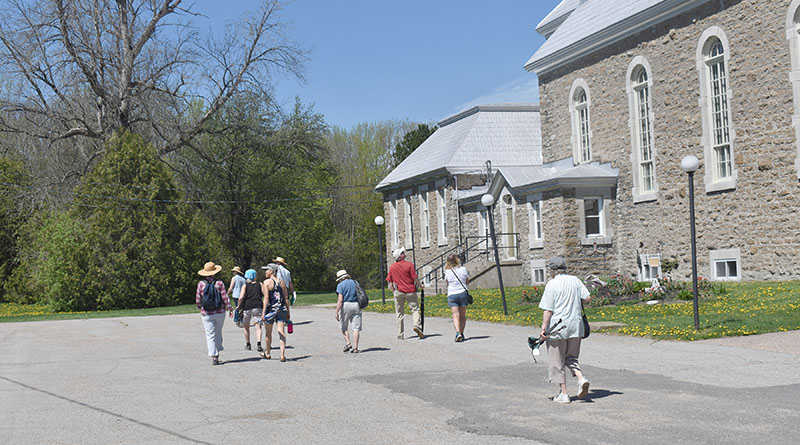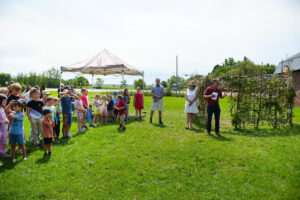



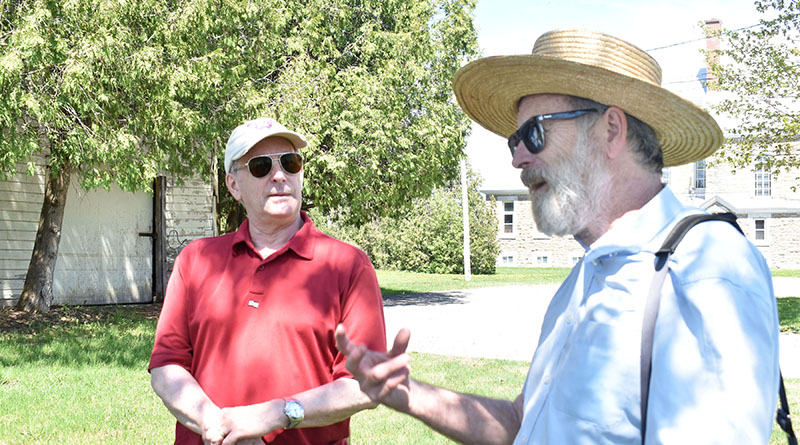



The Friends of Chats Falls held a historical walk in Quyon on Saturday morning. The walk was led by two guides who discussed the history of Quyon and included some stories of interesting characters who lived in the village in the past.
The walk was divided up into two groups, one led by a francophone guide and the other by an anglophone.
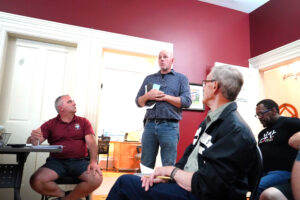
Mike McBane, a Quyon native and author of a book on the founder of the village, John Egan, led the anglophone group. He said . . .
his goal was to give a sense of the spirit of the people and the culture of the place.
Quyon was founded in 1848 as a node along Egan’s lumber operation, which was specially attracted to the area because of the exceptional pine trees.
Many of the original settlers were employees of Egan and came from diverse backgrounds.
“Quyon was a mixed settlement, so, it’s not all one religion or ethnicity,” said McBane. “There were large Irish settlements, but also some English, Scottish and French Canadian. For the most part, the different ethnic groups got along quite well.”
A major theme of the discussions about Quyon’s past centred on the lumber industry, on which the village and much of the region’s economy relied on during its first decades of existence.
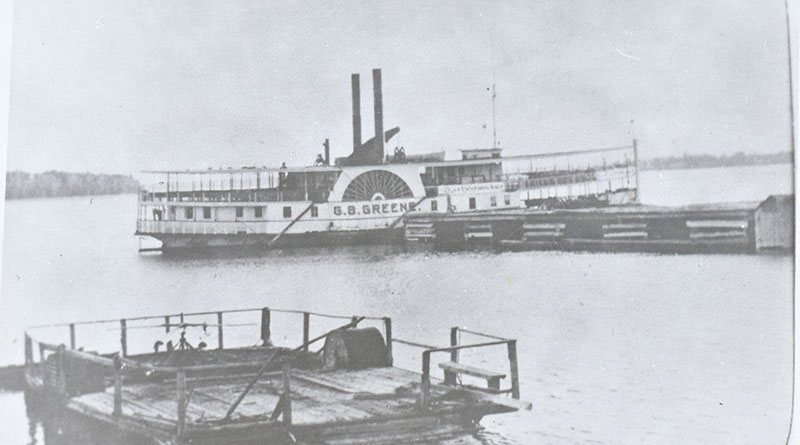
The Quyon and Ottawa rivers were key to the village’s economy, as logs were floated down the rivers towards Montreal.
McBane described the complex relationship between the village’s founding settlers using anecdotes of the people who lived there. This includes a long history of cooperation and intermarriage, but also of strife, which mainly would arise along interreligious lines between Protestants and Catholics as opposed to between those who spoke French and English.
In practice this means that French Canadians and Irish Catholics typically got along, though not without some mutual teasing.
He also described the history of the deep interconnection in the Ottawa Valley, of which Quyon was a focal point, in part due to its famous hotels.
“It was a very active community so that in the summer months there would be lots of sports events and other social organizing. People would come down to Quyon from places including Shawville and further west, people from Aylmer across from Ontario at Fitzroy. They would all come to Quyon for these social outings. It would be quite an active place on Saturday nights and developed a strong reputation for fights, which was almost a cultural thing in Canada at that time.”
McBane described these fights, which were not organized but still subject various conventions and rules as an institution in Quyon. “Farmers would come in after a week of doing chores and blow off some steam. It was connected to Irish clan fighting.”
The particular character of the people of Quyon revolved around the village’s large Irish heritage which was largely characterized by a strong sense of humour and a very distinct Irish sounding accent.
“Quyon had a strong culture,” he said. “Basically, Ottawa Valley Irish.”
Another interesting fact McBane explained was the confusion over the spelling of Quyon. The original word comes from Algonquin and means small river with sandy bottom. However, the name was first appropriated by the French, then the English and finally the Irish who settled there, which led to a significant divergence in how the name was spelled.
“I’ve come up with about 16 variations on the spelling of Quyon from documents in the 19th century”, said McBane. For example, the Irish spelled it Quio which was the name on the town’s train station and also matches how it is phonetically pronounced by anglophones today. The original spelling by the early French explorers was Couilloa, according to McBane.
“There was a lot of confusion and a lot of spelling variations until it was standardized when the town was incorporated in 1870,” he said. With 16 different spellings you may think it would have been challenging the post office.”
Overall many of the participants on the walk appreciated what they learned and said they looked forward to more events, despite the brutal heat of the day.
“I just think listening to someone like that, who’s done all this research is so important to keep that history alive,” said Jean McNab, who is from Pontiac Station.
The sentiment was also echoed by others who took the walk.
“I think for people to a have connection to where they are, a knowledge of history is really important,” said Deb Powell, who is a member of The Friends of Chats Falls .
The Friends of Chats Falls main goals are to preserve the historical heritage of the area and to promote the conservation of its native biodiversity, according to Powell
The group was incorporated as a not-for-profit in 2016 and has been organizing the recreational and educational activities around Quyon ever since.
While Saturday’s walk primarily focused on the history of Quyon in the last 200 years, or since it was settled by Europeans, Powell emphasized that it was important to consider how old this area really is.
“Sometimes it looks like we’re emphasizing the sort of blink-of-an-eye that has been the settler history of the area but we also work on emphasizing the natural wealth and certainly the recognition of thousands of years indigenous occupation in the area,” said Powell.
Both Powell and McBane both said that they planned to hold similar events in the future.
“We need people to not just come out and participate but you know, people who have a real interest in history or the natural side of things to be willing to organize events.”
The Friends of Chats Falls will hold their annual general meeting in June.