





Brett Thoms
Fort Coulonge April 26, 2022
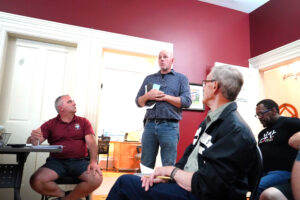
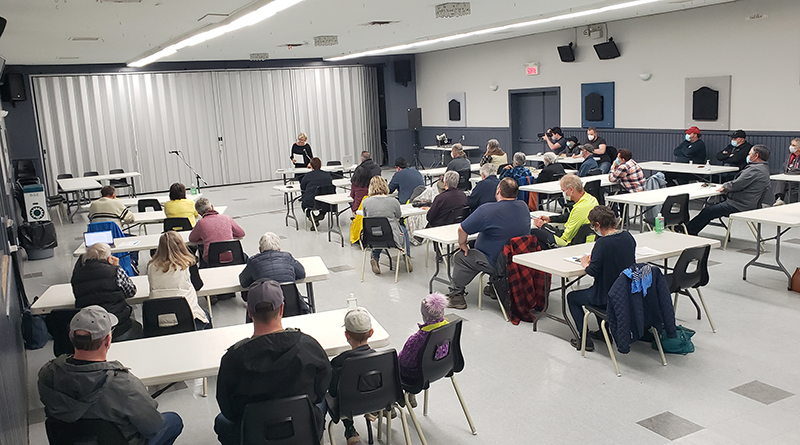
A public forum on the near surface disposal facility (NSDF) at Chalk River for low level radioactive waste proposed by Canadian Nuclear laboratories (CNL) was hosted by Jane Toller, warden of the MRC Pontiac, on April 26 at the Knights of Columbus Hall in Fort Coulonge.
The forum was an opportunity for residents of the MRC Pontiac to express their views on the proposed site. The majority of those who spoke at the meeting expressed strong opposition to the current proposal by CNL.
The forum was . . .
recorded and will be submitted to the Canadian Nuclear Safety Commission (CNSC) before the scheduled May 31 public hearings on the matter, according to Toller.
There were about 40 people in attendance at the in-person event, including the mayors of four municipalities within the MRC.
The mayor of Shawville, Bill McCleary, who attended the meeting via Zoom on account that he was chairing a municipal meeting at the time, was the first to speak. He announced that he was introducing a motion at the Shawville municipal council which requested that the site of the NSDF be moved as far away from the Ottawa river as possible.
“Get this thing as far away from the river as humanly possible,” said McCleary.
After McCleary concluded his remarks, Toller added that a similar resolution was passed by the MRC Pontiac in December 2021
The next person to speak was Ole Hendrickson who was the representative of the Concerned Citizens of Renfrew County, which is based on the Ontario side of the Ottawa River.
Hendrickson’s contribution focused on technical aspects of the problem, particularly bringing up the many hazardous materials that would have to be stored.
He stated that the waste of Chalk River was not managed well for its entire history reaching back to 1945.
Hendrickson went on to say that an above ground storage facility like the one proposed by CNL was not safe based on his understanding of the kind of waste that would be stored at the site, and instead said that authorities should opt for an underground facility.
Hendrickson suggested that the consortium behind CNL should have looked at other places to store waste.
“There’s federal property at the garrison at Petawawa that’s further from the river they should have looked at when they did the sighting process,” said Hendrickson.
Carl Hager, an executive of the NDP riding association of the Pontiac, was next to speak. He read a prepared statement which focused on problems with the regulation of the nuclear industry.
“Canada needs a truly independent regulator and comprehensive regulations, which do not vary with each project the regulator reviews,” said Hager. “Right now, the Canadian Nuclear Safety Commission lets the industry set most of the rules about where to sight in a facility, about the design, and what will be dumped there permanently.”
Hager concluded his remarks by asking the MRC to oppose the site and ask for a moratorium on any new proposals until governance issues with the nuclear industry are addressed.
Catherine Emond-Provencher, the president of the Pontiac NDP Riding Association then gave the same statement delivered by Hager in French.
Charles Dickson, publisher of THE EQUITY was the next to speak. He outlined his reasons to be sceptical of the assurances that the facility will be safe which included referencing past nuclear disasters like Nine Mile Island, Chernobyl and Fukushima. Dickson said his greatest concern was that anything that was a threat to the environment of the Pontiac has the potential of undermining the region’s main economic lifeline.
“In short, the welfare of this community that lies at the very bottom rungs of the economic ladder depends on a healthy environment. This is all we got. We are up against the wall here and we have no choice but to defend that with every ounce of our energy,” concluded Dickson.
Joanne McCann, representative of the Old Fort William Cottagers Association was the next person to speak. McCann’s remarks focused on three issues with the NSDF. First was that she believed the site was the wrong kind of facility, at the wrong location. Second, she believed that the site could potentially have a negative impact on the drinking water of the region and therefore affect the health of future generations. The third reason was that it would be a deterrent to people moving to the Pontiac.
McCann was also concerned with the lack of consultations of both residents along the water and Indigenous communities, pointing out that the site is located on unceded Algonquin territory
“The mayors were never consulted on the proposal until after decisions had been made,” said McCann. “That’s not consultation, that’s ticking a box.”
McCann concluded by accusing CNL of spending money to sway the public into supporting the site.
“Every time I open the paper [CNL] is cutting a cheque, and it’s been particularly in the last two months,” said McCann.
Deb Powell, president of Pontiac Environmental Protection, a small volunteer community group, was next to speak.
During remarks Powell said that Pontiac Environmental Protection is currently working with the Canadian Environmental Law Association to examine the difference between what is being proposed at Chalk River and the international standards set by International Atomic Energy Association.
Powell mentioned the necessity of dealing with the waste, but emphasised the current proposal was not the way to go about it.
“If there is some site within the Ottawa Valley or the Outaouais [to deal with the waste], then so be it,” said Powell. “But what they’re proposing now is not suitable for all the reasons that everyone has mentioned.”
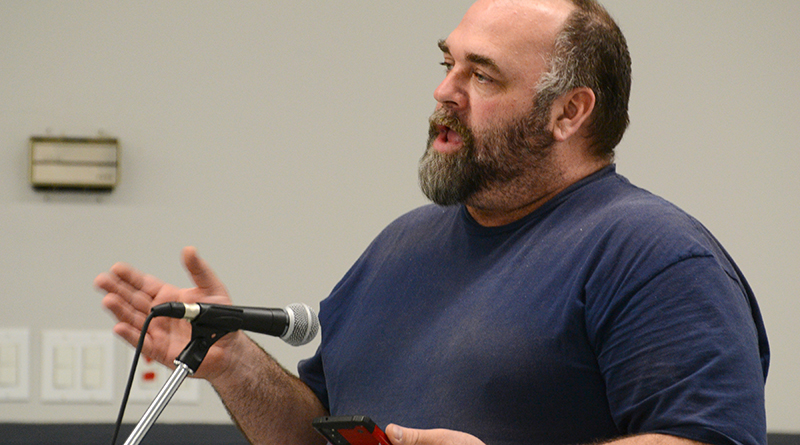
Stephen Weese, resident of the Pontiac and Libertarian Party candidate for the Pontiac spoke next. He explained that he has a lot of experience in heavy haul trucking and that based on that experience he was deeply concerned about the safety of transporting any nuclear waste.
“I worked for companies with as few as five trucks to as many as 16,000 trucks and 45,000 trailers and I’m going to tell you right now in the industry, every company I’ve ever worked for sweeps stuff under the rug,” said Weese.
He went on to explain that truck accidents are inevitable and corporations often do not report when they cause environmental damage.
Weese also expressed concern that trucks carrying nuclear material are vulnerable to terrorists who could deliberately harm the environment.
Weese, like many others who spoke that evening, also expressed concern about SNC Lavalin involvement with CNL.
“SNC Lavalin is running the show and letting them have the job is like letting the fox guard the chicken coop,” said Wesse.
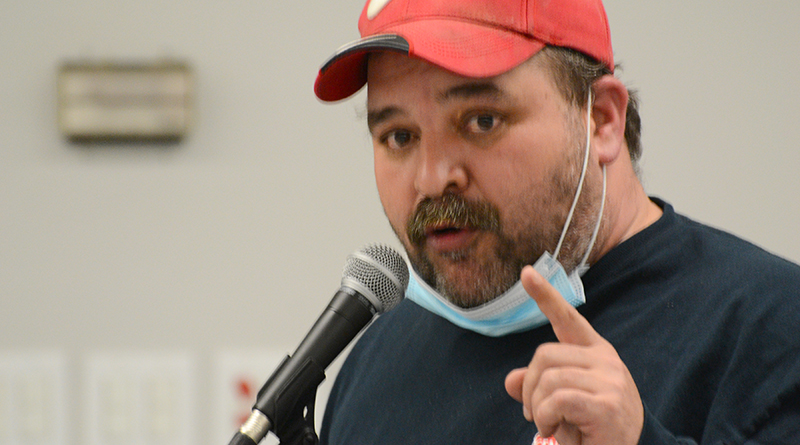
Jim Coffey, owner of Esprit Whitewater, was next to speak.
His remarks focused on the fact the proposed site had very bad optics.
“There are many obvious and blatant concerns that have yet to convince me and the general public that this proposal just doesn’t hold water in the court of public opinion,” said Coffey. “I believe that CNL needs to prove what’s right about the project to the rest of us to ensure that security and I don’t believe that they’ve done that effectively.”
Coffey, being a recent cancer survivor, also was concerned that his health issues may have been connected to Chalk River.
The mayors in attendance then went on to speak. They included Mayor Maurice Beauregard of Campbell’s Bay, Mayor Colleen Larivière of Litchfield, Mayor Christine Francoeur of Fort Coulonge and Sandra Armstrong, mayor of Mansfield et Pontefract and pro-warden of the MRC Pontiac.
All the mayors reiterated the concerns that they expressed at the last public MRC meeting.
“My concern is for the generations to follow my grandchildren, great grandchildren and so on, said mayor Larivière. “Once it’s done, we can’t turn back time. Another solution has to be found; this is not a legacy we want to leave our future generations.”
The next person to speak was Pontiac resident Cathy Welsh who cited a study performed by the CNSC that claimed that underground facilities are preferable when storing low to intermediate nuclear waste.
Larry Charbonneau, Robert Wells, Maureen Gagnon and others also contributed to the discussion.
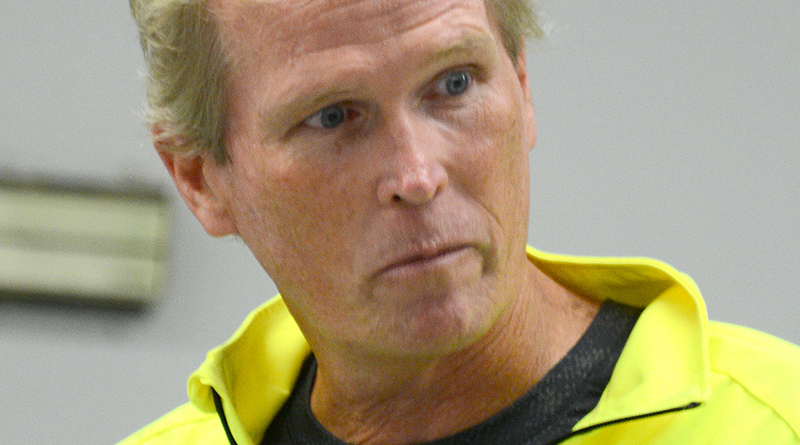
Finally, Dave Herault, resident of Fort Coulonge and employee of Chalk River contributed to the discussion. He was the sole person attending the forum to express support for the site.
“I can see there’s a lot of misinformation going around,” said Herault. “I’ve got to give it to CNL because a lot of people are bashing it here, but I can say that over the years they’ve made leaps and bounds of trying to develop facilities to try to clean up the site.”
He explained that in his view the proposed site is necessary to clean the waste that’s at Chalk River.
Herault then went on to state that CNL is important to the local economy. “There’s about 200 of us coming from the Pontiac that are employed by CNL and [we] spend money at local stores here,” he said. “There’s a lot of things to take into consideration with this.”
After Herault’s contribution, there was further discussion from some who had already spoken and a dispute over whether Toller’s contribution to the planned public hearings on May 31 should include alternate proposals on what to do with waste.
Toller supported bringing alternatives to the CNSC and suggested it would give her position some credibility, while those who opposed that move thought that any alternative proposals would lack sufficient expertise.
Toller also promised that she would launch a petition to give to MP Sophie Chatel to include in her intervention in the upcoming public hearings. She also stated she would reach out to all the municipalities along the Ottawa River to coordinate a collective response.
“These are the last days so it’s an important time to come forward and, as I said, to stand up and be counted and fight to the finish,” said Toller.