





A walking tour of Shawville’s architectural history
Madelaine Methot
Shawville August 13, 2023
A guided tour along Shawville’s Main Street last Tuesday provided a fascinating glimpse into the town’s architectural and brick-making history.
The walk set off from the Pontiac Archives, led by Archives president Venetia Crawford and Chris Seifried, President of the Pontiac Museum, with help from the Pontiac Museum’s summer student Lea Gagnon. But to kick things off, we were treated to a presentation by former Shawville mayor Albert Armstrong on the brickworks founded and operated by his great-grandfather, Samuel Armstrong.
As we learned, it was in 1865 that Samuel began making bricks by hand on a property just east of Shawville, still known as the Armstrong Farm today, that would be the first of the three Armstrong brick yards. Armstrong explained that the farm fields there were rich with clay that was perfect for brick making.
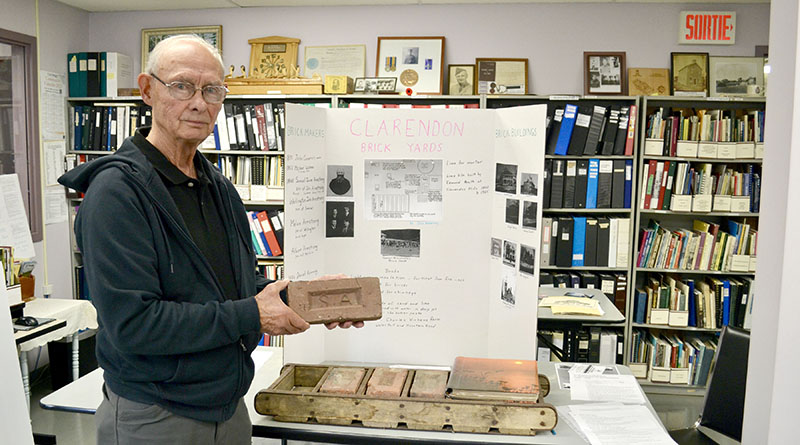
Armstrong went on to describe that, in the original days of manual brick production, clay was pressed into wooden pallets, much like butter moulds and bread tins, to shape it into the rectangular brick shape before being baked in a kiln. Each of these pallets was engraved with the brick maker’s initials so that it would leave an imprint on the bricks, a brick maker’s signature, of sorts. Over the years, Albert has collected several bricks bearing his great-grandfather’s initials SA.
In addition to their use in numerous local construction projects, cart loads of brick were also pulled by horse to the train station to be shipped “all over the place,” as Albert put it.
In 1911, Samuel’s son Wellington Armstrong closed the brickyard to specialize in brick laying, a business continued by his son, Melvin Armstrong, Albert’s father. Albert shared stories of he and his brother, as children, carrying bricks and mortar from the yard to their father’s job sites around town.
Another major focus of the Archives presentation was the work of well-known Wyman-born architect, Moses Edey, many of whose projects were brought to life with bricks from the local brickyard.
Eady designed a number of notable buildings around Shawville and the surrounding regions, including the former octagonal wooden agricultural hall that used to be in the Shawville Fairgrounds until it burned down decades ago, the G.E. Reid house in Portage du Fort, and the Aberdeen Pavilion that still stands in Landsdowne Park in Ottawa.
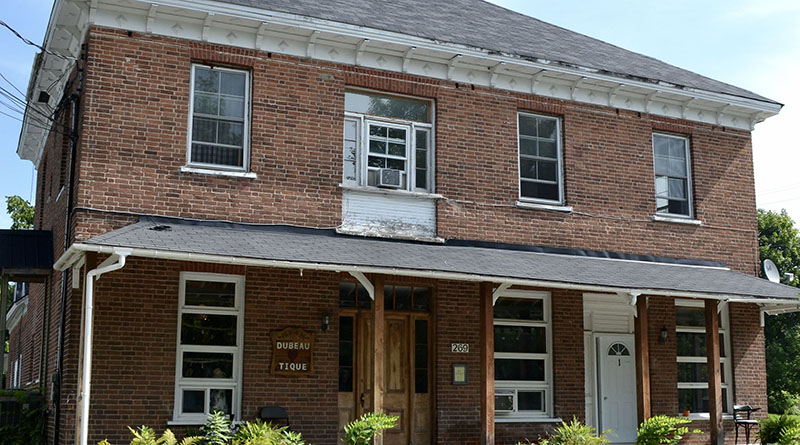
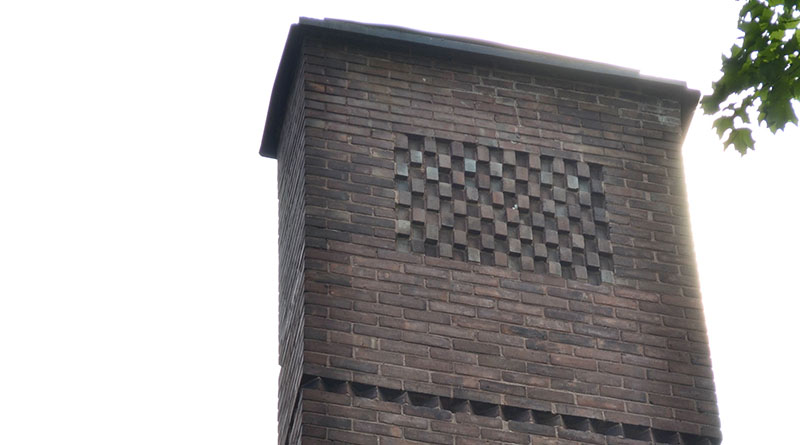
The walking portion of the presentation brought us along Main Street to see some of Shawville’s finest architectural specimens made of local brick, from the G.F. Hodgins building, now Stedmans, to the Town Hall and on to Dubeautique, which was originally a hospital, and the Masonic Hall, where photographer Harry Imison used to have a photo gallery on the top floor.
We saw the former homes of James Shaw, Dr. Wallace Hodgins and Watt Taylor. A bit further east on Main Street we stopped to admire two magnificent brick mansions, one designed by Moses Eady and built for G.F. Hodgins, later occupied by George Hynes, undertaker, and the other built for Dr. McNaughton, later occupied by veterinarians Roly Armitage and Grant Rogers and now being transformed into a B&B by Emma Judd.
From there, it was a few short blocks to the Pontiac Museum where Lea Gagnon had prepared a poster on the history of the Armstrong brickyards, along with drawings donated to the museum by artist Mike Leblanc of some of the Shawville homes built of bricks from the Shawville brickyards.