







Photos and story by CALEB NICKERSON
When most people think of sustainable, organic agriculture, they usually think of fruit and veggie stalls at the local farmers’ market, or a stand at the end of the laneway.
But one business in Clarendon is breaking into the market a slightly different way, by harvesting crops of mushrooms rather than plants.
Dany Fortin and his wife Tiziana Rompelburg-Fortin moved to the region five years ago and their farm currently sits on the 11th Concession in Clarendon. Fortin is originally from the Lac St. Jean region and had worked as a forestry technician. A government program provided him the opportunity to learn about foraging for wild mushrooms and plants, and kept at the trade when he moved to the Pontiac.
“I find the area very good for mushrooms,” he said. “The challenge here is to find a market for mushrooms.”
For several years, he sold the wild fungi at various markets in Ottawa, but the off-seasons were tough. That’s why he decided to build his growing facility in 2016.
In the main building Fortin stores some of his pasteurizing equipment as well as a sterile chamber, where he introduces the mycelium (the fungal colony out of which the mushrooms grow) to a nutrient mixture. Fortin said he’s experimented with the mixture, but uses a combination of wheat grain with sawdust and water. He explained that the sawdust is used as a sort of filler, since the grain is expensive.
They mature in these mixtures for about 10 days before they’re ready to be mixed in a growing medium through a process called inoculation.
The entire process is kept extremely sterile to avoid introducing any unwanted bacteria into the mix. Since the environment for growing mushrooms is equally perfect for less appetizing organisims, even a small contamination could spoil a crop.
Jutting off from the main farm structure is an enclosed space where Fortin introduces the small bags of mycelium to a growing medium. He explained that he uses organic straw from a farmer on Calumet Island named Jacques Lance and shreds it himself.
The straw is pasteurized in a large, jerry-rigged steamer that Fortin designed with an old cooler and some propane heaters.
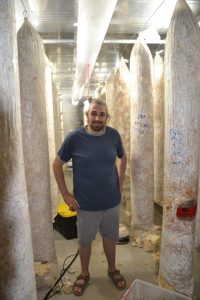
Once the straw is cooled, it’s mixed with the mycelium and on a sterile table and stuffed into large six foot tubes. Using a home-made hole punch, Fortin punches holes in the bag at regular intervals, out of which the mushrooms will eventually sprout.
Though he doesn’t have any employees, Fortin said that he enlists friends and family for this labour-intensive portion of the process.
He said that even the optimal number of holes to punch in the bags was something he had to learn through trial and error.
“My system isn’t finished,” he said with a laugh. “It’s given me a lot of problems but I learned. It’s a process.”
The bags are hung from the ceiling of one of his two grow rooms, which are converted steel shipping containers that jut off another part of the main building. The structures are highly climate controlled, with heavy duty humidifiers and precise heating equipment.
Fortin even has cameras rigged so he can check all of the growing conditions from his phone.
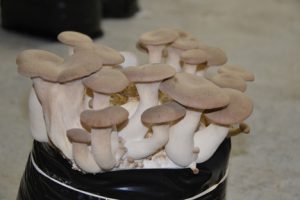
Once the mushroom pins grow and the caps open up, they’re ready for harvest with a sterilized box cutter. Each bag can produce multiple crops, or flushes, usually around three or four.
Fortin emphasized the nutritional value of mushrooms, which contain many anti-oxidants and nutrients while also being low in calories.
Currently, he said that he sells most of his mushrooms to local businesses, but asks that customers looking to stop by the farm call in advance, as availability can vary.
Fortin said that he is currently working towards an organic certification and hopes to add more grow rooms to expand his operation.