






Zainab Al-Mehdar
Gatineau May 14, 2022
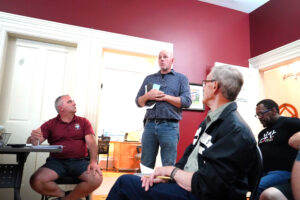
A roundtable discussion of issues and concerns about the proposed nuclear waste disposal site at Chalk River was convened by the Pontiac NDP riding association in Gatineau on Saturday.
The event took place at Université du Québec en Outaouais (UQO) where four speakers presented their views on the proposal by Canadian Nuclear Laboratories to construct a Near-Surface Disposal Facility (NSDF) on the Ontario shore of the upper Ottawa River.
Eva Schacherl was the first speaker. A writer with a lifelong interest in health and environmental issues, Schacherl is an avid advocate for the protection of the Ottawa River.
Schacherl started off the panel discussion with . .
an overview and an explanation of the dangers and implications of the Near Surface Disposal Facility (NSDF). She explained that in 2015 the Harper government signed a contract with private companies to manage all of the federal nuclear sites, which meant that private sector facilities were operated by the private sector, she emphasized.
“The contract actually encourages cheap and fast waste disposal, so the Canadian Nuclear Laboratories (CNL) which is the entity run by these corporations, very quickly after taking this contract, came up with this plan,” said Schacherl.
She gave a very holistic view of the history of Chalk River and explained that the campus was first developed during the end of WW2 as part of the Allies’ efforts toward developing nuclear weapons and then nuclear energy.
She claimed there was a meltdown and a major reactor accident in the 50s was covered up.
“This is important to know because at that time, in a fairly hush hush way, the reactor parts and other radioactive material were simply buried and dumped into semi-trenches in the ground. That leads to very high levels of contamination on the site,” she said.
At the time the cost of the clean-up was estimated to have been at least $7 billion.
Schacherl highlighted the main criticisms: First that its’ the wrong technology because landfill-type facilities are only suitable for very low level, short-lived radioactive wastes; second the location is only one km from the Ottawa River, the objective of creating the mound does not address waste management areas impacting water quality; and third the notion that CNSC has sole decision-making authority, with no federal oversight.
“They did not seriously consider alternative sites. This one was really chosen for convenience because it’s at Chalk River, the roads are there, the campus is there, the base is there, but that’s not the reason to consider this the best site,” said Schacherl.
Another of the main challenges is the failure to consult the Indigenous population and adequately speak to them, said Schacherl.
The function of this facility, as explained, would be to accommodate what is being referred to as low-level or intermediate-contaminated waste under a mound designed specifically for this purpose. Less than one kilometer from the Ottawa River, which is the main source of drinkable water for millions of Quebecers and Ontarians. Therefore many experts and activists who see this project as posing many risks.
Schacherl emphasized that there is a waste problem and it is her generation’s responsibility to deal with it, but there should be a better siting process rather than just choosing the most convenient site.
CNL hopes the NSDF is operational within the next few years. The final hearing for both the licensing and environmental assessment will take place between May 30 to June 30.
Ole Hendrickson, National Science Contact for Canada’s participation in the UN Convention on Biological Diversity from 2003 to 2012 and Editor-in-Chief of Biodiversity: Journal of Life on Earth, who spoke after Schacherl concluded, delved deep into the science behind nuclear energy. He explained how long radioactive elements last, why they are so dangerous and why safe storage and disposal is so important.
He explained that this mound would be Canada’s first permanent nuclear waste disposal facility for reactor wastes, disused sources, hazardous waste with heavy metals, and waste from fuel reprocessing.
Although the commercial radioactive waste (or disposal sources) that gets dumped in the Chalk River is said to be at a low level, according to the International Atomic Energy Agency they instead should be classified as intermediate level because of their intense radioactivity, said Hendrickson.
“So this is a terrible precedent,” he said.
He said there should have been an assessment of alternative technologies and alternative sites. “It’s a terrible place for a permanent radioactive waste disposal,” said Hendrickson.
Putting long lived waste in the mound would violate international standards and would create significant adverse environmental effects, he added.
He also explained that there is huge uncertainty about how much the NSDF would cost, which is why he believes there should be proper waste characterization for choosing the type and location of the disposal facility.
“Wrong plan, wrong place,” said Hendrickson.
After Hendrickson, NDP MP for Rosemont – La Petite-Patrie and Deputy Leader of the NDP, Alexandre Boulerice spoke next over zoom.
Boulerice opposed the site.
After his remarks, an audience member asked Boulerice how far they were really willing to push their anti-nuclear position if they are partnered up with the liberals who are pro-nuclear energy, and is the NDP willing to tell the liberals they need to get a neutral regulatory agency and that they have to stop this project.
Boulerice responded: “We are an opposition party and we will continue to fight and put pressure on the government to do things better. We will continue to denounce that and we will continue to fight that because it’s wrong. It’s against the science, it’s against the future of our kids.”
He added that the NDP’s deal with liberals didn’t include nuclear energy, and they would only support the liberals on issues they agreed to support them on, like the expansion of dental and pharmacare.
Denise Giroux, lawyer, activist and NDP candidate for Pontiac in the 2019 and 2021 elections, spoke next.
She discussed that although Canada has been producing nuclear waste for almost 80 years, there has never been an adequate disposal plan for such waste.
While nuclear waste has also been characterized as being one of the most affordable energy sources, it is rather very costly, according to Giroux.
“They’re selling us a snow job, it really is a snow job. I’m not gonna mince words. It’s all about this clean energy business. We’re gonna make it safe, you can trust us, but can we trust them?” she said.
A big driver for this project is the jobs and employment opportunities it will create, but the harm of being exposed to any level of radiation is harmful the longer a person is exposed to it, explained Giroux. “But the risks are there,” she said.
One way to reduce the risks is by bringing the best practices and complying with international standards, which she points out the government is not following.
After the conclusion of all the panelist remarks, a question period was open for the about 35 attendees.
The Equity asked the panelists whether the upcoming decision of whether or not to grant the site a construction permit was really the last chance to stop the site.
Schacherl followed up by saying that there are legal actions that can be taken, and Giroux added that she hopes the Indigenous communities would be able to challenge the project as many First Nation communities have not been adequately consulted.
“There’s still opportunities to politically challenge there. But the problem is that the government has said, you know, well, it’s not our decision there’s an independent regulator to decide that but we’ve seen the weaknesses. So they’re washing their hands of it, whatever the commission decides it’s good enough for them. But it puts the onus on concerned citizens to fight a bad decision done by a captured regulator,” said Giroux.
Hendrickson said that once the construction permit is issued, he expects the other permits required to invitablely be granted.
To lighten the mood the organizers also had some musical guests like Randy Smith who played a song and Ottawa Raging Grannies, who showed some videos and read a letter.
After the session ended, Catherine Emond-Provencher, president of the riding association for the NDP Pontiac and moderator, mentioned that the riding association set up a letter campaign that was launched to make elected officials aware of the issues related to this possible waste dump.
The letter asks that the decision to allow the construction of a waste management facility near the surface should be suspended until the office of the Auditor General, who is currently conducting a study on radioactive waste management, makes its report public.
The riding association also pointed out that a report from the Parliamentary committee on the environment and sustainable development that investigated the subject this winter is expected in June.
Since the CNCS has never refused a license, Schacherl said, “we have to prepare for a fight.
For the letter campaign, the link is on the website, and the google doc link is https://docs.google.com/document/d/1MiP_6g5VG9qnBCd7YFMwMDzoVjAl-Yrl/edit