






Donald Teuma-Castelletti
QUYON July 29, 2018
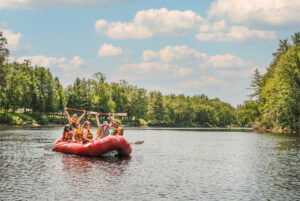
Two boatloads of curious, history-hungry adventurers hit the Ottawa River Sunday morning seeking to catch a glimpse of various sites in Pontiac Bay that are only accessible by watercraft.
Led by the organizers of the Friends of Chats Falls (FCF)) the rabaskas, plus a few extra canoes, explored five sites along the Ottawa River, before returning to the Domaine de Pontiac Village for some further discussion.
“The idea is to showcase for people the rich history of the area,” said Maude-Emmanuelle Lambert, the group’s president. “A good way to do that is to go where the history is.”
Launching from 1061 chemin de la pointe Indienne, FCF members first learned about the history of that spot as a trading post, before continuing to historic sites relating to the logging trade.
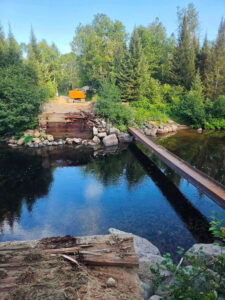
From there, they continued onto the entrance of what was to be a series of locks in the Chats Canal, a project meant to make the Ottawa River navigable by steamboats but was later abandoned. As well, guests would see the group’s namesake, tucked amongst the overgrown vegetation in the area.
Next up was a visit to the John Egan Sawmill, before the tour wrapped up with a stop at the location of an Indigenous portage site.
“It’s a very dense area and it’s easier to show the place via canoe,” said Lambert, of visiting the sites with the group.
The trip was only open to members of the group, though membership could be acquired through purchase for a mere $10 – otherwise the outing was free.
Two of the tourists joining the group that day were there on missions of reconnaissance, seeking knowledge of the area’s part in the lumber trade of years ago. They plan to use the knowledge gleaned, as well as their research into rivers and areas across Quebec, as they seek to open a museum exploring the logging industry.
Alexandre Pampalon, the project coordinator, and Isabelle Regout, the director general, said that they took part because they’re currently still exploring the history of the timber trade and are well-aware of the importance of the Pontiac during this period of time.
They were very excited to see firsthand locations that were once home to important achievements to their research, such as Ruggle Wright’s Slide. This was a method of circumventing long and dangerous portages for their timber by lashing together a raft and riding humongous creations across many miles of river.
“To see it all in person was to understand how they transport the wood to feed the mills,” said Regout.
Having worked towards their goal of making a national museum dedicated to log drivers and raftsmen for two years now, operating under the name Columbo 1806, they hope to open in Gatineau once their research is complete.
However, with the amount of new information regularly discovered, they are still very much in the studying phase.
“We’re finding more and more information all the time, going through old images and paintings,” said Pampalon.
Sunday’s trip was a surely refreshing breath of air, both literally and figuratively, as they laid their eyes on locations they were anxious to explore.
“For us, it’s like a castle, it’s huge, unbelievable,” said Regout, of the mega-rafts used in the trade.
While they may not be able to see those mega-rafts that once ventured through the area, simply getting a glimpse of spots that it had travelled through, so close to the source, was a reason of great excitement.
The Sunday morning venture was a project put on in collaboration between FCF and Gatineau Plein Air. Lambert said that, with the success and popularity of the trip, as it did fill up in three days, there was a good chance another one will be organized.
“I think it’s a nice way to learn, to see,” said Lambert. “As a historian, I think it’s a better way to learn than just reading books.”