





Judith Spence found out her Clarendon home tested high for radon in Feb. 2024.
It was during some particularly meticulous research that she found many areas of the Pontiac have an elevated risk of the radioactive gas.
Spence, who lives in the home with her husband Gerry, said their result was alarmingly high. Twenty-two hundred becquerels per square metre (bq/sq. metre) was the reading, over 10 times Health Canada’s recommended limit.
While not particularly dangerous if diluted outdoors, the invisible, odorless and tasteless gas can be harmful to human health if it accumulates indoors. According to Health Canada, radon is the second leading cause of lung cancer, after smoking.
“It’s our retirement home. We wanted it to be safe, and that vision of it was demolished in an instant,” she said of the moment she found out about the radon levels.
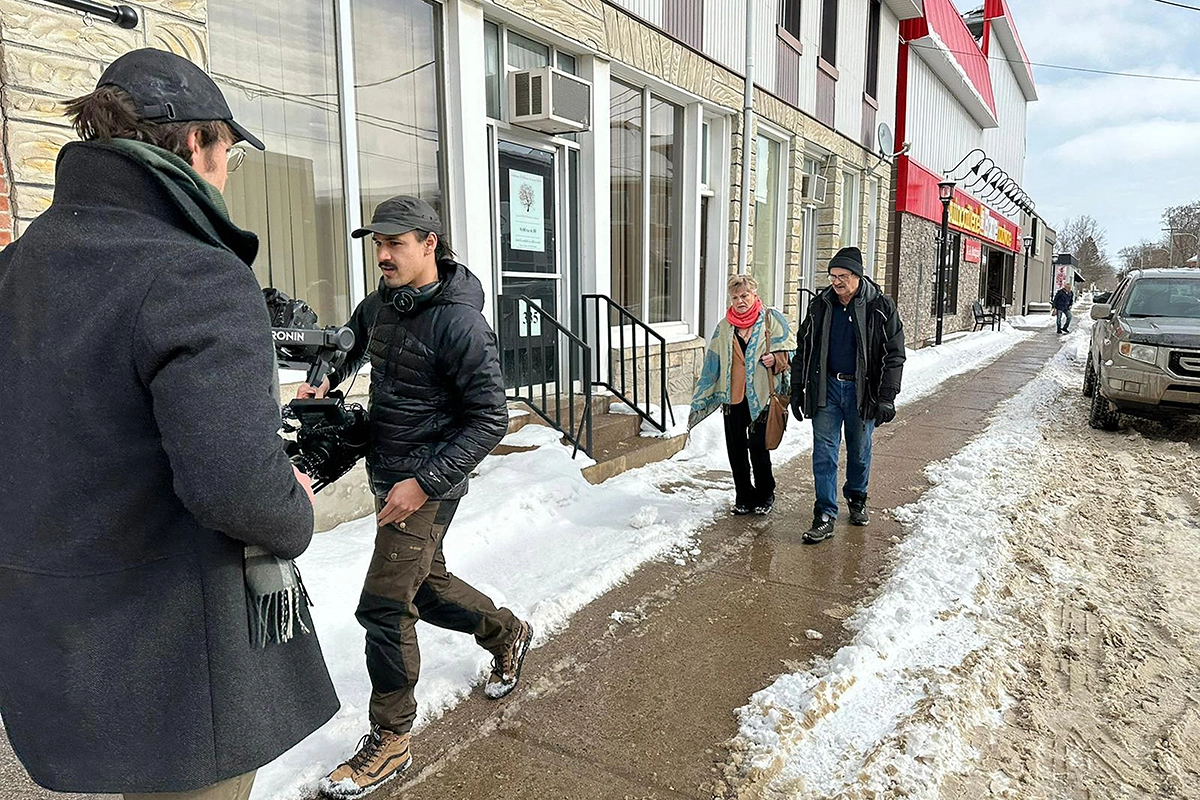
Last week, Spence had a chance to tell her story to a BBC video crew, who visited their home to record an episode of an upcoming short series highlighting her experience with radon gas.
Over three days, the couple hosted the British and South African crew’s members as they filmed various scenes inside their home as well as in Shawville. They will be used in Spence’s episode of The Human Component, a series that will spotlight technological solutions to the world’s greatest challenges.
The series is being produced by BBC StoryWorks, the sponsored content branch of the British news corporation, and is being made for the Consumer Technology Association (CTA), a North American trade organization representing over 1,200 companies.
“The short films are high-quality cinematic pieces of storytelling that educate and engage viewers about the issues and solutions being addressed by a featured company, ultimately highlighting their work and impact as a company,” wrote CTA communications specialist Grace Venes-Escaffi.
The BBC crew denied THE EQUITY’s interview request, but Spence said to her understanding the BBC was approached by the CTA to find a company innovating solutions to solve the issue of radon gas in homes. The company they located, and the one that is featured in the production, is called Airthings, a Norwegian-based business that has developed at-home radon testing devices, as well as other tools for monitoring other indoor air contaminants.
Spence was contacted as a potential subject for the film as someone who had prior knowledge of radon and its dangers, and who used and had positive reviews of Airthings radon detectors. She said she was interested in the project as an opportunity to tell her own story about the dangers of radon.
“This can happen anywhere. It’s part of the Earth’s crust, and that’s why it’s important to raise the issue,” she said of the gas.
Pontiac’s radon levels above average
Radon is a radioactive gas made from the disintegration of uranium in the earth’s crust. It tends to gather in homes, especially in basements and poorly ventilated rooms, which it can enter through cracks in the foundation walls, dirt floors, construction joints, space around drainage pipes, or between floor slabs.
According to Health Canada, annual deaths from radon-induced lung cancer in Canada total 3,200, outnumbering deaths from car accidents, house fires, and carbon monoxide poisoning combined.
The Pontiac has above-average levels of radon gas. According to a tracker on the Pulmonary Association of Quebec’s website, of all dwellings with postal codes starting in J0X, 30 per cent of the 209 that tested for radon measured above the current Canadian guideline. This number exceeds the provincial rate for Quebec, which states that 18 per cent of dwellings tested exceeded the guideline.
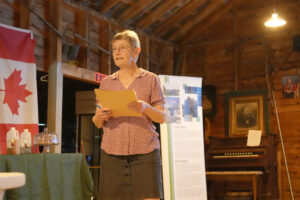
This is one of the reasons Spence organized a radon information session in Campbell’s Bay last November where, with support from MRC Pontiac and CISSSO, she brought together four radon experts to raise awareness about the gas and help other Pontiac residents protect themselves against it.
One of these speakers was Marcel Brascoupe, founding member of the Canadian Association of Radon Scientists and Technologists (CARST).
On Saturday afternoon, he joined Spence, Otter Lake resident Robin Zacharias, and MRC Pontiac warden Jane Toller for a round table discussion about radon that would serve as one of the scene’s in the film.
Zacharias, who heard something about elevated levels of uranium in the Pontiac a few years ago, decided to test his home for radon.
“As soon as I saw that, I said, ‘Let me go get a tester.’ [ . . . ] Three days later it shows up and it was reading like 1,000,” he said.
He wishes there had been more awareness around radon when he was building his home.
“I moved here in 2014, but for 10 years I’ve been breathing these dangerous levels of radon, so that’s a little worrisome.”
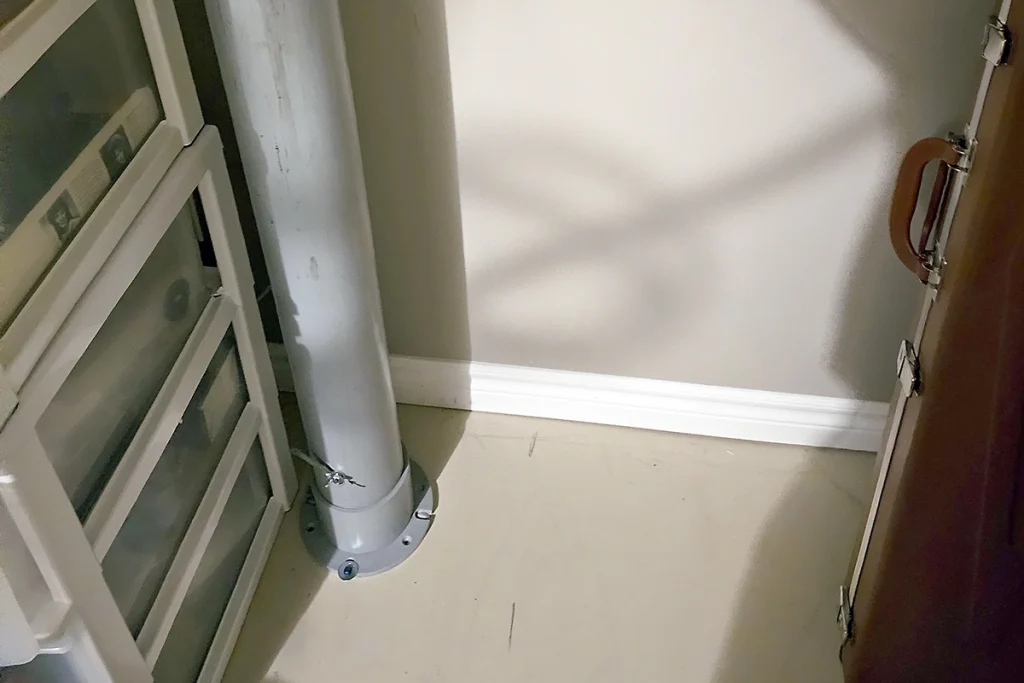
Upon finding out about the uranium, Zacharias got in touch with Brascoupe, who owns a company called MB Radon that helps people mitigate high radon levels. Not long after, Zacharias had a system installed to expel the radon gas from his home.
“He did just a little inspection and had a bunch of questions,” he said. “When you have in-floor heating, what they do is they drill a four-inch PVC pipe in that hole. And then on top of it, they put a fan motor, and then on top of the fan motor there’s a pipe that goes to the inside of a hole in your wall, to the other side of your house.”
Zacharias said the main reason he wanted to participate in the round-table discussion was to get information to the public about the dangers of radon, and how simple a problem it can be to fix.
“If we can get [the documentary] on the air and get as many people informed as they can about radon, [I will be happy],” he said.
Spence has also raised the issue of radon at the MRC’s council of mayors meetings. She has teamed with the MRC to send out free bookmarks with radon-related information with residents’ 2025 tax bills.
She said her community organization Citizens of the Pontiac has also submitted an application to CARST to receive 100 free radon test kits, to be distributed throughout the MRC.
“We brought on the heavyweights, the decision-makers of our MRC, and we were starting to be taken very, very seriously,” she said. “Not everyone can afford [the testing], that’s one of the problems.”
Spence reflected on how neat it was to have the international focus shifted to the Pontiac and to the issue of radon awareness. “It’s real cool.”