





eva baldi
Shawville June 14, 2023
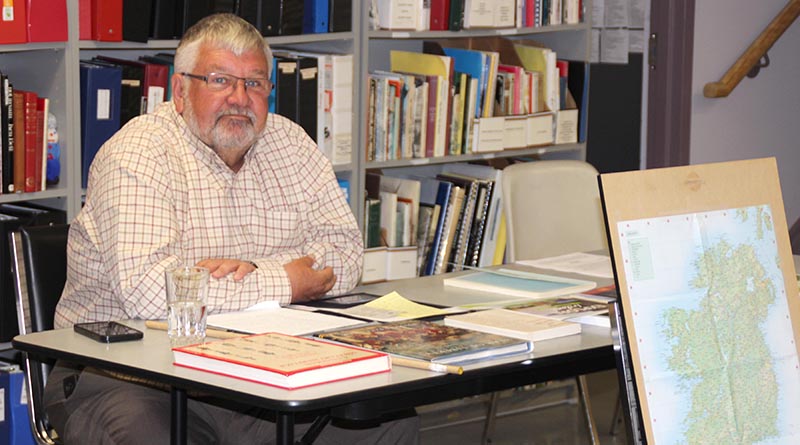
On Tuesday May 30, the Pontiac Archives hosted a talk by Dr. Thomas O’Neill on Ireland’s history and its impact on the settling of Shawville and Clarendon. Dr. O’Neill, who has spoken at the Pontiac Archives before, offered to do this presentation as a way to celebrate Shawville’s 150th anniversary. The talk focused on Irish history, and the events that led founder of Shawville and Clarendon James Prendergast to choose to settle here, and his decision to keep the society as religiously homogeneous as possible.
Dr. Thomas O’Neill
Dr. O’Neill was born and raised in Dublin, Ireland. His love for history and his ambition to become a doctor were passed down to him from his father who always had an interest in history and was a trauma surgeon during the second world war. For the past 50 years, O’Neill has been a member of the Irish Military Historical Society. His involvement with the Irish Military Historical Society has brought him on several trips to Europe where he has given talks on battlefield injuries.
O’Neill attended Trinity College, a school founded in 1592 by Queen Elizabeth I.
O’Neill explained that he has had some experience with “The Troubles” in Ireland, refering to the period between 1969 and 1998 characterized by . . .
much civil unrest and political violence between the largely Protestant unionists (loyalists) and the largely Catholic nationalist (republicans) based on their opposing positions on Irish Independence.
His experience with “The Troubles” began in 1972, when O’Neill participated in a peaceful protest that escalated to the burning down of the British embassy in Dublin. Two years later, upon completing medical school in May 1974, ten minutes after he exited the back gates of Trinity College, a bomb went off that killed 33 people and injured 300. Nearly 20 years later, as O’Neill brought his wife Jane to Ireland, the couple drove into Crossmaglen; their car was stopped by nine men in military uniform holding machine guns. Jane noted that she was “looking for an adventure of getting into Northern Ireland”, while O’Neill was very relieved to drive back to safety.
Brought in by his interest in rural medicine, O’Neill moved to Shawville in October of 1978 and has lived and practiced medicine here ever since.
A brief summary of Irish History
Throughout Irish history, a series of significant events have shaped the region’s history and subsequently the history of Shawville and Clarendon.
The Anglo-Norman Invasion in 1169 marked the beginning of English involvement in Ireland. The Normans were very organized but they did not have enough numbers to effectively form plantations. This meant that within 200 years of their invasion the group had assimilated to the local culture.
“They’d become more Irish than the Irish themselves,” said O’Neill.
The religious landscape shifted in 1533 with Henry VIII’s desire to divorce his wife, leading to a break from Catholicism. This, however, was a problem in Ireland as a vast majority of the population were practicing Catholics. King Henry VIII further solidified English control over Ireland by declaring himself the King of Ireland in 1541.
The Nine Years’ War from 1594 to 1603 witnessed Irish lords and Gaelic Irish rising against English rule, ultimately leading to increased English control. The Plantation of Ulster began in 1610, followed by the Irish Rebellion of 1641 and the Wars of the Three Kingdoms. The Battle of the Boyne in 1690 solidified Protestant dominance in Ireland.
The American Revolution in 1776, however, put England at a disadvantage. This along with the French Revolution in 1789 was probably one of the causes of the Irish Rebellion of 1798. These revolutions brought in a new ideology that suggested that a shift away from a monarchical rule would be best for Ireland. This notably was pushed by Theobald Wolfe Tone, a Protestant lawyer from Dublin, who fought for Irish independence. The Act of Union in 1801 united Great Britain and Ireland, leading to direct rule from London.
“These revolutions caused a lot of discomfort to the various kings in Europe. They were the promotion of the Rights of Man,” said O’Neill, “whereas before that it was your God given right. You were the king, you got to tell people what to do.”
James Prendergast
James Prendergast was born in 1789 to a family that had been living in Ireland since the twelfth century. According to the book “Shawville and Clarendon” by J. Lloyd Armstrong, the name Prendergast was given to the family as a way to commemorate their work as innkeepers on the road between Paris and Germany. Prendergast finds its origins in two linguistic roots: the French word “prendre,” meaning “to take,” and the German word “gast,” signifying “guest”.
His mother, Maria Corry, was a direct descendant of Cornet Walter Corry, a protestant Englishman who fought for Oliver Cromwell in his invasion of Ireland.
Not much is definitively known about James Prendergast’s early life or his family, though it is believed that he was the oldest of six children.
Prendergast enlisted as a private in Captain Enraght’s Company of the 100th Prince Regents in Dublin 1805 at age 16. His contingent was split into two parts, the first set to sail to Canada on August 21, 1805. However, Prendergast was not booked for this voyage. This was a stroke of luck as Shawville and Clarendon would be quite different if he had been on that ship as soon after its departure, the ship and all 11 officers and 260 men were lost at sea off the coast of Port aux Basque, Newfoundland.
Prendergast first set foot in Quebec in September of 1805. He spent his time working his way up in the army. Dr. O’Neill noted that this was a testament to his bravery as, at this time, most people bought their military position and were unlikely to move up in rank during their service: “That’s very, very unusual because most people bought their Commission’s in those days. Like if you wanted to be an officer, you had to buy a commission. So what happened was he rose just through his bravery in battles.”
On November 11, 1813 Prendergast was mentioned in dispatch, another indication of his bravery.
By 1818, Prendergast had made his way back to Ireland.
“He would have gone back to see a lot of civil strife and unrest, with people fighting against each other for property,” explained O’Neill.
By 1825, Predergast and several members of his family had moved to Canada with permission from the king. Prendergast was awarded 500 acres for his military service. In correspondence with the crown land agent, Prendergast negotiated to have the rights to survey all of the land in the township at personal cost, which would be repaid to him when people bought land for 28 shillings and eight pence.
Prendergast chose to make the area a Protestant township by selling only to Protestant settlers.
O’Neill points out that after understanding the political religious strife that Predengast lived through in Ireland, it is understandable that he would attempt to avoid the same problems that plagued his childhood.
“So I think really, in that sense, you’d understand why the area of Shawville-Clarendon was settled only by Protestants. In a sense, he wanted to do the same thing probably, you know, keep it as a homogenous society with no strife, unlike everything that he was seeing in Ireland,” said O’Neill.
According to Venetia Crawford, of the Pontiac Archives, over 45 people attended the presentation.
“We had to sit people on chairs in the stairs because there was no more seating space,” said Crawford.