





Brett Thoms
Rapides-des-Joachims April 19, 2023
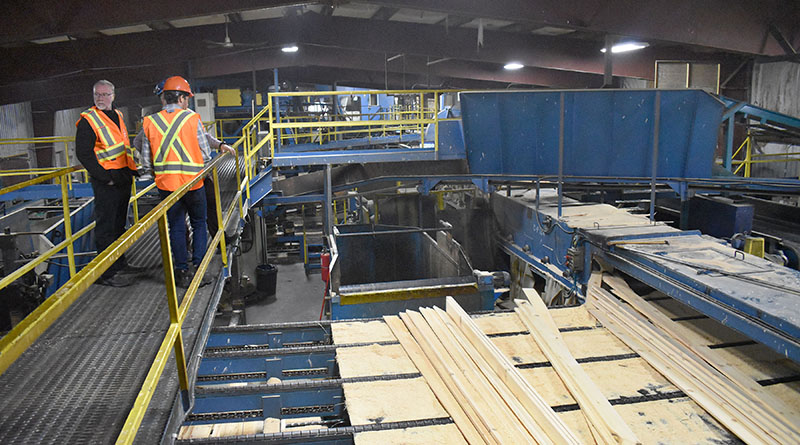
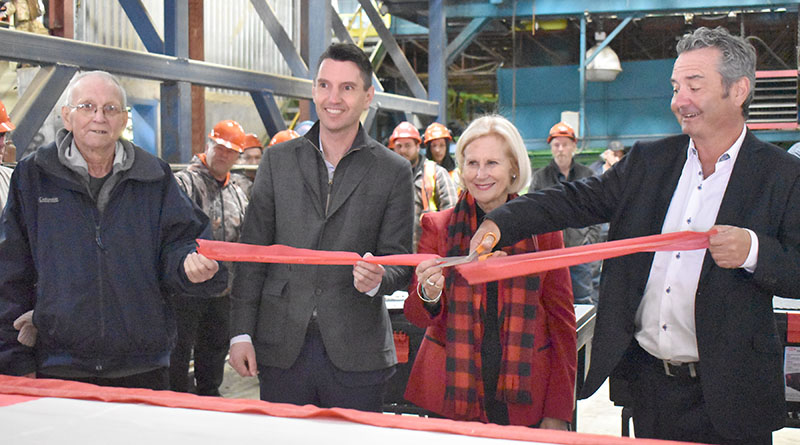
Commonwealth Plywood held a ribbon-cutting ceremony to celebrate the reopening of its mill in Rapides-des-Joachims last Wednesday. The mill had been closed for over a decade before returning to operations last January.
It is the first lumber mill to reopen in the Pontiac in over a decade.
The opening ceremony was presided over by Commonwealth Plywood President Bill Caine Jr., Rapides des Joachines Mayor Doug Rousselle, MRC Pontiac Warden Jane Toller and Pontiac MNA André Fortin.
The visiting officials all lauded the reopening as a long-awaited boon to Pontiac’s forestry industry, which has been struggling since 2008.
“We’ll get some of our young people back in the workforce and some of the older ones that have been sitting around back to work. It’s great, just great,” Mayor Rousselle said about the occasion.
“The smell of a sawmill is something we’ve been waiting to smell for a long time. It’s the aura of success, economic development and stability,” Fortin said during his remarks.
“It’s not every day you get to reopen a mill, especially one that has been closed for 10 years. Pontiac has once again become a player in forestry,” Toller said during her speech.
“I worked here when I was 16 and 17, so I always had an appreciation for this place,” Caine said. “For 10 years we didn’t sell one piece of equipment. Instead, we waited, saying ‘one of these days, this is going to reopen’.”
The mill currently employs roughly 20 people, with roughly 50 more in lumber-gathering operations supplying the mill, according to Caine. Of those working in the mill Caine estimates about 10-12 live in Swisha.
Caine’s family bought the m=ill in 1976 and rebuilt and modernized it in the 1980s after a fire. It is designed to process eastern white pine and red pine lumber for the manufacture of products like cabinetry, pallets and fence posts.
Caine explained that the mill closed a decade ago due to factors like exchange rates, high lumber duties, the closure of the pulp mills in the area and government regulations.
However, favourable economic conditions prompted Caine to take the decision to reopen the mill.
“The recent economic boom and US and Canadian housing growth led us to believe we should restart the mill, lay down our bets and take our chances,” Caine said.
The process to reopen the Swisha mill started last fall, according to Caine. While most of the equipment remained in good shape as the company maintained the mill during its closure, Caine did mention that much of the software had to be updated.
Overall, Commonwealth Plywood invested roughly $1 million in upgrades and refurbishments in order to reopen.
Caine said that if all goes well, they plan on adding another shift, which will bring about 20 more employees to the mill.
It is hoped that the reopening of the mill will have a virtuous impact on both Swisha’s economy and the broader Pontiac.
While those THE EQUITY spoke with were skeptical that the mill’s reopening would bring back the local depanneur or hotel, they did expect the mill to make a difference, especially if it started running at full capacity.
Swisha’s previous mayor, Jim Gibson, who was mayor when the mill closed down, said at the ceremony that the mill would make a very positive impact on the town’s tax receipts, which suffered a lot from the closure of the mill. He added that he hoped the mill’s reopening would prove to be important to the effort to reopen Pontiac’s other shuttered mills in Litchfield and Mansfield.
“I’m hoping this is the start of a few other mills opening like Davidson or Javelco,” Gibson said. “When we talked about this initially, part of the runoff from here would go to Davidson which would get that mill going. Hopefully, that will start to get the industry going again. If we can just talk the government into allowing Canada to participate more in wood production, rather than going to China and going to India, that would help. I’d rather see all the production working here. Get the guys to work in Canada,” Gibson said.
Challenges
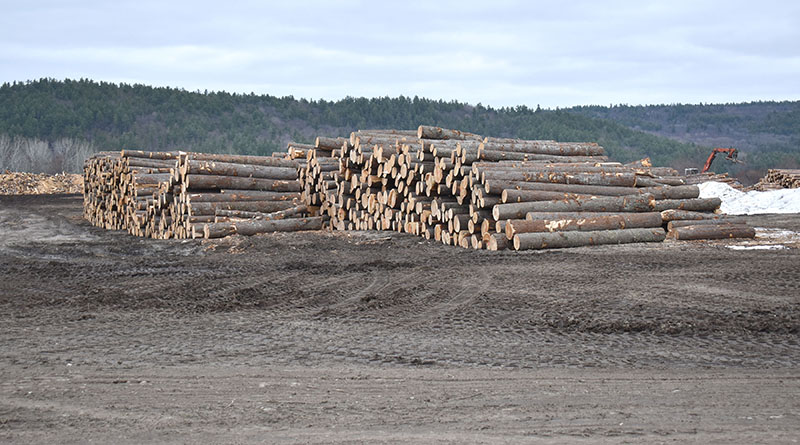
While the mood at the ribbon cutting was generally celebratory, Caine and Toller voiced concern about Commonwealth’s Plywoods pine allocation being cut 40 per cent just after Caine made the decision to reopen.
Allocation essentially denotes how many trees in public forests can be cut, as determined by Ministère des Forêts, de la Faune et des Parcs (MFFP).
Caine said Commonwealth Plywood was only made aware of the reduction allocations shortly after they made their intentions to reopen the mill known to the MFFP last fall.
“The question you have to ask is ‘well for 10 years there was no cutting. So what happened to all those trees growing for 10 years, where are they?’ So we believe there’s an error that’s been made in the way the calculation has been done. And we should be able to get the allocation back to where it’s supposed to be to support the mill,” Caine said.
Fortin commented on how he understands the position of the MFFP and has sympathy for Caine.
“I can understand Mr. Caine’s frustration with the decision that was made by the chief forestry officer,” Fortin said. “The reason, as I understand, is that the pine hasn’t regenerated over the years as fast as they initially thought. But the issue is more that he made a million-dollar investment and then learned about the reduction immediately after, so I can certainly understand where he’s coming from. There have been discussions with the ministry, I don’t know where they will land ultimately, but at the same time, they’re looking at using other wood sources to keep the mill as busy as possible.”
Caine pledged to continue lobbying the MFFP for the law to change the allocation.
However, it’s not just the pine allocation that concerns Commonwealth Plywood’s president. Uncertain economic conditions also pose challenges.
“Interest rates are going to have an impact on people’s ability to afford a home and so that should slow down some housing starts, so the question is by how much,” he said. “On the other hand, there’s a lot of pent-up demand for housing in both Canada and the United States. So they’ll need materials to build that out. So right now, when gambling on that things will be relatively stable going forward.”
Right now Rousselle said they’ll have to wait and see how much of an impact the mill will have on the municipality’s economy, saying a lot depends on whether the mill can get the second shift going.
Regardless of what happens with the mill, Rousselle is generally optimistic about the future of Swisha.
“We have a bunch of young families coming in anyway,” he said. “It’s a small community so it’s great for bringing up your kids. We’re trying to increase things in our little park. We have a water playground coming. We already have three or four new young families that have moved into the area. So it’s already expanding. If we get a young entrepreneur to come in and expand something, that would be nice for sure. We’ll work with anybody that’s willing to try.”
In terms of other Pontiac mills, Warden Toller said while it is too optimistic to see Davidson reopening anytime soon, she is very optimistic about Javelco reopening in the near future.
“Forestry is not dead. Forestry built the Pontiac. We have 65 different types of trees and 40 per cent forest. We deserve to be a player in forestry,” Toller said. “Vive forestry in the Pontiac!”