






Brett Thoms
Campbell’s Bay January 18, 2023
The MRC Pontiac held a relatively brief meeting of the Council of Mayors last Wednesday night.
The meeting was chaired by Pro-Warden and Mayor of Mansfield-et-Pontefract, Sandra Armstrong, as Warden Jane Toller was absent.
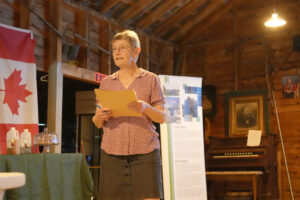
Pontiac MP Sophie Chatel headlined the meeting by making a presentation about the Green and Prosperous Outaouais initiative her office has been pursuing with other elected officials and businesses in the riding over the last year.
“That includes sustainable agriculture, forestry, mobility, and lately the protection of our biodiversity and tourism as well,” Chatel said about the topics that were discussed during various forums facilitated by her office as a part of the initiative.
Chatel announced the launching of a public consultation platform that would offer residents of the riding a chance to give input on the several proposals brought forward in the intial consultations.
“In two months we will start to harvest the reactions and proposals. I just learned we have 900 PhDs in the riding of Pontiac, so there are a lot of smart people here,” Chatel said. “It is also for people who worked in a field for years and years. We are going to put solutions to organizations and elected officials to ensure that the Pontiac is green and prosperous.”
Any resident can access the online public consultation at outaouaisvert.cocoriko.org.
Following Chatel’s presentation, the MRC passed a resolution adopting a by-law setting the remuneration rates of the warden and members of the Council of Mayors for 2023.
Mayor Odette Godin of Waltham made a point to emphasize that none of the mayors or the warden received any pay increase this year.
According to the by-law, as part of their duties to the MRC, the mayors are paid $4,258.67 for 2023. The warden is paid $49,759 for the year 2023.
Radon campaign
Interim Director General Kim Lesage presented a letter from the Quebec Lung Association (APQ) announcing a 2023 campaign for radon awareness. Radon is a radioactive gas that occurs naturally when uranium underground breaks down, which can be dangerous when it seeps into an enclosed area like a house.
According to the APQ, radon is responsible for the death of nearly 1,200 Quebecers each year and is the cause of 16 per cent of incidences of lung cancer.
The letter encourages municipalities to enact by-laws in their building codes that account for the detection and minimization of radon gas and encourages other awareness raising activities.
According to data, the Outaouois is tied for third in the province in instances of radon gas being detected in homes, with 355 of 1,662 homes tested showing signs of the gas in the region.
Radon is detectable with a radon detector, which can be ordered off the APQ’s website for $45. You can also visit the APQ website for more information on radon.
Assessment issue
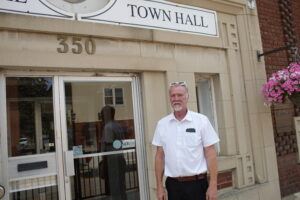
Before the closure of the meeting Bryson mayor Alain Gagnon asked when his municipality would be able to close its accounting books for 2022.
Gagnon explained that the municipality received an email from the MRC evaluation department asking them to not close the year of 2022 in their accounting software because there is an incoming assessment update for the year 2021 which will affect their accounting numbers for 2022.
He explained the notice said that the closing of the year of 2022 before the update may cause some loss of revenue for the municipality.
Gagnon said that as of Jan. 18 the update still hadn’t come, which was causing some accounting problems for the municipality.
“We have to pay bills, we have payables. The accounting system has to keep on going, we can’t hold it up indefinitely. That’s why I brought it up, because now it’s an emergency, we need to be able to work,” Gagnon said.
Gagnon said the issue requires bills from January 2023 to be back-dated to December 2022, which causes problems with payments.
“It creates a mess,” Gagnon said, noting however that it doesn’t affect the budget process.
He also said he doesn’t know how many households the update will reflect, or how much of a financial difference the update will make once complete.
“I’m not blaming anybody. There are backlogs, and things can happen like shortage of employees … or sick leave, but the fact is we need that issue resolved. ASAP,” he said.
Bristol, Clarendon and Fort-Coulonge municipalities also reported being affected by the notice. In an email to THE EQUITY, director general of the MRC Kim Lesage rejected Gagnon’s characterization of the situation as a backlog.
“The evaluation department issued a technical recommendation to the DGs to delay the change of fiscal year for 2023 in their taxation system until the updates were completed,” she wrote.
“The objective of this recommendation was to facilitate their work and to avoid having to intervene manually in their taxation system if they closed their 2022 before receiving their assessment roll update. This was intended to avoid any loss of potential revenue for the year 2021 for local municipalities since, if the year in the taxation system moves to 2023 (to retroact to 2021), the municipality would have to process the update files manually, which could potentially require assistance from our taxation software supplier.
“The local municipalities who had to face this situation are those who had a big potential for development and who have known an explosion of the real estate market in the last two years. Therefore, waiting for the roll update before turning the taxation system over to 2023 would only help municipalities by avoiding having to carry out additional manual entries and increasing their assessment roll. Municipalities could still close their year in the accounting system, it was simply recommended not to close their year in the taxation system.”
Lesage said the problem would be solved for the four municipalities concerned by the end of the day Jan. 26.