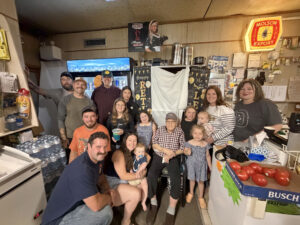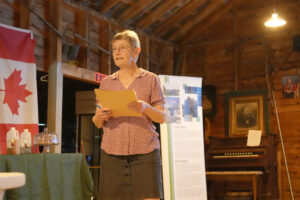






Saturday night, we had the privilege of attending our local 4-H banquet. This is the night of the year when the local 4-H members and their parents get together to celebrate the accomplishments that the members have made during the past year. They enjoy a great meal with real food on the plate, listen to an older 4-H member motivate both the present 4-H members and everyone else in the room, and have fun listening to music and dancing.
“Learn to do by doing,” is one of the motto’s of 4-H and they did that by organizing and conducting the entire event with only slight encouragement by some very dedicated leaders.
In 2022, there were more than 50 local members in the local club. We used to think that 4-H was just for . . .
farm kids. Now most 4-H members do not live on a farm. Their projects vary from chickens, rabbits, sheep, goats, horses, beef and dairy calves, and include public speaking and judging everything from food quality to the conformation of a beef animal.
No matter what the 4-Hers background is whether it be farming or if their parents are shop owners or insurance brokers they all learn what’s involved in getting your food to the table, working together as a team and doing the best job possible no matter how long it takes. You can learn as much coming last in a class as if you win.
Young people with a 4-H background on their resumé have a much better chance of being selected for a position in almost any job that they are competing for.
Farmers make up less than two per cent of the population and 4-H members become good-will ambassadors for life. Any child over the age of six can belong to a 4-H club and club leaders and farmers will make sure that they are made welcome and help with finding a project that is interesting.
On Sunday, a room full of farm leaders gave up the day and even attending church to participate in a day dedicated to looking at what the future brings. Farm safety, mental health, what we can do to live with climate change and hopefully slow it down and reverse it, and look at the importance of networking with and educating our ever changing crop of politicians.
For several decades, farmers have known that they have seven bank accounts. The seven bank accounts are soil, seed, continuous education, the team that they have put together, their neighbors who they have been neighbourly with, politics, and money. They know that if they have looked after the first six bank accounts they will not have to worry about the seventh. If they have depleted the first six bank accounts then the seventh bank account will also dry up.
They also know that their most important bank account is their soil. If the soil is depleted including organic matter, water holding capacity, any of the essential nutrients, compacted soil, soil tilth and life in the soil. Good topsoil contains a million of microscopic living organisms in only one teaspoon of topsoil.
The dirty 30s showed many farmers what happens to top soil when it is neglected and blows away in the wind in a dry year. It also showed our farmers and loggers in B.C. that clear cutting and burning of forests can cause topsoil to wash away and flood extensive areas of productive farmland, washing millions of tons of topsoil in the ocean.
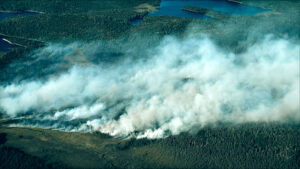
Years of denying climate change has resulted in an ever increasing temperature change in the entire world. This places humanity in a position of either taking some very drastic action now or prepare for an inevitable end to life on our planet.
By recording temperature change in the past, climatologists agree that the most productive land in western Quebec near the west side of the Ottawa River will become the most affected by drought conditions within 20 years or by 2040. There will be increasingly longer periods of drought conditions followed by heavier, longer lasting than normal rains causing our precious topsoil to be washed away into ditches, streams and eventually the ocean.
Farmers have been warned to increase the water holding capacity, use cover crops to conserve soil moisture and decrease wind and water erosion, decrease soil compaction, decrease the use of chemical fertilizers and sprays to improve the life in the soil which will improve naturally the soil fertility, make better use of crop rotation which also rebuilds a healthy soil and reduces soil compaction. This will require extensive training of all farmers in the world but we are most interested in what we can do locally to deal with the results of inevitable climate change.
For years, we have been told that cows burping and farting is a major cause of the increasing hole in the ozone layer. During the early stages of the COVID-19 lockdown when most planes were grounded and much automobile and truck traffic was curtailed, even though the same number of cows were belching and farting, the ozone layer magically healed over, the air became cleaner, cities where smog was choking the population was reduced and even city dwellers could again see the stars at night which they hadn’t seen through the polluted air in years.
No, we are not all going to switch to an electric car. No, we will not all be locked inside our home. Maybe we can enjoy more of our locally grown foods that require less transportation. Maybe we can explore and enjoy the wonderful sights close to home instead of taking a plane ride (which causes more pollution than a thousand cows) to a far-away resort that may not have food as safe as you can buy at the restaurant in town.
No, we cannot save the planet ourselves but let’s do what we can to alleviate the problems close to home.