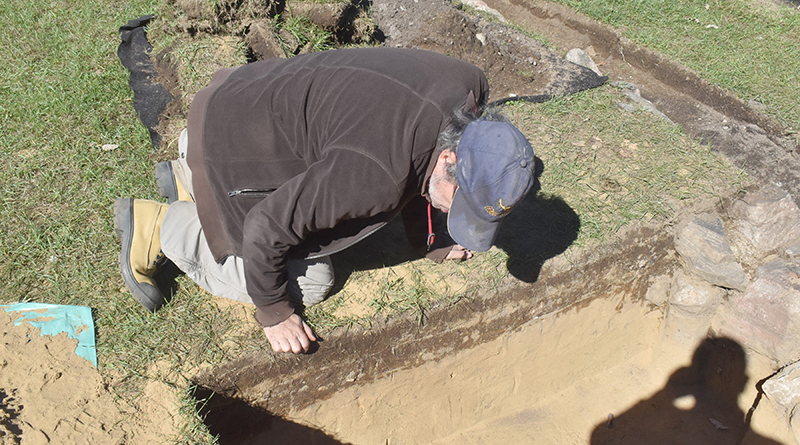



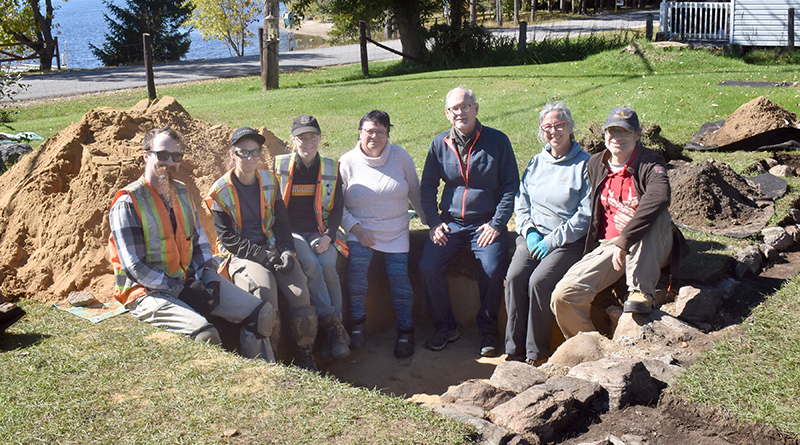



A search for the site of the fur trading post that served as the namesake for Fort-Coulonge has been underway in Davidson for the past two years on the property of Vella Boisvert Lefebvre.
A team of archaeologists led by Francis Lamothe has made its second visit to the plot since 2020, with the partial goal of determining whether or not European activity at the site’s dates back as far as 1685.
Historians know that a fur trading post that would later lend its name to the modern day town of Fort-Coulonge was built in the area in the late 1600s, yet the precise location is vague. While details like how regularly the original post was occupied are uncertain, it does seem certain that it was completely abandoned after the British conquest of New France in 1761 and then rebuilt and enlarged by the Northwest Company in the late 1700 and early 1800s, possibly in a different location.
The Hudson’s Bay Company then acquired the post after merging with the Northwest Company in 1821 and was operated until the region’s economy transitioned away from the fur trade and towards the lumber industry in the 1840s and 50s.
While historians have already confirmed that the 1800s post was located in . . .
Davidson on Boisvert Lefebvre’s property, there is some debate over whether it’s also the site of the of the original fort, which was thought to be located at the junction of the Coulonge and the Ottawa Rivers, which is to the south east of the Davidson site.
The search was instigated by Greg Piasetzki, a retired patent lawyer from Toronto, who in the midst of investigating his genealogy, discovered that his ancestor, Joseph Godin, ran the rebuilt post from 1795 to 1823.
“There’s a lot of interesting stuff about Joseph Godin, there’s a whole chapter in the book in 1848 about him, there’s contracts they did with him,” said Piasetzki about his ancestor. “He was a bit of a character. So sometimes, people in the company would make some snide remark about Joseph being difficult.”
Godin was also exceptional for being at one fur trading post for so long and for his positive reputation with the Indigenous groups he traded with, which was apparently rare, according to Piasetzki.
With his ancestor’s story drawing him to the site, Piasetzki decided to investigate as much as he could about it.
“I came up to the site in 2018. And was just surprised there wasn’t even really a plaque,” said Piasetzki. “So it bothered me a bit. And I thought, you know, something should be done. I’m close to retirement. And I thought, you know what, I always liked archaeology. I think I’ll hire an archaeological team.”
And with that a dig began in 2020.
“We came two years ago and did a survey where we dug 50 or 60 pits, ‘’ said Piasetzki. “They’re about a metre square roughly. And they’re survey pits where you’re looking to see where the soil has been really turned over and churn by activity; could be farming, or it could be industrial activity. We found stuff the last time from the fur trading era, including forged nails, which would be the oldest, simple to identify items. Forged nails are made by hand in a forge with the guy hammering a nail, they tend to be thick and round, and they stopped doing that around about 1790 to 1800.”
Piasetzki explained how the hand forged would have been replaced by cut nails after 1790, which was a more industrial process that produced flat nails called cut nails. Cut nails quickly became very common and would have been distributed widely, so to Piasetzki this signals that the forged nails discovered at the site are likely from prior to 1790.
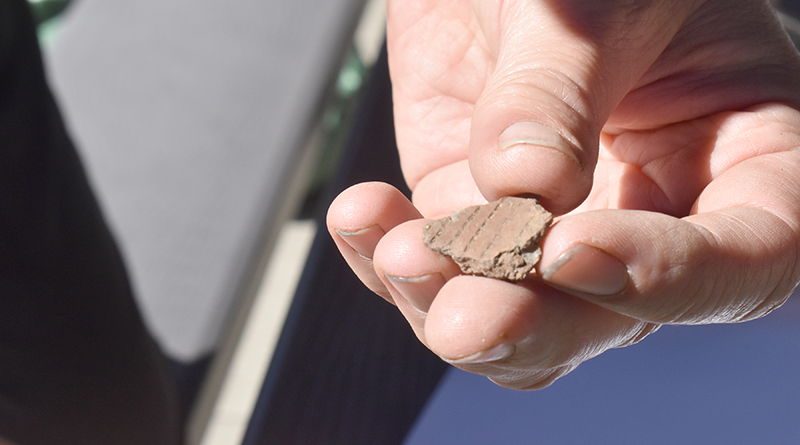
The digs in the area also discovered evidence of extensive Indigenous occupation of the site like pottery, projectiles and fire pits.
“For thousands of years, natives would have stopped here,” said Piasetzki. “They would stop at the same places you’d stop these days, where there’s a beach and where there’s a point of land that gives you a breeze to blow the bugs away. So, we found lots of prehistoric stuff going back several thousand years, but mostly in the form of pottery chips.”
However despite all the team unearthed, it remains unclear whether the Davidson site represents the original site of the 1685 post.
“My pitch is it is a big historic site in the sense that it might have been the first forts outside of the St. Lawrence Valley, the first time the French went outside of St. Lawrence Valley to try and build a post, said Piasetzki.
According to the lead archaeologist Lamothe, much of what they found fits the description of the site as it was described in the late 1800s, including an 1892 account of one of the buildings burning down that was reported on in THE EQUITY .
And while Piasetzki holds out hope that the Davidson site is the original 1685 post, Lamothe sees no evidence.
“There’s no evidence of a 17th and 18th century occupation,” said Lamothe. “There are few objects, like forged nails but not the typical trade beads, French gunflints or objects from the 17th century.”
However there is also no evidence of the 1685 post being at the alternative site at the mouth of the Coulonge river according to Piasetzki.
“There’s no evidence for it at the Coulonge river,” said Piasetzki. “No artifacts. And it’s partly because of Davidson’s lumber operations in that area has chewed it up quite a bit. But nobody that I know has actually done a dig there or anything.”
The question may prove impossible to answer as there is reason to believe that the full scope of the site has been erased by human activity. At some point a lot of gravel was removed from the site which may have disturbed evidence, according to Piasetzki. Lamothe added there may also be evidence buried under the road built alongside the property that is difficult to get at now.
Environmental factors also may have played a role in preventing the full picture from being realized.
“Maybe erosion took part of the archaeological context that was there, because you can see by the river shore that it’s still getting eroded heavily right now,” said Lamothe.
However, the team theorizes the site may have been secure from flooding due to the relative elevation of the property.
“My hope was when we started, we’d find enough to get people excited. and they’d put up a plaque along the river there and maybe open a small museum somewhere around Fort-Coulonge to be an attraction for the local people and for other people,” said Piasetzki.
While the remnants of the 1685 post remain to be conclusively discovered, the site undoubtedly played a role in the storied fur trade, which remains a crucial part of early Canadian history.
Piasetzki said he needs to talk it over with Lamothe to see if the site is still worth investigating further. It is to be determined whether there will be any further or deeper digging on the Davidson site.
“Sometimes in life questions remain. You can’t get the final answer you want,” said Piasetzki. “The 1685 post would have been nice.”