






DARIUS SHAHHEYDARI
CLARENDON July 15, 2020
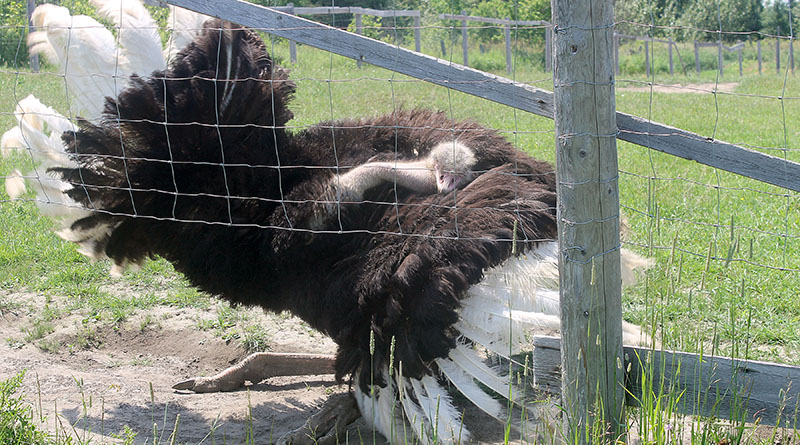
While exploring the vast scenery throughout Pontiac, a wandering eye could spot sprawling lakes, acres of worked land sprinkled with bales of hay, herds of cattle grazing on pastures and … ostriches?
Marc-André Dorval and his partner Cornelie Dinkel established their ostrich farm in Clarendon four years ago, buying the property off a sheep and goat farmer. It has . . .
a large barn and plenty of outdoor space, ideal for the birds to roam freely, according to Dorval.
The farm is now looking for tourists to come in just to see the ostriches, although this was not initially planned.
“At the market, I always had people asking ostrich questions,” said Dinkel. “I had more people asking questions than buying anything so I thought we had to get into tourism.”
She said she’s in the process of studying regulations and obtaining financing for running an ostrich exhibit, looking to double up and reinforce the fencing of their pens prior to opening to the public.
“I noticed when the kids run around, [the ostriches] start to get aggressive,” said Dinkel.
It was Dinkel’s initial idea to run an ostrich farm, inspired by her home country, Germany, where Dorval said there are over 200 of these farms. Dorval also liked the idea because it is more affordable to raise ostriches compared to other animals, like cattle.
“If you start a cow farm, you need a lot of equipment to start with and it’s very, very expensive,” said Dorval. “Cows give milk every day, so you gotta be ready for that.”

Dorval and Dinkel named the ostriches based on their personalities or past endeavours. Houdini resided behind the barn and kept escaping his pen when he was younger, Caesar often ran up and down, patrolling his perimeter and Cinderella had her feathers picked off her back by the other ostriches.
“She doesn’t have much clothing on her back,” said Dorval. “She’s poor, that’s why I called her Cinderella.”
Ostriches provide eggs in season, which begins in the spring and ends sometime in the beginning of September, according to Dorval. Their eggshells are sold as a canvas by the farm.
“Some people will use it to carve on them or paint them,” said Dorval. “It makes [for] a nice Easter egg.”
The egg itself could also be consumed and is available for purchase.
“Everybody asks ‘Does it taste like chicken egg?’” said Dorval. “It actually has a different taste.”
The egg’s protein differs, as well. Someone could be allergic to chicken eggs, but not ostrich ones.
“The yolk is big, like a lemon,” said Dorval, adding that a single ostrich egg is the equivalent of 24 chicken eggs.

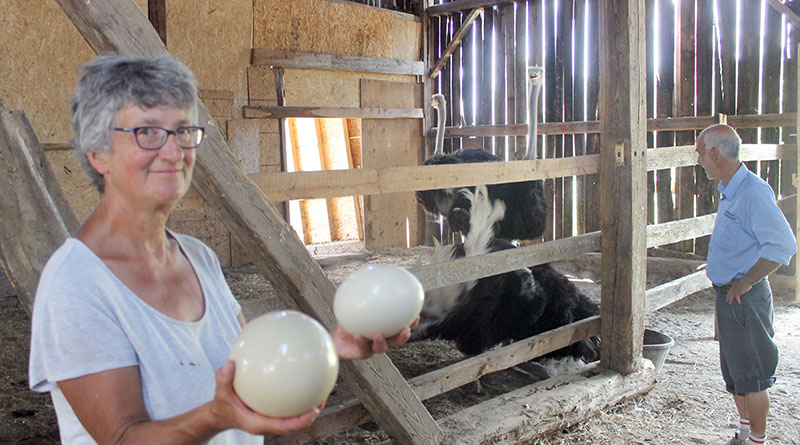
Ostrich eggs could be kept inside a mason jar in the fridge for about five days, according to Dorval. Their shell cannot be broken on the side of a kitchen counter, for example, since it would shatter and the pieces would be difficult to remove. Thus, in order to remove its contents, a hole needs to be drilled through the shell.
“When the females lay eggs every two days, you got to go pick up those eggs before they stay on the ground for too long,” said Dorval. “You don’t want to leave the eggs in the sun all day.”
Dinkel said it is easier to sell the eggshells since they can be distributed nationwide on the market. The egg itself is removed from the shell by the farm beforehand and can only be sold locally.
The two farmers are also looking to bring ostriches to a slaughter house and profit off their protein, which will be cut up, vacuum sealed in packages and stored in a freezer for purchase. Ostrich oil is also planned to be marketed just like the meat.
A big chunk of ostrich meat comes from its legs, but there could also be some on the abdomen, which is a bit more tender, according to Dorval.
The meat, especially from the leg, is lean and often mixed with other animal products to make hamburgers or sausages.
“Some would mix it with a bit of pork fat if they want to make sausages because you need fat in sausages,” said Dorval.
Abdomen meat, on the other hand, holds a bit more fat, needed to absorb the shock when the ostriches run into their fence, according to Dorval.
Ostrich hide could also be used in personal accessories, such as gloves and purses and their feathers as dusters. As for their leg bones, Dorval joked they are good for dogs.
Once the meat is up for sale, Dorval said it will be difficult to round the ostriches in the trucks, as they are not as obedient as other farm animals and will try to kick the person rounding them up.
“You have to have single holding pens to keep them in there first before you send them,” said Dorval.
A mixture of corn and minerals in the form of dry pellets are fed to the ostriches – an expensive choice, according to Dorval.
“We try and keep it as natural as possible,” he said. “I think that if you have low quality feed, it will be tasted in the meat.”
In order to cut costs, the two farmers are planning on making their own feed in the future, which would be a mix of alfalfa and beans. Ostriches will eat grass at times as well.
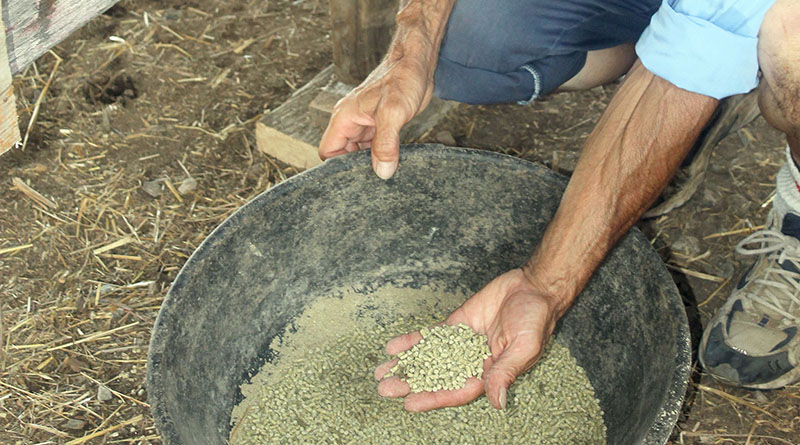
Breakfast time starts around 8 a.m. on the farm, when Dorval prepares the feed and distributes it with a tractor, then fills buckets with water for the ostriches.
“After the first round of water, I have to do a second round, especially in the summer because the feed in the morning is dry so [the ostriches] will drink lots of water,” said Dorval.
If the birds were to be given cold water in the winter to drink, it will freeze up quickly. To avoid this, Dorval warms it up beforehand.
This routine is kept regardless of the season or weather conditions.
“In the winter, whether it’s minus 40 outside or a big snowstorm, you still have to do your routine,” he said. “When you have a thunderstorm in the summer – well, you might wait till the storm [passes] – but you still have to do your feed run.”
According to Dorval, as long as the ostriches have a dry shelter to go into when it’s windy in the winter, they are good to survive the season, staying outside even in negative double digit weather.
“Ostriches come from the north of Europe, not from Africa and they went through the Ice Age,” said Dorval. “So, they’re pretty well adjusted to the cold.”
Despite being able to run an ostrich farm, the farm still faces several challenges.
Dorval said they still have ways to go before turning a prof it, needing about 160 ostriches but currently having only 19. Self-sufficiency within the next few years is the ultimate goal for the farm, according to Dorval.
“I have an incubator almost ready to incubate the eggs, said Dorval. “So we’ll be hatching our own eggs soon.”
The barn itself, which Dorval believes was erected in 1905, also needs to be restored. There are ground water pipes on site which could ease the process of giving water to the animals that need to be repaired.
“It’s an old farm,” he said. “There’s a lot of fixing to do.”
The property itself is not the only issue.
“When you think that everything’s going well there’s always something happening with the ostriches,” said Dorval, adding that two of the males once had a fight and broke the fence, which needed to be replaced.
Leaving the farm for a few days is also not possible because of the ostriches’ constant need for attention.
On the positive side, Dorval said ostriches, specifically the female, are just as friendly as dogs and can be taken on walks in the pastures.
“The females are not as aggressive as the males, that’s for sure,” said Dorval.
The males, on the other hand, are like sharks, according to Dorval. When they are taken out on walks they could turn on him anytime.
Besides ostriches, the farm also raises chickens and ducks in a separate shelter. Dorval said the idea was to start raising them and sell their eggs before the ostriches were ready. Chickens also lay eggs year round, unlike the ostriches, and thus provide a stable income.
The farm has started wlecoming visitors in. Those that are interested in booking a tour are asked to call the farm in advance at 819-459-1664.