


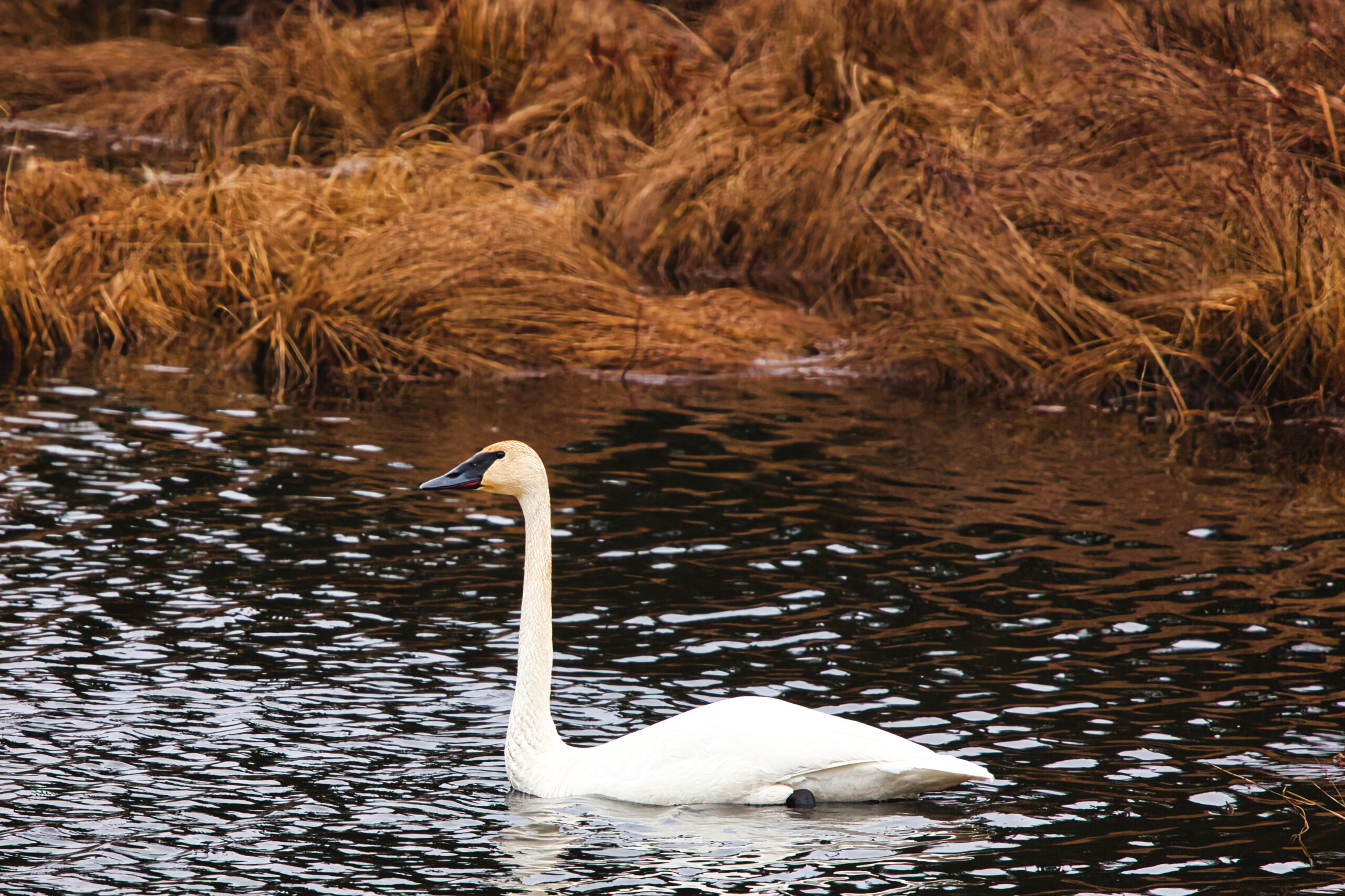



When local birder Deb Powell first saw a trumpeter swan, she was struck by just how big it was.
Known for its sheer size – exceeding five feet in length and weighing about the same as a two-year-old child – and its characteristic ‘musical’ call, the trumpeter swan is North America’s largest bird capable of flight.
“You could understand why people ate swans,” Powell said jokingly about their size.
Powell said when she was struck by the bird’s elegance and beauty by the Bristol pier a few years ago, trumpeter swans were still a relatively rare occurrence. But that doesn’t seem to be the case anymore.
Powell isn’t the only Pontiac birder who’s managed to catch a glimpse of the trumpeter swan. She said in the past few years more and more birders have been reporting seeing them in the area.
In the past few weeks, sightings of the birds have been reported near Johnson Lake in Thorne, on Litchfield Lake, and on chem. Perrault in Sheenboro, with others reported in Eastern Ontario and in the Ottawa area, despite the bird not being commonly found in the area.
Kyna Intini, the master bander of Trumpeter Swan Conservation Ontario, volunteers tagging hundreds of the birds every year for the organization, which rescues and rehabilitates birds across the province. She said the birds are making a remarkable comeback after the species’ future once looked grim.
She said trumpeter populations once lived across North America, but starting in the late 1700s companies such as the Hudson’s Bay Company started hunting the birds for their skin and feathers, which were used in women’s fashion items as well as for writing quills. Their webbed feet were also used to make change purses.
“The Hudson’s Bay Company sent skins back to England in the hundreds of thousands,” Intini said.
By the late 1800s, trumpeter swan populations had been decimated due to overhunting. A 1932 survey by the United States National Park service found 69 birds in the states of Montana and Wyoming, believed at the time to be the only birds of the species still alive. Later, more remnant populations were found in the Canadian Rocky Mountains and Alaska.

In Ontario, a volunteer named Harry Lumsden saw an opportunity to re-populate the species. In the 1980s, he obtained eggs from the Rocky Mountain and Alaska populations, and with the cooperation of wetland-owning volunteers, began to host breeding pairs.
“As the cygnets [baby swans] were ready to fledge, they would be taken and held for a year so that they would be a little bit more experienced. And then they were released around the province,” Intini said.
Today, 140 years after the final bird in Ontario was shot, the Ontario population has rebounded to 3,200, with large rehabilitated populations in southern and eastern Ontario. The American Trumpeter Swan Society determined there to be over 15,000 trumpeters worldwide, though most are in North America.
Trumpeter swans were not known historically to be very common in Quebec. The first confirmed breeding record in the province was from 2010, in the Abitibi region, with various sightings being reported since then in the Rouyn-Noranda and Val-d’Or regions.
Intini said many of the birds recently spotted in the Pontiac very likely belong to some of the Eastern Ontario population. Many swans in Quebec have been wing-tagged on the species’ wintering grounds on Lake Ontario, including populations in Burlington, Kingston and other locations.
According to the Trumpeter Swan Society, the species lost many of its migration traditions when the population was decimated, and many swans are re-learning new migration patterns.
The birds breed in various kinds of wetland including small ponds, marshes, bogs, and quiet stretches of river. As they prepare for migration, trumpeter swans gather at sites near open water such as inlets with moving water and larger, deeper lakes.
Intini said as these populations continue to grow, and the birds seek out more breeding sites, residents in Quebec will likely see more of these birds in the future.

“Anywhere there’s a suitable wetland, they’re definitely going to be looking at breeding, and as the population expands more birds are going to be looking for those types of areas,” she said.
Intini, who handles several hundred of the birds every year, spends a lot of time around the swans and says they are not afraid to use their very unique call.
Lorsque l’ornithologue locale Deb Powell a vu pour la première fois un cygne trompette, elle a été frappée par sa taille impressionnante.
Connu pour sa taille imposante – dépassant les cinq pieds de long et pesant à peu près le même poids qu’un enfant de deux ans – ainsi que pour son cri ‘musical’ caractéristique, le cygne trompette est le plus grand oiseau d’Amérique du Nord capable de voler.
« On comprend pourquoi les gens mangeaient des cygnes », a déclaré Powell en plaisantant sur leur taille.
Powell a raconté que lorsqu’elle a été frappée par l’élégance et la beauté de l’oiseau près de la jetée de Bristol il y a quelques années, les cygnes trompettes étaient encore relativement rares. Mais ce ne semble plus être le cas.
Powell n’est pas la seule ornithologue du Pontiac à avoir aperçu un cygne trompette. Elle a indiqué qu’au cours des dernières années, de plus en plus d’ornithologues ont signalé en avoir vu dans la région.
Au cours des dernières semaines, des observations d’oiseaux ont été signalées près du lac Johnson à Thorne, sur le lac Litchfield et sur le chemin Perrault à Sheenboro, d’autres observations ayant été rapportées dans l’Est de l’Ontario et dans la région d’Ottawa, même si l’oiseau n’est pas couramment trouvé dans la région.
Kyna Intini, la responsable de baguage pour Trumpeter Swan Conservation Ontario, bénévole pour baguer des centaines d’oiseaux chaque année pour l’organisation, qui sauve et réhabilite des oiseaux dans toute la province. Elle a déclaré que les oiseaux font un retour remarquable après que l’avenir de l’espèce ait semblé sombre par le passé.
Elle a expliqué que les populations de cygnes trompettes vivaient autrefois partout en Amérique du Nord, mais à partir de la fin des années 1700, des compagnies comme la Compagnie de la Baie d’Hudson ont commencé à chasser ces oiseaux pour leur peau et leurs plumes, qui étaient utilisées pour des articles de mode féminine ainsi que pour des plumes à écrire. Leurs pattes palmées étaient également utilisées pour fabriquer des porte-monnaie.
« La Compagnie de la Baie d’Hudson a renvoyé des centaines de milliers de peaux en Angleterre », a déclaré Intini.
À la fin des années 1800, les populations de cygnes trompettes avaient été décimées en raison de la chasse excessive. Une étude menée en 1932 par le Service des parcs nationaux des États-Unis a recensé 69 oiseaux dans les États du Montana et du Wyoming, que l’on croyait à l’époque être les seuls oiseaux encore vivants de l’espèce. Plus tard, d’autres populations résiduelles ont été découvertes dans les Rocheuses canadiennes et en Alaska.
En Ontario, un bénévole du nom de Harry Lumsden a vu une occasion de repeupler l’espèce. Dans les années 1980, il a obtenu des œufs des populations des Rocheuses et de l’Alaska, et avec la coopération de bénévoles propriétaires de milieux humides, il a commencé à accueillir des couples reproducteurs.
« Lorsque les cygneaux [bébés cygnes] étaient prêts à prendre leur envol, on les prenait et on les gardait pendant un an afin qu’ils soient un peu plus expérimentés. Ensuite, ils étaient relâchés dans toute la province », a expliqué Intini.
Aujourd’hui, 140 ans après que le dernier oiseau en Ontario ait été abattu, la population de l’Ontario a rebondi à 3 200 individus, avec d’importantes populations réhabilitées dans le sud et l’est de l’Ontario. L’American Trumpeter Swan Society a déterminé qu’il y avait plus de 15 000 cygnes trompettes dans le monde, bien que la plupart se trouvent en Amérique du Nord.
Historiquement, les cygnes trompettes n’étaient pas très courants au Québec. Le premier dossier de reproduction confirmé dans la province remonte à 2010, dans la région de l’Abitibi, diverses observations ayant été signalées depuis dans les régions de Rouyn-Noranda et de Val-d’Or.
Intini a déclaré que bon nombre des oiseaux récemment aperçus dans le Pontiac appartiennent très probablement à la population de l’Est de l’Ontario. De nombreux cygnes au Québec ont été bagués à l’aile sur les aires d’hivernage de l’espèce sur le lac Ontario, y compris les populations de Burlington, Kingston et d’autres endroits.
Selon la Trumpeter Swan Society, l’espèce a perdu bon nombre de ses traditions de migration lorsque la population a été décimée, et de nombreux cygnes réapprennent de nouveaux schémas migratoires.
Les oiseaux se reproduisent dans divers types de milieux humides, y compris les petits étangs, les marais, les tourbières et les tronçons de rivière calmes. Alors qu’ils se préparent à la migration, les cygnes trompettes se rassemblent sur des sites près de l’eau libre, comme les anses avec de l’eau en mouvement et les lacs plus grands et plus profonds.
Intini a déclaré qu’à mesure que ces populations continuent de croître, et que les oiseaux recherchent davantage de sites de reproduction, les résidents du Québec verront probablement davantage de ces oiseaux à l’avenir.
« Partout où il y a un milieu humide approprié, ils vont certainement chercher à se reproduire, et à mesure que la population s’agrandit, plus d’oiseaux vont chercher ces types de zones », a-t-elle déclaré.
Intini, qui manipule plusieurs centaines de ces oiseaux chaque année, passe beaucoup de temps avec les cygnes et affirme qu’ils n’ont pas peur d’utiliser leur cri très unique.