






Leystone Farms sits in idyllic surroundings. Protected by the Gatineau mountain ridge, the area is enveloped by stunning, resplendent landscape. The quiet farmhouse situated at the edge of the Pontiac is the home of Karri Munn-Venn.
A busy senior policy analyst and . . .
mother, Munn-Venn moved here with her family near the start of the pandemic — ostensibly to slow down a little bit, spend more time on creative pursuits and practical concerns. Like tending to her sheep farm and vineyard.
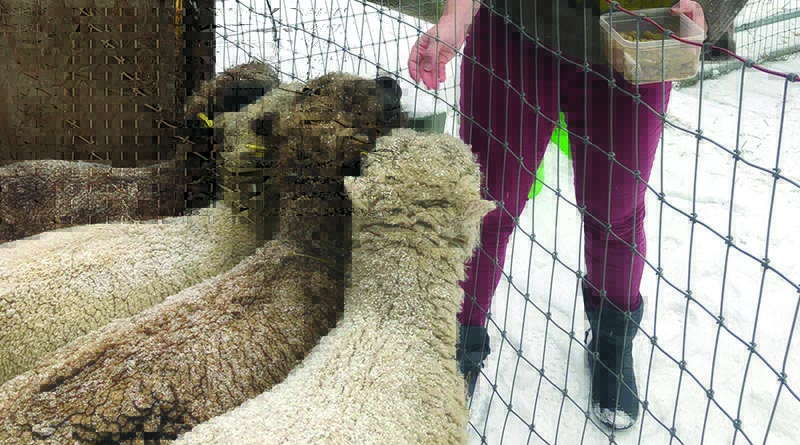
She explained the motivations and aspirations for her adventures in animal husbandry whilst dispensing treats to her curious ovine flock. She has two sheep varieties: “My little sheep are Southdown Babydolls, also known as Olde English Southdowns” she said, calling her animals by name as she coaxed them with food.
The next enclosure along the path houses her big sheep. Munn-Venn is participating in a breeding program targeted toward developing Valais Blacknose, a breed native to Switzerland: “These are F1 and F2 Valais Blacknose, crossed with Scottish Blackface,” (F1 is a desgiation for the first filial offspring from the parents, and F2 denotes a subsequent generation). She discussed her interest in the breeding program, later elucidating her interest in the animals. “Different lengths of hair fibres produce different types of wool — which affects the characteristics of the yarn they produce.”
At the conclusion of the farm tour is a spacious, modernized cabin perched on the side of the hill, overlooking even more bucolic scenery. “The vineyard is going to make artisan vinegar,” said the enterprising agrarian, who confessed, “I am still trying to figure it all out, still learning what to do and how to do it. But we’ve had a lot of support from the community — especially our neighbours.”
Taking a seat behind the boardroom-style
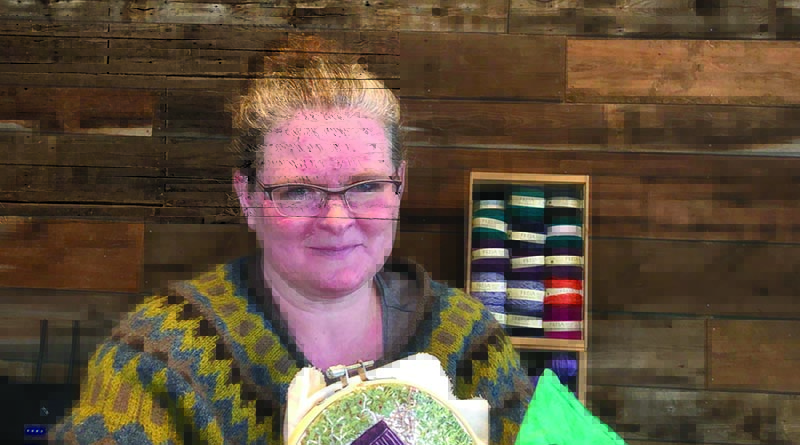
table, she presented some examples of textures achieved through the use of different wool varieties. “The length of hair fibre the animal produces will determine the amount of ‘halo’ you will encounter after the raw wool has been processed,” she said, demonstrating the difference amongst a few of her
finished pieces. Yarn made from shorter fibres have more of a fuzzy texture.
Not surprising, Munn-Venn is particular about the type of wool she uses because she is a ‘process knitter,’ she explained. “I’m not motivated solely by the final product. Some people are ‘product knitters’ and they find the completion of a finished piece is what drives their motivation. I don’t really need another scarf — I derive a lot of my gratification from the activity itself, as well as gaining insight into technical aspects. I always aim to better understand the mechanics of what I’m doing.”
As such, Munn-Venn will not hesitate to take apart her work if she finds something that isn’t quite right — painstakingly disentangling rows of interlocked yarn, often undoing hours of work. “I don’t have any qualms about unraveling, finding, and fixing things that aren’t right,” she said.
Being interested in how materials function is helpful for any artist wishing to achieve mastery. And being able to elucidate these insights is a fortuitous and desirable trait for those who gravitate toward teaching. Munn-Venn is already offering knitting classes and hosting other knitting events. “Of course, teaching something like knitting is more effective in person,” she noted. “I was supposed to start a series of classes at the beginning of January, but I’m postponing it by a couple of weeks because COVID restrictions prevent us from meeting in person.”
Having more time and space to ‘relax’ has given Munn-Venn a chance to apply her analytical skills to unraveling the intricacies of process knitting — and obtain insight into the knitting process. “The only part of the sheep-to-sweater production line I don’t control is the wool processing,” she noted.
Though she is still in the process of trying to assess what is feasible, Munn-Venn has already speculated as to what machinations might allow her to control the entirety of her production line. “Right now, I shear the wool from the sheep, clean it up, and send it to a processor in Ontario,” she said. “I get my wool back as yarn.”
Though for now this arrangement is agreeable, she lamented the fact that Quebec does not have any wool processing facilities. “I would love to have an autonomous, self-contained product line, but I’m still trying to figure out what that entails, and how much work I’m willing to put into it,” she laughed.
That said, if her progress at Leystone Farms thus far is any indication, Munn-Venn is adroit at getting things done. In the meantime, the head shepherd is awaiting delivery of her first batch of wool. “It will be really nice to knit something with wool that came from our flock,” she said.
Her class schedules and registration for future activities can be accessed by visiting her website: https://fermesleystone.com/collections/experiences/products/small-group-knitting-lessons-winter?variant=42249251094783.