


A local activism group is hoping to raise $30,000 as soon as possible to pay Pontiac’s six full-time medical imaging technicians to stay in their jobs for another year instead of leaving for higher paying positions elsewhere.
Citizens of the Pontiac has launched a GoFundMe campaign to raise $5,000 for each technician – an amount that would more than equalize the discrepancy between the $22,000 bonus the Quebec government offered to technician positions in Hull, Gatineau and Papineau, and the $18,000 bonus it offered to those in Maniwaki, Wakefield and Pontiac.
The group’s hope is that this additional $5,000 would be enough to convince five of the technicians who, according to their union (APTS), are on track to leave their positions in the Pontiac by Sept. 9, to stay in these positions for another year.
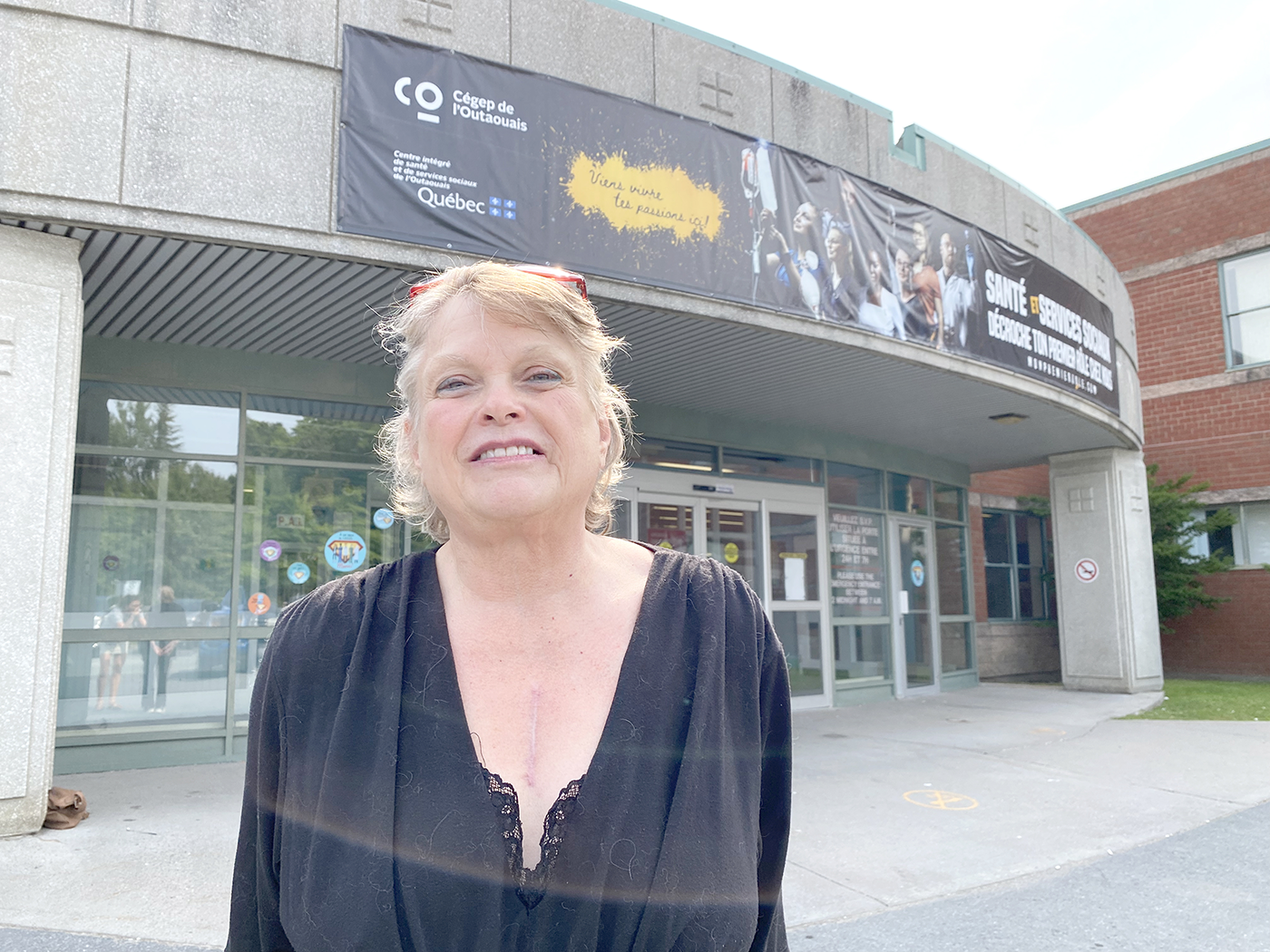
“I’ve heard that five out of six are going. That’s going to shut the hospital down. That’s going to turn into a doctor’s office or a CLSC, and that’s basically not the function of a hospital,” said Citizens of the Pontiac spokesperson Judith Spence, explaining the drive behind the fundraiser.
“We don’t want to lose people for four grand a piece.”
Spence and three other members – Myles Jones, Amanda Brewster, and Nikki Buechler – have formed what she calls a steering committee responsible for organizing the fundraiser and ensuring the money is managed according to group policies.
“You don’t get a lump sum ahead of time,” Spence said, explaining how the money would be distributed to the technicians if the desired sum is raised. “You work, and every month you get a stipend.”
Spence said if the province does decide to pay Pontiac technicians the $22,000, the money raised will be returned to the donors, with the exception of the small percentage claimed by GoFundMe.
“We’ve always had to fight for basics,” she said, emphasizing this campaign is in no way political. “This is just, ‘You’re my neighbour and I don’t want you to go.’”
Spence has spent many years in community organizing and activism. She worked as a representative for her nurses union, as well as the president of the Environmental Illness Society of Canada, which lobbied the federal government to recognize multiple chemical sensitivity, fibromyalgia, and chronic fatigue syndrome.
“Government people do pay attention when people are sharing their voice and getting attention,” Spence said. “They will pay attention. Will they change? I believe they will.”
This spring the union agreed for the Quebec government to offer $22,000 bonuses to imaging technician positions in Papineau, Hull and Gatineau hospitals in an attempt to keep technicians employed there from moving to higher-paying jobs in Ontario.
The union later agreed for those working in Maniwaki, Wakefield and Pontiac hospitals, originally excluded from these bonuses, to be offered $18,000 bonuses, in an effort to incentivize them to stay in their positions rather than seeking the higher bonuses in urban hospitals.
But last month, APTS said five of the six full-time technicians working in both the hospital in Shawville and the CLSC in Mansfield were still planning to leave their positions even though they had been offered bonuses.
The union said last week it is continuing to pressure the province to extend the higher bonuses to all technicians, but this has not happened yet.
By this newspaper went to print, the Citizens of the Pontiac GoFundMe campaign had raised $2,150. Those wishing to contribute can search ‘Keep our Radiology Technicians here with us in Shawville’ in Google to find the campaign page.
Not first community fundraiser for imaging services
Josey Bouchard, founder of local healthcare advocacy group Pontiac Voice, said she is frustrated the government’s management of the staffing shortage has pushed some in the Pontiac community to try to raise the bonus shortfall themselves.
“I find it amazing that they’re doing it, and appalling that they have to do that,” Bouchard said. I hope it relates to them that the community wants their services close by [ . . . ] It’s appalling that we have to go to this extreme, for the government to wake up.”
She noted this isn’t the first time residents of the region have organized themselves to raise money to support local radiology services, pointing to the $800,000 the community raised in the late 90s to purchase the hospital’s first CT scan.
At the time, Dr. Thomas O’Neill was president of the Pontiac Hospital Foundation, which was spearheading a plan to attract doctors to the region, and so he was very involved in the fundraising efforts.
“So we identified [purchasing a CT scan] as something that would be necessary to attract and keep doctors in the area,” Dr. O’Neill said.
“The initial goal was to raise $700,000 which we did in a remarkable period of two and a half years, and that was from one of the poorest communities in Quebec.”
He said while he saw that fundraising effort as, at its core, a community proving it was committed enough to its healthcare to raise the needed money, he sees the current fundraising effort underway in a slightly different light.
“When you’re looking at this GoFundMe, I really appreciate the people that are doing this, it’s coming from their heart [ . . . ], but the problem is the real attention needs to be focused on the political aspect because it’s unfair,” Dr. O’Neill said.
“It’s the country areas that produce the food, produce the hydro, produce everything. They should, at least, be entitled to basic medical care.”
Dr. O’Neill, who now works as a family doctor at the Lotus Clinic, has spent many decades working at the Pontiac Hospital, as chief of anesthesia and of the department of general medicine, as a doctor in the emergency room, and delivering babies in the now-dissolved obstetrics unit.
He said losing five of six technicians – those responsible for running the machines that produce images interpreted by radiologists – would effectively mean the gradual death of the most services offered at the hospital.
“If you lose your technicians, and the surgeons can’t do their jobs, and you can’t run the ICU, you get a cascading effect of the deterioration of the institution,” he said.
“You cannot run this hospital at the moment unless you have the diagnostic tools to do it. Part of those tools are having x-ray technicians who will actually run the equipment.”
*Update: Aug. 9, 2024 This article previously reported the technicians’ union, APTS, had signed a new deal with the province enabling medical imaging technicians to join the province’s ‘flying squad’ of healthcare workers. This was incorrect. The new agreement enabled other kinds of technicians to join the squad, but not imaging technicians. This article has been corrected to reflect this.
Un groupe d’activistes local espère amasser 30 000 $ le plus rapidement possible afin de payer les six techniciens en imagerie médicale à temps plein du Pontiac pour qu’ils restent à leur poste une année de plus plutôt que de partir pour des postes mieux rémunérés ailleurs.
Citoyens du Pontiac a lancé une campagne GoFundMe pour amasser 5 000 $ pour chaque technicien – un montant qui compenserait largement l’écart entre la prime de 22 000 $ que le gouvernement du Québec a offerte aux postes de techniciens de Hull, Gatineau et Papineau, et la prime de 18 000 $ qu’il a offerte à ceux de Maniwaki, Wakefield et Pontiac.
Le groupe espère que ces 5 000 $ supplémentaires seraient suffisants pour convaincre cinq des techniciens qui, selon leur syndicat (APTS), sont sur le point de quitter leur poste dans le Pontiac d’ici le 9 septembre, de rester à ces postes pour une autre année.
« J’ai entendu dire que cinq sur six partent. Cela va fermer l’hôpital. Cela va se transformer en cabinet médical ou en CLSC, et ce n’est pas vraiment la fonction d’un hôpital », a déclaré Judith Spence, porte-parole de Citoyens du Pontiac, expliquant la motivation derrière la collecte de fonds.
« Nous ne voulons pas perdre des gens pour quatre mille dollars chacun. »
Mme Spence et trois autres membres – Myles Jones, Amanda Brewster et Nikki Buechler – ont formé ce qu’elle appelle un comité directeur chargé d’organiser la collecte de fonds et de s’assurer que l’argent est géré conformément aux politiques du groupe.
« Vous ne recevez pas une somme forfaitaire à l’avance », a expliqué Mme Spence, détaillant comment l’argent serait distribué aux techniciens si la somme souhaitée était amassée. « Vous travaillez, et chaque mois vous recevez une allocation. »
Mme Spence a indiqué que si la province décidait de payer 22 000 $ aux techniciens du Pontiac, l’argent amassé serait retourné aux donateurs, à l’exception du petit pourcentage prélevé par GoFundMe.
« Nous avons toujours dû nous battre pour les choses essentielles », a-t-elle dit, soulignant que cette campagne n’est en aucun cas politique. « C’est simplement : ‘Tu es mon voisin et je ne veux pas que tu partes.’ »
Mme Spence a passé de nombreuses années dans l’organisation communautaire et l’activisme. Elle a travaillé comme représentante pour son syndicat d’infirmières, ainsi que comme présidente de la Société canadienne des maladies environnementales, qui a fait pression sur le gouvernement fédéral pour qu’il reconnaisse l’hypersensibilité chimique multiple, la fibromyalgie et le syndrome de fatigue chronique.
« Les gens du gouvernement prêtent attention quand les citoyens se font entendre et attirent l’attention », a dit Mme Spence. « Ils feront attention. Changeront-ils ? Je crois que oui. »
Ce printemps, le syndicat a accepté que le gouvernement du Québec offre des primes de 22 000 $ aux postes de techniciens en imagerie dans les hôpitaux de Papineau, Hull et Gatineau dans le but d’empêcher les techniciens qui y travaillent de déménager vers des emplois mieux rémunérés en Ontario.
Le syndicat a par la suite accepté que ceux qui travaillent dans les hôpitaux de Maniwaki, Wakefield et Pontiac, initialement exclus de ces primes, se voient offrir des primes de 18 000 $, dans le but de les inciter à rester à leur poste plutôt que de chercher les primes plus élevées dans les hôpitaux urbains.
Mais le mois dernier, l’APTS a déclaré que cinq des six techniciens à temps plein travaillant à l’hôpital de Shawville et au CLSC de Mansfield envisageaient toujours de quitter leur poste même s’ils avaient reçu des primes.
Le syndicat a déclaré la semaine dernière qu’il continue de faire pression sur la province pour qu’elle étende les primes plus élevées à tous les techniciens, mais cela n’a pas encore été fait.
Au moment de mettre sous presse, la campagne GoFundMe de Citoyens du Pontiac avait amassé 2 150 $. Ceux qui souhaitent contribuer peuvent rechercher ‘Keep our Radiology Technicians here with us in Shawville’ sur Google pour trouver la page de la campagne.
Pas la première collecte de fonds communautaire pour les services d’imagerie
Josey Bouchard, fondatrice du groupe de défense des soins de santé local Pontiac Voice, a déclaré qu’elle est frustrée que la gestion gouvernementale de la pénurie de personnel ait poussé certains membres de la communauté du Pontiac à tenter d’amasser eux-mêmes le manque à gagner des primes.
« Je trouve cela incroyable qu’ils le fassent, et consternant qu’ils aient à le faire », a dit Mme Bouchard. « J’espère que cela leur montrera que la communauté veut leurs services à proximité [ . . . ] C’est consternant que nous devions en arriver à de telles extrémités pour que le gouvernement se réveille. »
Elle a fait remarquer que ce n’est pas la première fois que les résidents de la région s’organisent pour amasser des fonds afin de soutenir les services de radiologie locaux, citant les 800 000 $ que la communauté a amassés à la fin des années 90 pour l’achat du premier tomodensitomètre (CT scan) de l’hôpital.
À l’époque, le Dr Thomas O’Neill était président de la Fondation de l’Hôpital du Pontiac, qui menait un plan pour attirer des médecins dans la région, et il était donc très impliqué dans les efforts de collecte de fonds.
« Nous avons donc identifié [l’achat d’un tomodensitomètre] comme quelque chose qui serait nécessaire pour attirer et retenir les médecins dans la région », a déclaré le Dr O’Neill.
« L’objectif initial était d’amasser 700 000 $, ce que nous avons fait en une période remarquable de deux ans et demi, et cela venait de l’une des communautés les plus pauvres du Québec. »
Il a dit que, bien qu’il ait perçu cet effort de collecte de fonds comme une communauté prouvant son engagement envers ses soins de santé en amassant l’argent nécessaire, il voit l’effort actuel de collecte de fonds sous un angle légèrement différent.
« Quand on regarde ce GoFundMe, j’apprécie vraiment les gens qui font cela, ça vient de leur cœur [ . . . ], mais le problème est que la véritable attention doit être portée sur l’aspect politique parce que c’est injuste », a déclaré le Dr O’Neill.
« Ce sont les régions rurales qui produisent la nourriture, l’hydroélectricité, qui produisent tout. Elles devraient, au minimum, avoir droit à des soins médicaux de base. »
Le Dr O’Neill, qui travaille maintenant comme médecin de famille à la Clinique Lotus, a passé plusieurs décennies à travailler à l’Hôpital du Pontiac, comme chef d’anesthésie et du département de médecine générale, comme médecin à la salle d’urgence, et en accouchant des bébés dans l’unité d’obstétrique maintenant dissoute.
Il a déclaré que la perte de cinq techniciens sur six – ceux qui sont responsables de faire fonctionner les machines produisant des images interprétées par les radiologues – signifierait effectivement la mort graduelle de la plupart des services offerts à l’hôpital.
« Si vous perdez vos techniciens, et que les chirurgiens ne peuvent pas faire leur travail, et que vous ne pouvez pas faire fonctionner l’unité de soins intensifs (USI), vous obtenez un effet en cascade de la détérioration de l’institution », a-t-il dit.
« Vous ne pouvez pas faire fonctionner cet hôpital actuellement sans avoir les outils de diagnostic pour le faire. Une partie de ces outils est d’avoir des techniciens en radiologie qui feront fonctionner l’équipement. »
*Mise à jour : 9 août 2024 Cet article rapportait précédemment que le syndicat des techniciens, l’APTS, avait signé un nouvel accord avec la province permettant aux techniciens en imagerie médicale de rejoindre la ‘brigade volante’ de travailleurs de la santé de la province. C’était incorrect. Le nouvel accord permettait à d’autres types de techniciens de rejoindre la brigade, mais pas aux techniciens en imagerie. Cet article a été corrigé pour refléter cela.