





About once a week, anyone walking down Shawville’s Main Street might pick up on something peculiar in the air. A nutty, somewhat chocolatty, somewhat acidic smell rides the breeze for a few hours, and if you’re positioned just downwind of it, you may be lucky enough to get a whiff.
The smell rarely occurs at the same time every week. It could be first thing in the morning, or after most businesses have closed for the day. But it’s the smell of a process that produces something most depend on to get through their day: coffee.
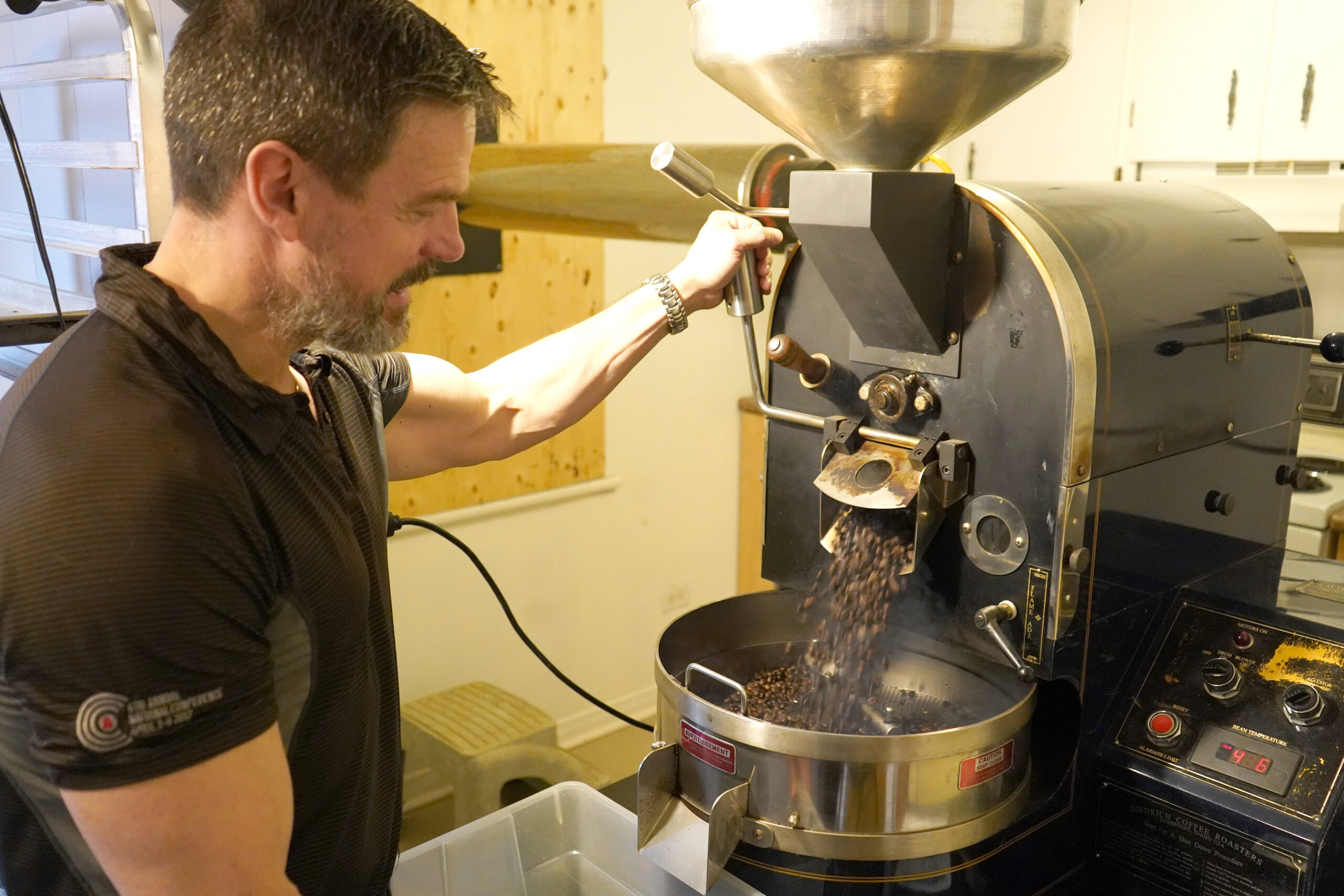
Around the back of Café 349 and up a rickety set of wooden stairs lives Pontiac’s only commercial coffee roaster – that is, as far as Ruth Hahn, its current owner, is aware. Once a week it comes alive, toasting various medleys of beans imported from all over the world that are then brewed and served as piping hot coffee to Hahn’s café customers downstairs.
The roaster has lived in the Pontiac since 2010, when Thorne resident Raymond Sander-Regier decided to open a small coffee shop in his studio and gallery space in Shawville, in the strip mall across from Valu-mart. He called it Art Brulant, and for just about a decade he produced the only Pontiac-roasted coffee beans that could be found on grocery store shelves from Fort-Coulonge to Shawville. For some of that time, he also brewed the beans right there in his studio.
“I actually had somebody show up from south of Ottawa and they had been told that I served a good cup of coffee,” he said.
But in 2022, he decided his coffee roasting days had come to an end, and decided to close the business, selling the roasting machine to Hahn.
“I just think it’s a neat thing to have in the Pontiac, and it was so close to being gone,” Hahn said of her decision to take it on. “I think I just thought it would just add something more to the café and it would fit in well with what we do.”
Now, the machine has a new master. For three years, café employee Glen Hartle has been experimenting with blends and perfecting the process of getting each roast just right.
“The art or the craft of roasting is you have to decide when you add air, when you reduce the heat, and when you do any of these things in order to get that flavour profile you want,” Hartle explained one rainy morning in April as he dumped a bowl of raw coffee beans into the top of the roaster.
Through a complicated process of controlling heat and airflow, and tracking the temperature at many intervals throughout, a master roaster can bring the beans to just the right hue of golden brown.
“The first part of the roasting process is endothermic, where the beans are absorbing heat,” Hartle explained. “The second part is exothermic, where they can actually heat themselves. They have enough heat that they’ll finish the roasting process.”
This means careful attention needs to be paid to ensure the machine’s temperature is reduced as soon as the beans reach a certain internal temperature, to ensure they don’t burn.
Soon after that point, the beans will start to pop, or crack, as the industry insiders prefer to call it. Releasing the beans after the first round of cracking produces a light roast. Leaving them in there a few more minutes until just before their second round of cracking produces a medium roast, and letting them finish their second crack in the roaster produces a dark roast.
It’s a process Hartle learnt with guidance from Sander-Regier, and performed solo at the café for the first time in Feb. 2023.
“Raymond kind of gave me an apprenticeship-mentorship over several laughter-fueled sessions at his shop. We had such fun,” Hartle said.
On this particular April morning, Hartle was beginning his roasting session with the Isla blend he created (and named) using a combination of three beans: a Sumatra bean from Indonesia, a decaf bean from Columbia, and a Robusta bean from India. He said he’s found it to be one of the favourites for people who like a medium coffee.
“We tend to mix all the blends ourselves,” he said, noting this allows the café to adapt to local preferences. “You know how you can drink a glass of wine and I can drink a glass of wine and you’ll go, ‘Hmm, cherry,’ and I’ll go, ‘Hmmm, plum,’ and we’ll have completely different ideas as to what we just drank. Well, the same thing is true with coffee beans.”
Hartle works with a distributor in Montreal to source the beans needed for the various blends he’s created over the years, something Sander-Regier said he didn’t spend as much time doing.
“He’s working with one of their suppliers very closely,” Sander-Regier said, noting he was happy to see the roaster stay in the community.
“Glen’s probably doing a better job than I did, when it comes down to it.”
Hahn said while she doesn’t have big plans to expand the reach of the coffee roasted by her business, and is happy simply serving it to customers in house and selling it on her own shelves, she wishes more people could see all that goes into producing a single cup.
Though customers don’t get to see the roasting process first-hand, Hartle, who also works serving food in the restaurant, knows the extra effort is appreciated.
“People who come here love the authenticity of the café roasting and producing its own coffee,” he said. “That feels really good, especially when I’m serving them.”
Environ une fois par semaine, toute personne se promenant sur la rue Principale de Shawville pourrait percevoir quelque chose de particulier dans l’air. Une odeur de noisette, un peu chocolatée, un peu acide, flotte dans l’air pendant quelques heures, et si vous êtes positionné sous le vent, vous pourriez avoir la chance d’en percevoir une bouffée.
L’odeur se manifeste rarement à la même heure chaque semaine. Cela peut être tôt le matin, ou après la fermeture de la plupart des commerces pour la journée. Mais c’est l’odeur d’un processus qui produit quelque chose dont la plupart des gens dépendent pour traverser leur journée : le café.
À l’arrière du Café 349 et en haut d’un escalier en bois branlant se trouve le seul torréfacteur commercial du Pontiac – du moins, à la connaissance de Ruth Hahn, sa propriétaire actuelle. Une fois par semaine, il s’active, grillant divers mélanges de grains importés du monde entier qui sont ensuite infusés et servis sous forme de café chaud fumant aux clients du café de Mme Hahn, au rez-de-chaussée.
Le torréfacteur est dans le Pontiac depuis 2010, lorsque Raymond Sander-Regier, résident de Thorne, a décidé d’ouvrir un petit café dans son studio et sa galerie à Shawville, dans le centre commercial en face du Valu-mart. Il l’a nommé Art Brulant, et pendant près d’une décennie, il a produit les seuls grains de café torréfiés dans le Pontiac que l’on pouvait trouver sur les étagères des épiceries de Fort-Coulonge à Shawville. Pendant une partie de cette période, il a également infusé les grains directement dans son studio.
« J’ai même eu quelqu’un du sud d’Ottawa qui s’est présenté, et on lui avait dit que je servais une bonne tasse de café », a-t-il déclaré.
Mais en 2022, il a décidé que ses jours de torréfaction de café étaient terminés, et il a décidé de fermer l’entreprise, vendant la machine à torréfier à Mme Hahn.
« Je trouve que c’est une chose intéressante à avoir dans le Pontiac, et il était sur le point de disparaître », a déclaré Mme Hahn à propos de sa décision de reprendre l’entreprise. « Je crois que j’ai simplement pensé que cela ajouterait quelque chose de plus au café et que cela s’intégrerait bien à ce que nous faisons. »
Maintenant, la machine a un nouveau maître. Depuis trois ans, Glen Hartle, employé du café, expérimente les mélanges et perfectionne le processus pour obtenir chaque torréfaction parfaitement.
« L’art ou le métier de la torréfaction, c’est de décider quand ajouter de l’air, quand réduire la chaleur, et quand faire toutes ces choses pour obtenir le profil de saveur désiré », a expliqué M. Hartle un matin pluvieux d’avril alors qu’il versait un bol de grains de café crus dans la partie supérieure du torréfacteur.
Grâce à un processus complexe de contrôle de la chaleur et du flux d’air, et en surveillant la température à de nombreux intervalles, un maître torréfacteur peut amener les grains à la teinte parfaite de brun doré.
« La première partie du processus de torréfaction est endothermique, où les grains absorbent la chaleur », a expliqué M. Hartle. « La deuxième partie est exothermique, où ils peuvent en fait se chauffer eux-mêmes. Ils ont suffisamment de chaleur pour terminer le processus de torréfaction. »
Cela signifie qu’il faut accorder une attention particulière à la réduction de la température de la machine dès que les grains atteignent une certaine température interne, afin de s’assurer qu’ils ne brûlent pas.
Peu après ce point, les grains commenceront à « éclater », ou à « craquer », comme les initiés de l’industrie préfèrent l’appeler. Libérer les grains après le premier craquement produit une torréfaction légère. Les laisser quelques minutes de plus juste avant leur deuxième craquement produit une torréfaction moyenne, et les laisser terminer leur deuxième craquement dans le torréfacteur produit une torréfaction foncée.
C’est un processus que M. Hartle a appris sous la direction de M. Sander-Regier, et qu’il a effectué seul au café pour la première fois en février 2023.
« Raymond m’a en quelque sorte offert un apprentissage-mentorat au cours de plusieurs séances remplies de rires dans sa boutique. Nous nous sommes beaucoup amusés », a déclaré M. Hartle.
En ce matin d’avril particulier, M. Hartle commençait sa séance de torréfaction avec le mélange Isla qu’il a créé (et nommé) en utilisant une combinaison de trois grains : un grain de Sumatra d’Indonésie, un grain décaféiné de Colombie et un grain Robusta d’Inde. Il a dit qu’il l’avait trouvé parmi les préférés des gens qui aiment un café moyen.
« Nous avons tendance à mélanger tous les assemblages nous-mêmes », a-t-il dit, notant que cela permet au café de s’adapter aux préférences locales. « Vous savez comment vous pouvez boire un verre de vin et je peux boire un verre de vin et vous direz, “Hmm, cerise”, et je dirai, “Hmm, prune”, et nous aurons des idées complètement différentes de ce que nous venons de boire. Eh bien, la même chose est vraie avec les grains de café. »
M. Hartle travaille avec un distributeur à Montréal pour s’approvisionner en grains nécessaires aux divers mélanges qu’il a créés au fil des ans, une chose à laquelle M. Sander-Regier a dit ne pas avoir consacré autant de temps.
« Il travaille très étroitement avec l’un de leurs fournisseurs », a déclaré M. Sander-Regier, notant qu’il était heureux de voir le torréfacteur rester dans la communauté.
« Glen fait probablement un meilleur travail que moi, quand on y pense. »
Mme Hahn a dit que bien qu’elle n’ait pas de grands projets pour étendre la portée du café torréfié par son entreprise, et qu’elle soit heureuse de le servir simplement aux clients sur place et de le vendre sur ses propres étagères, elle souhaiterait que plus de gens puissent voir tout ce qui entre dans la production d’une seule tasse.
Bien que les clients ne puissent pas voir le processus de torréfaction de première main, M. Hartle, qui travaille également au service de la nourriture dans le restaurant, sait que l’effort supplémentaire est apprécié.
« Les gens qui viennent ici aiment l’authenticité du café qui torréfie et produit son propre café », a-t-il dit. « Cela fait vraiment du bien, surtout quand je les sers. »