


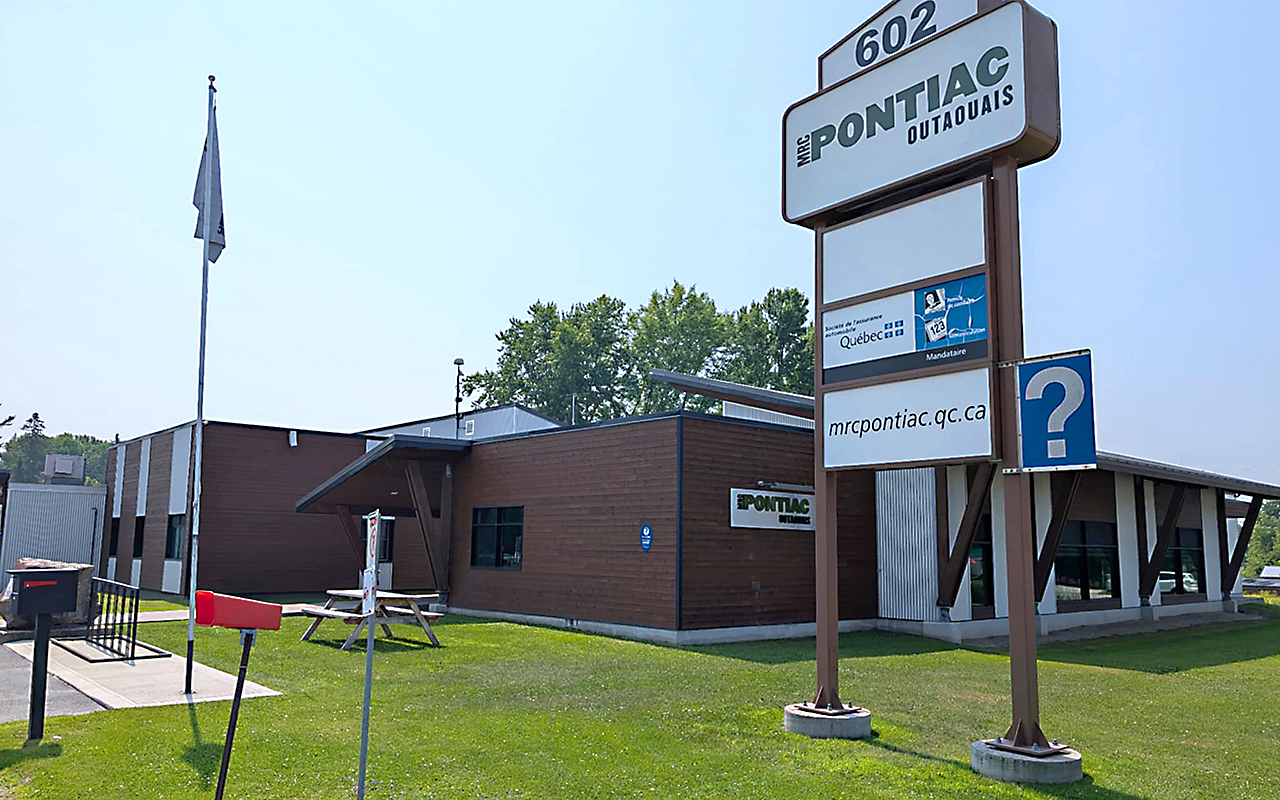



On Wednesday evening, MRC Pontiac held a public consultation on its climate plan, offering the public an opportunity to weigh in on the county’s efforts to identify and reduce excess greenhouse gas (GHG) emissions.
Hosted by MRC environment manager Kari Richardson, the consultation was held both in-person and via zoom, with around five members of the public participating, including media.
“Through the whole process, there was consultation with municipal employees, with the public, through surveys and workshops,” Richardson said. “There was a lot of effort to make sure that there was a collaborative input, not just in MRC Pontiac but across the other MRCs.”
The plan includes analysis from the MRC’s greenhouse gas inventory, which showed that transportation was the number one contributor, as well as waste management and municipal buildings
Richardson’s presentation on the report notes that MRC Pontiac residents emit GHG equivalent to around 7.2 tonnes of CO2, compared to the provincial average of 9 tonnes.
Mitigation efforts are focused around eight orientations identified in the plan: sustainable mobility and transport, buildings and energy efficiency, renewable energy and energy resilience, waste management and the circular economy, civil security and risk adaptation, local food systems and community resilience, land use planning and green infrastructure, as well as governance and sustainable finance.
From these eight orientation categories, the plan identifies 19 objectives, with 54 “concrete measures” to achieve them, with different priorities allocated to each one.
For example, in the transport orientation, one of the objectives is to reduce dependence on automobiles, with the top priority measure being “strengthening rural and interterritorial public transit”.
To reduce transportation emissions, the MRC is aiming to have 15 per cent of road vehicles and five per cent of offroad vehicles use non-petroleum energy by 2035. The MRC is also aiming to reduce building energy use by 20 per cent over that same time period, and reduce fossil fuel use in buildings by 50 per cent. It is also aiming to reduce waste going to landfill by 25 per cent by 2035.
Richardson said that the MRC has received $1,068,877 from the Ministry of Municipal Affairs’ municipal climate transition fund, known under the French acronym ATCL, to implement these mitigation efforts. She said that the MRC had been fortunate to already have its climate plan in the works prior to the ATCL funding being announced, thanks to FRR funding, a separate envelope from the ministry for regional development.
“The warden’s table, and specifically MRC des Collines who kind of spearheaded this project, had the foresight to use FRR funding, to use the regional funding to start the climate plan,” she explained. “So we had already signed contracts and were working with FRR money, and then the government announced this ATCL program. The MRC has already received a million dollars for updating the climate plan, but also to realize actions. We’re lucky we still have the whole envelope, other MRCs would have had to use that to develop their plan, to do their greenhouse gas emissions studies, to do their risk analysis, to create their plan. We haven’t touched it yet.”
The ATCL funding can cover up to 80 per cent of a project, with at least five per cent coming from a municipality or MRC.
A copy of the plan is available on the MRC’s website, however, the majority of the documents are in French only. Questions and comments for the final draft of the plan can be sent to k.richardson@mrcpontiac.qc.ca and will be accepted until May 22.
Richardson said that the MRC is aiming to have the final draft tabled at the June council of mayors meeting, and subsequently sent to the ministry for approval.
Mercredi soir, la MRC de Pontiac a tenu une consultation publique sur son plan climatique, offrant au public l’occasion de se prononcer sur les efforts du comté pour identifier et réduire les émissions excessives de gaz à effet de serre (GES).
Animée par Kari Richardson, gestionnaire de l’environnement de la MRC, la consultation s’est déroulée en personne et via Zoom, avec la participation d’environ cinq membres du public, y compris les médias.
« Tout au long du processus, il y a eu des consultations avec les employés municipaux, avec le public, par le biais de sondages et d’ateliers, » a déclaré Mme Richardson. « Beaucoup d’efforts ont été faits pour s’assurer qu’il y ait une contribution collaborative, non seulement à la MRC de Pontiac, mais aussi dans les autres MRC. »
Le plan comprend une analyse de l’inventaire des gaz à effet de serre de la MRC, qui a montré que les transports étaient le principal contributeur, ainsi que la gestion des matières résiduelles et les bâtiments municipaux.
La présentation de Mme Richardson sur le rapport indique que les résidents de la MRC de Pontiac émettent des GES équivalant à environ 7,2 tonnes de CO2, comparativement à la moyenne provinciale de 9 tonnes.
Les efforts d’atténuation sont axés sur huit orientations identifiées dans le plan : mobilité et transport durables, bâtiments et efficacité énergétique, énergies renouvelables et résilience énergétique, gestion des matières résiduelles et économie circulaire, sécurité civile et adaptation aux risques, systèmes alimentaires locaux et résilience communautaire, aménagement du territoire et infrastructures vertes, ainsi que gouvernance et finance durable.
À partir de ces huit catégories d’orientation, le plan identifie 19 objectifs, assortis de 54 « mesures concrètes » pour les atteindre, avec différentes priorités allouées à chacune.
Par exemple, dans l’orientation transport, l’un des objectifs est de réduire la dépendance à l’automobile, la mesure prioritaire étant le « renforcement du transport en commun rural et interterritorial ».
Pour réduire les émissions liées aux transports, la MRC vise à ce que 15 % des véhicules routiers et 5 % des véhicules hors route utilisent des énergies non pétrolières d’ici 2035. La MRC vise également à réduire la consommation d’énergie des bâtiments de 20 % au cours de la même période, et à réduire de 50 % l’utilisation de combustibles fossiles dans les bâtiments. Elle vise également à réduire de 25 % les déchets destinés à l’enfouissement d’ici 2035.
Mme Richardson a indiqué que la MRC a reçu 1 068 877 $ du Fonds de transition climatique des municipalités du ministère des Affaires municipales, connu sous l’acronyme français ATCL, pour mettre en œuvre ces efforts d’atténuation. Elle a déclaré que la MRC avait eu la chance d’avoir déjà son plan climatique en cours d’élaboration avant l’annonce du financement ATCL, grâce au financement du FRR, une enveloppe distincte du ministère pour le développement régional.
« La table des préfets, et plus spécifiquement la MRC des Collines qui a en quelque sorte mené ce projet, a eu la clairvoyance d’utiliser le financement du FRR, d’utiliser le financement régional pour démarrer le plan climatique, » a-t-elle expliqué. « Nous avions donc déjà signé des contrats et travaillions avec l’argent du FRR, puis le gouvernement a annoncé ce programme ATCL. La MRC a déjà reçu un million de dollars pour la mise à jour du plan climatique, mais aussi pour la réalisation d’actions. Nous avons la chance d’avoir encore toute l’enveloppe, d’autres MRC auraient dû l’utiliser pour développer leur plan, pour faire leurs études d’émissions de gaz à effet de serre, pour faire leur analyse de risques, pour créer leur plan. Nous n’y avons pas encore touché. »
Le financement ATCL peut couvrir jusqu’à 80 % d’un projet, avec au moins cinq pour cent provenant d’une municipalité ou d’une MRC.
Une copie du plan est disponible sur le site web de la MRC, toutefois, la majorité des documents sont en français seulement. Les questions et commentaires concernant l’avant-projet de plan peuvent être envoyés à k.richardson@mrcpontiac.qc.ca et seront acceptés jusqu’au 22 mai.
Mme Richardson a déclaré que la MRC vise à faire déposer l’avant-projet lors de la réunion du conseil des maires de juin, puis à l’envoyer au ministère pour approbation.