





The RA grounds and campground in Ladysmith rang with clinking beer glasses and squeaking sauerkraut as the 40th edition of Oktoberfest Ladysmith took over the village last weekend.
But one sound missing from this festival of German culture was the German language itself. Aside from a few German-speaking visitors and the band flown in from Germany, not much of the tongue remains on the lips of locals.
For a community once founded in part by settlers from German-speaking regions of Europe, the language has given way to English and French. For many, Oktoberfest is one of the last traces of the region’s heritage — though some longtime volunteers worry about the festival’s future.
Thorne was first settled mainly by Irish immigrants in the late 1800s, with Germans soon following. Names like Schwartz, Steinke and Bretzlaff were among the first in the area, bringing with them their language, culture and traditions, including the famous Ladysmith Wedding — an all-night affair with music, drink, and a roasted calf and pig butchered special for the occasion.
Early settlers spoke German at home, and the language spread through schools and churches.
According to Up the Hills to Home (1977), published by the Pontiac Printshop, Thorne’s first school was a German school in Ladysmith, which had already closed by 1900. After that, children of German descent went to German school on Saturdays, though this practice was discontinued around the 1960s.
At St. John’s Lutheran Church, youth once received instruction in German. Starting in 1878, a parsonage housed a German-speaking minister, a tradition that lasted for over 70 years. An article by Gunda Lambton in Up the Gatineau! noted that pastors came from Germany until the 1950s.
“It became increasingly difficult to find a German-speaking minister, and in the late 1950s church services were even discontinued,” Lambton wrote.
At Zion Lutheran Church, pastors preached only in German until 1935, then mixed in English. By the 1950s, German was used at Zion about once a month for older parishioners. Soon, German became less and less of the norm in Thorne as the third and future generations of residents were no longer widely exposed to it.
“As soon as an English-speaking minister began to serve the congregations, German survived only at home, on tombstones, or in Christmas hymns,” Lambton wrote.
For Winnifred and Gerald Mielke, descendants of early settlers, the language became a family code.
“We didn’t speak it at home… only if we didn’t want the kids to hear what we were saying,” she said.
Their daughter Jennifer said she’d be lucky to muster a few words. “I never learned it,” she said.
While most of the original settler families have let the language go, it has lingered in part through postwar immigrants like Karl Erfle and Gerda Bretzlaff, who arrived in the early 1960s after fleeing Bessarabia, then part of Romania. They were evacuated to Poland, later moved to Germany, and followed their brother Helmut to Canada.
Gerd Hemken, from northern Germany, came to Canada in 1951 following his uncle, who found farm work near Shawville.
“There were Germans here, so I guess they got connected,” he said, adding that his uncle found work making suitcases in Ladysmith.
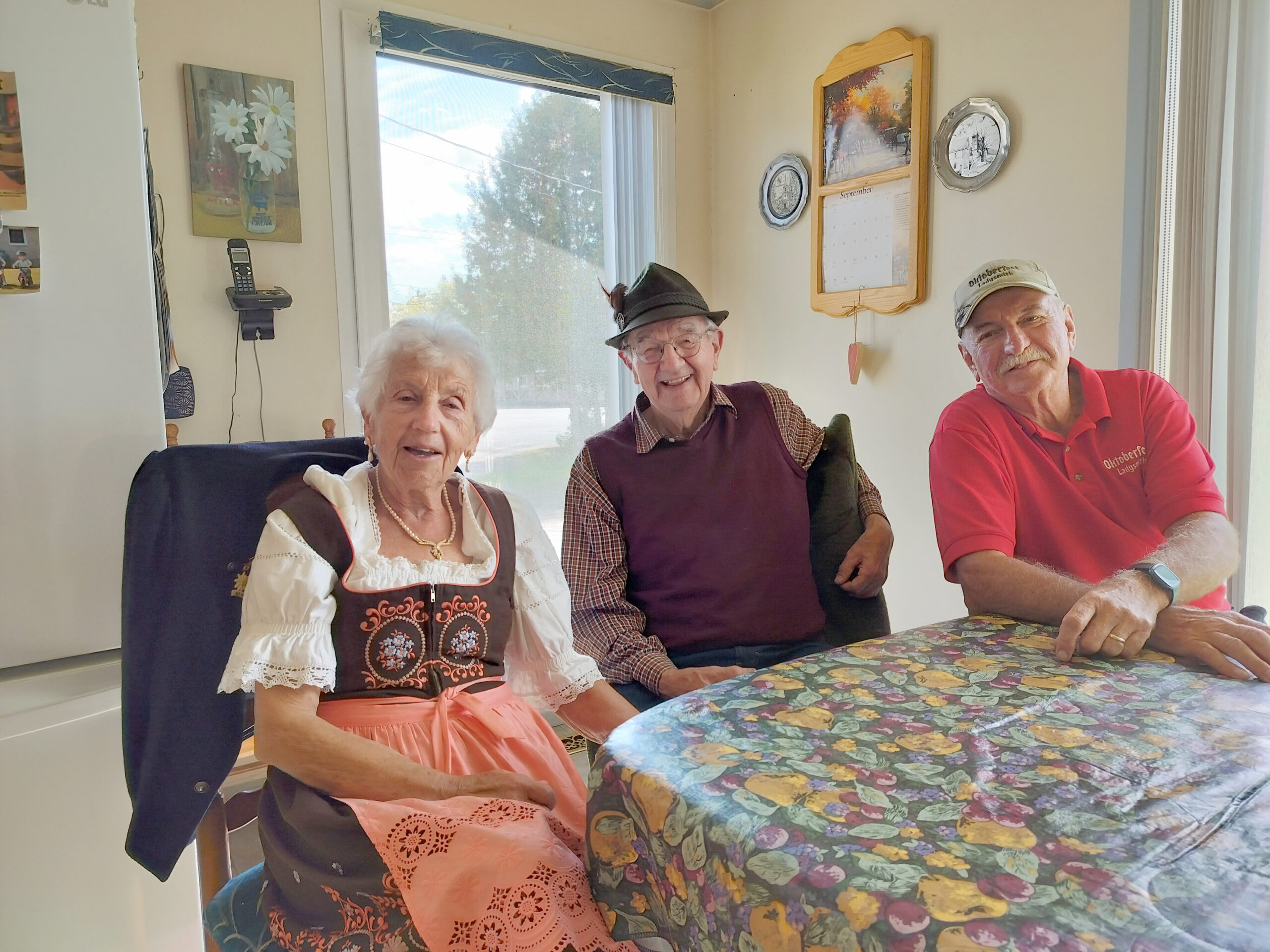
In September, the three met with THE EQUITY over Kaffee – coffee – and Kuchen – cake – at Bretzlaff’s kitchen table to discuss the state of the language in Thorne.
Erfle, who arrived in Canada at age nine, spoke no English. “I learned it in school, but I spoke German with my mom all the time,” he said.
Hemken said when he arrived in Thorne there was a stark difference between the Low German he spoke, and the dialect spoken by residents of Thorne. He said locals were kind despite his different dialect. “They spoke as if I was one of their own,” he said.
Even among newer arrivals, though, the language didn’t survive.
“My kids don’t speak it, Gerda’s kids don’t — it was never really passed along,” said Erfle, who still chats with his sister in “age nine–level” German to try and remember.
Erfle said while he regrets not being more skilled in his mother tongue, a certain baggage associated with the German language made it part of a history you wanted to forget.
“When I went to school in Shawville, it’s not something that you wanted to broadcast that you were,” he said.
Bretzlaff, a self-identified “German-Canadian” who is among the more fluent of the remaining speakers, said she is proud to still speak the language even today despite rarely using it.
“Ich kann nicht glauben, dass ich immer noch Deutsch spreche, genau wie ich es gelernt habe [I can’t believe I still speak German exactly the way I learned],” she said.
In the 1980s, the language’s decline was already in full force. But volunteers in the community started to organize a festival to honour the German heritage in the community, and they called it Oktoberfest.
“People wanted something dramatic,” said co-founder Karen Kelly. “It was to bring the municipality to the fore and let everyone know what [Thorne] was all about.”
Since then, Oktoberfest has become one of the Pontiac’s biggest events, drawing crowds from across Eastern Canada. This year’s 40th edition featured a band from Germany.
But with German voices on the streets of Thorne mostly faded, Oktoberfest remains one of the last signs of German heritage in the community. But some volunteers are saying a recent decline in volunteers could jeopardize the future of the festival.
Kelly said about 10 years ago organizers began to wonder how many more years they would be able to put it on. “There were a couple of years we weren’t sure we were going to have it,” she said.
Erfle and Bretzlaff are longtime volunteers, Erfle handling setup and teardown; Bretzlaff acting as the village’s sauerkraut expert. “Once the party’s over, everyone just wants to go home,” Erfle said.
Marguerite and Randy Born, who lead the annual meatball- and sauerkraut-making parties, told THE EQUITY in September that recruiting volunteers is tough despite repeated attempts to increase participation.
Still, Oktoberfest remains a major economic driver. Hemken said he comes for the beer and music, though the German identity has mostly faded. “I wonder if it exists anymore,” he said.
For Erfle, the festival is more about community identity than culture. “It’s something to bring to Ladysmith,” he said. “It brings money back into the community and has put Ladysmith on the map.”
In recent years, Ladysmith native Jennifer Mielke has taken a larger role, securing a spot on CTV Ottawa and booking a German band through the German Embassy.
Kelly said it’s encouraging to see younger volunteers step up, but more are needed to keep it going.
“If you want to maintain the German culture, you’d better make an effort,” she said.
When the three parted ways from Bretzlaff’s kitchen table, they exchanged Auf Wiedersehens – goodbyes – not knowing how many of those greetings they will have left.
Bretzlaff said it’s tough to see the language and culture slip away, both essential parts of the community that, German or not, she has come to call home.
For now, she’s going to keep celebrating Oktoberfest every year, volunteering her sauerkraut services and speaking auf Deutsch.
“It’s part of Ladysmith,” she said.
Le terrain et le camping du RA à Ladysmith ont résonné du tintement des verres de bière et du grincement de la choucroute alors que la 40e édition de l’Oktoberfest de Ladysmith s’emparait du village le week-end dernier.
Mais un son manquait à ce festival de culture allemande : la langue allemande elle-même. Mis à part quelques visiteurs germanophones et le groupe venu d’Allemagne, il ne reste plus grand-chose de cette langue sur les lèvres des habitants.
Pour une communauté autrefois fondée en partie par des colons originaires de régions germanophones d’Europe, la langue a cédé la place à l’anglais et au français. Pour beaucoup, l’Oktoberfest est l’une des dernières traces du patrimoine de la région — bien que certains bénévoles de longue date s’inquiètent de l’avenir du festival.
Thorne a été d’abord colonisée principalement par des immigrants irlandais à la fin des années 1800, suivis peu après par des Allemands. Des noms comme Schwartz, Steinke et Bretzlaff figuraient parmi les premiers de la région, apportant avec eux leur langue, leur culture et leurs traditions, y compris le célèbre Mariage de Ladysmith — une fête qui durait toute la nuit avec musique, boissons, et un veau et un cochon rôtis abattus spécialement pour l’occasion.
Les premiers colons parlaient allemand à la maison, et la langue s’est répandue dans les écoles et les églises.
Selon Up the Hills to Home (1977), publié par Pontiac Printshop, la première école de Thorne était une école allemande à Ladysmith, qui avait déjà fermé ses portes en 1900. Par la suite, les enfants d’origine allemande fréquentaient l’école allemande le samedi, bien que cette pratique ait été abandonnée vers les années 1960.
À l’église luthérienne St. John, les jeunes recevaient autrefois un enseignement en allemand. À partir de 1878, un presbytère abritait un ministre germanophone, une tradition qui a duré plus de 70 ans. Un article de Gunda Lambton dans Up the Gatineau! a noté que les pasteurs venaient d’Allemagne jusqu’aux années 1950.
« Il est devenu de plus en plus difficile de trouver un ministre germanophone, et à la fin des années 1950, les services religieux ont même été interrompus », a écrit Lambton.
À l’église luthérienne Zion, les pasteurs prêchaient uniquement en allemand jusqu’en 1935, puis ils ont intégré l’anglais. Dans les années 1950, l’allemand était utilisé à Zion environ une fois par mois pour les paroissiens plus âgés. Bientôt, l’allemand est devenu de moins en moins la norme à Thorne, car les troisième et futures générations de résidents n’y étaient plus largement exposées.
« Dès qu’un ministre anglophone a commencé à servir les congrégations, l’allemand n’a survécu qu’à la maison, sur les pierres tombales ou dans les chants de Noël », a écrit Lambton.
Pour Winnifred et Gerald Mielke, descendants des premiers colons, la langue est devenue un code familial.
« Nous ne la parlions pas à la maison… seulement si nous ne voulions pas que les enfants entendent ce que nous disions », a-t-elle déclaré.
Leur fille Jennifer a dit qu’elle aurait de la chance d’articuler quelques mots. « Je ne l’ai jamais apprise », a-elle dit.
Alors que la plupart des familles de colons d’origine ont abandonné la langue, celle-ci a persisté en partie grâce aux immigrants d’après-guerre comme Karl Erfle et Gerda Bretzlaff, qui sont arrivés au début des années 1960 après avoir fui la Bessarabie, alors partie de la Roumanie. Ils ont été évacués en Pologne, puis se sont installés en Allemagne, et ont suivi leur frère Helmut au Canada.
Gerd Hemken, originaire du nord de l’Allemagne, est arrivé au Canada en 1951, suivant son oncle qui avait trouvé du travail agricole près de Shawville.
« Il y avait des Allemands ici, alors je suppose qu’ils ont noué des liens », a-t-il dit, ajoutant que son oncle avait trouvé du travail dans la fabrication de valises à Ladysmith.
En septembre, les trois se sont rencontrés avec THE EQUITY autour d’un Kaffee – café – et d’un Kuchen – gâteau – à la table de cuisine de Bretzlaff pour discuter de l’état de la langue à Thorne.
Erfle, arrivé au Canada à l’âge de neuf ans, ne parlait pas anglais. « Je l’ai appris à l’école, mais je parlais allemand avec ma mère tout le temps », a-t-il dit.
Hemken a dit qu’à son arrivée à Thorne, il y avait une nette différence entre le bas allemand qu’il parlait et le dialecte parlé par les résidents de Thorne. Il a dit que les habitants étaient gentils malgré son dialecte différent. « Ils parlaient comme si j’étais l’un des leurs », a-t-il dit.
Même parmi les nouveaux arrivants, la langue n’a cependant pas survécu.
« Mes enfants ne la parlent pas, ceux de Gerda non plus — elle n’a jamais vraiment été transmise », a dit Erfle, qui converse encore avec sa sœur en allemand de « niveau neuf ans » pour essayer de se souvenir.
Erfle a dit que s’il regrettait de ne pas être plus compétent dans sa langue maternelle, un certain bagage associé à la langue allemande en faisait une partie de l’histoire que l’on voulait oublier.
« Quand j’allais à l’école à Shawville, ce n’était pas quelque chose que l’on voulait proclamer haut et fort », a-t-il dit.
Bretzlaff, qui se décrit comme une « Germano-Canadienne » et qui est parmi les locuteurs restants les plus fluides, a dit être fière de parler encore la langue aujourd’hui, même si elle l’utilise rarement.
« Ich kann nicht glauben, dass ich immer noch Deutsch spreche, genau wie ich es gelernt habe [Je n’arrive pas à croire que je parle encore allemand exactement comme je l’ai appris] », a-t-elle dit.
Dans les années 1980, le déclin de la langue était déjà en pleine puissance. Mais des bénévoles de la communauté ont commencé à organiser un festival pour honorer l’héritage allemand de la communauté, et ils l’ont appelé Oktoberfest.
« Les gens voulaient quelque chose de spectaculaire », a dit la cofondatrice Karen Kelly. « C’était pour mettre la municipalité en avant et faire savoir à tous ce qu’était [Thorne]. »
Depuis lors, l’Oktoberfest est devenu l’un des plus grands événements du Pontiac, attirant des foules de partout dans l’Est du Canada. La 40e édition de cette année a présenté un groupe venu d’Allemagne.
Mais avec les voix allemandes des rues de Thorne majoritairement estompées, l’Oktoberfest reste l’un des derniers signes du patrimoine allemand de la communauté. Cependant, des bénévoles affirment qu’une récente diminution du nombre de bénévoles pourrait compromettre l’avenir du festival.
Kelly a dit qu’il y a une dizaine d’années, les organisateurs ont commencé à se demander combien d’années ils pourraient encore l’organiser. « Il y a eu quelques années où nous n’étions pas sûrs de pouvoir le tenir », a-t-elle dit.
Erfle et Bretzlaff sont des bénévoles de longue date, Erfle s’occupant du montage et du démontage; Bretzlaff agissant en tant qu’experte en choucroute du village. « Une fois la fête terminée, tout le monde veut juste rentrer chez soi », a dit Erfle.
Marguerite et Randy Born, qui dirigent les fêtes annuelles de fabrication de boulettes de viande et de choucroute, ont déclaré à THE EQUITY en septembre que recruter des bénévoles est difficile malgré des tentatives répétées d’augmenter la participation.
Néanmoins, l’Oktoberfest reste un moteur économique majeur. Hemken a dit qu’il venait pour la bière et la musique, bien que l’identité allemande se soit majoritairement estompée. « Je me demande si elle existe encore », a-t-il dit.
Pour Erfle, le festival est plus une question d’identité communautaire que de culture. « C’est quelque chose à apporter à Ladysmith », a-t-il dit. « Ça ramène de l’argent dans la communauté et ça a mis Ladysmith sur la carte. »
Ces dernières années, Jennifer Mielke, originaire de Ladysmith, a joué un rôle plus important, obtenant une place à CTV Ottawa et réservant un groupe allemand par l’intermédiaire de l’ambassade d’Allemagne.
Kelly a dit qu’il est encourageant de voir de jeunes bénévoles se manifester, mais il en faut davantage pour que ça continue.
« Si vous voulez maintenir la culture allemande, vous feriez mieux de faire un effort », a-t-elle dit.
Quand les trois se sont séparés de la table de cuisine de Bretzlaff, ils ont échangé des Auf Wiedersehens – des adieux – ne sachant pas combien de ces salutations il leur resterait.
Bretzlaff a dit qu’il est difficile de voir la langue et la culture s’évanouir, deux éléments essentiels de la communauté que, allemande ou non, elle est venue appeler sa maison.
Pour l’instant, elle continuera de célébrer l’Oktoberfest chaque année, offrant bénévolement ses services de choucroute et parlant auf Deutsch.
« Ça fait partie de Ladysmith », a-t-elle dit.