


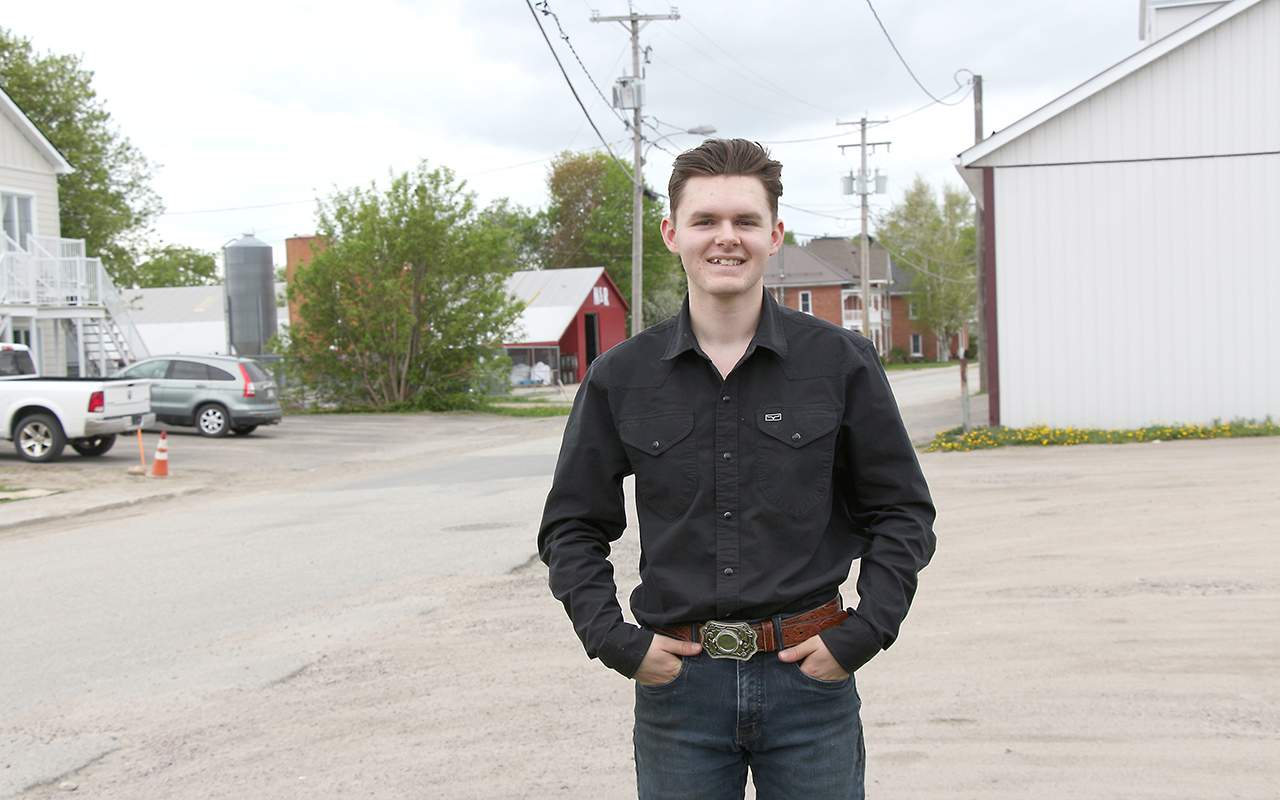



Pontiac High School student Ben Judd was one of 70 or so youth representatives from across the country who descended on the nation’s capital for the 4-H citizenship congress that ended last week.
Judd, who lives in Bristol with his parents Robin Judd and Jenn Russell-Judd, works on his family’s Starborn Farms and is in his tenth year with the Shawville 4-H club.
Last week he left the farm behind for Ottawa, where he spent six days representing Quebec at the annual event that sees youth nationwide gather to discuss challenges to the agricultural industry, and experience democracy firsthand.
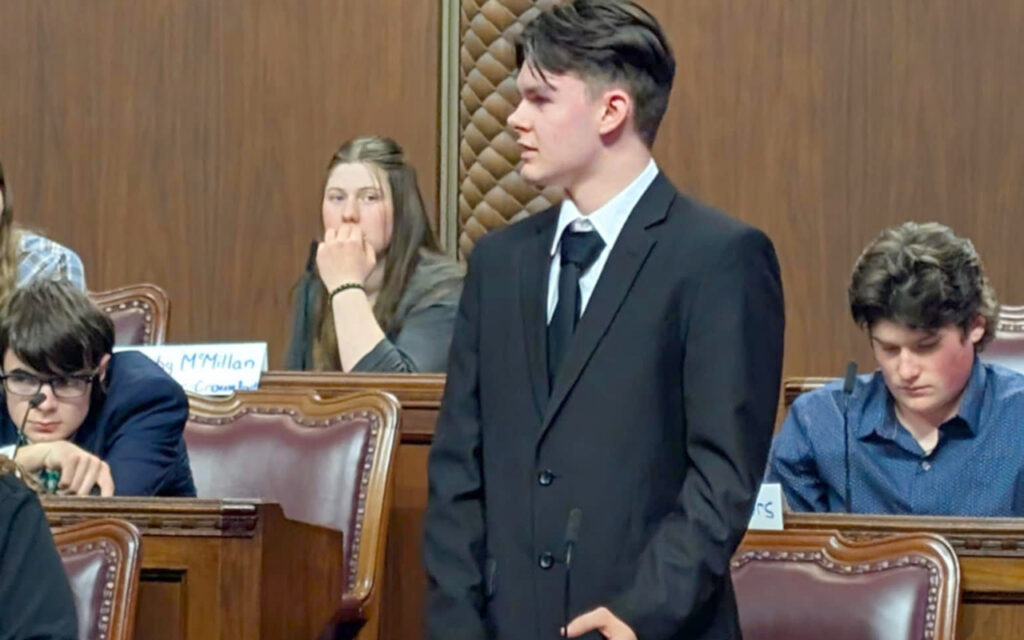
According to its website, the program is “an opportunity for youth to strengthen their citizenship skills, connection and identity,” and Judd said he did a lot of that over the course of the week’s activities, which included a mock Senate, focus groups discussing agricultural issues, and getting to meet federal senators.
After arriving in Ottawa and getting to meet some of his 70 fellow participants from across the country, Ben and his cohort were divided into two parties for a mock debate on various agricultural issues.
Each party voted in a leader, but when it came time to vote for Judd’s opposition party, he could not cast a ballot because he was one of the leading candidates. “There was three or four people elected in our group, and I lost by two votes,” he said. “It was disappointing, but also like, ‘Whew, I don’t have to do that.’”
As one of the electees, Judd was still responsible for writing one- to two-minute introductions for his team’s arguments, including one to protect agricultural land from housing development.
“It was a bit of a nerves thing, because we gave our debates in the Senate,” he said, adding that he was proud his group won the debate.
“The whole of us did a vote at the end,” he said. “And my group won by a vote of 49 to 16.”
Judd said one of the coolest moments was something called the “Speak-up challenge,” a series of group discussions addressing questions that actual Canadian senators and CEOs put to the groups.
His group, which discussed the challenges of agribusiness and difficulties for youth getting started in agriculture, met with Senators Robert Black and Mary Robinson, who took attentive notes and even presented some of their ideas in the Senate that night.
“It was incredible to see how fast an impact we had on the nation,” Judd said. “We got our ideas into the decision-making room of Canada.”
Judd was the lone applicant to the event from Quebec, and said he felt a responsibility to go to bat for his province and his region. “I talked a lot about our tourism and our culture, because we have a really unique culture here in Quebec,” he said, adding that many were surprised to find out that he is an anglophone in Quebec.
The event concluded with a dance, where participants showed off the various dances taught in their programs, including line dancing from the prairie provinces and Irish-style dancing from the Maritimes.
“You see all the different parts of culture of all the different people from different provinces,” Judd said, adding that he got to show off his square dancing skills, something he learned was not known to many of his cohorts. “It’s not common outside Quebec.”
Overall, Judd said he was happy to have made friends and contacts across the country who have the same views of agriculture and belief in helping people.
“It’s a cool thing to meet like-minded people from all over the country, people I never would have had a chance of meeting if it wasn’t for that.”
L’élève de l’école secondaire Pontiac, Ben Judd, était l’un des quelque 70 jeunes représentants de partout au pays qui se sont rendus dans la capitale nationale pour le congrès de la citoyenneté 4-H qui s’est terminé la semaine dernière.
Judd, qui vit à Bristol avec ses parents Robin Judd et Jenn Russell-Judd, travaille dans la ferme familiale Starborn Farms et en est à sa dixième année au club 4-H de Shawville.
La semaine dernière, il a délaissé la ferme pour Ottawa, où il a passé six jours à représenter le Québec lors de l’événement annuel qui rassemble des jeunes de partout au pays pour discuter des défis de l’industrie agricole, et vivre la démocratie de première main.
Selon son site web, le programme est « une occasion pour les jeunes de renforcer leurs compétences civiques, leurs liens et leur identité », et Judd a affirmé avoir fait beaucoup de cela au cours des activités de la semaine, qui comprenaient un Sénat simulé, des groupes de discussion sur des questions agricoles et des rencontres avec des sénateurs fédéraux.
Après être arrivé à Ottawa et avoir rencontré certains de ses 70 autres participants de partout au pays, Ben et sa cohorte ont été divisés en deux partis pour un débat simulé sur diverses questions agricoles.
Chaque parti a élu un chef, mais quand est venu le temps de voter pour le parti d’opposition de Judd, il n’a pas pu voter parce qu’il était l’un des principaux candidats. « Il y a eu trois ou quatre personnes élues dans notre groupe, et j’ai perdu par deux voix », a-t-il dit. « C’était décevant, mais aussi comme, ‹ Ouf, je n’ai pas à faire ça. › »
En tant qu’un des élus, Judd était toujours responsable de rédiger des introductions d’une à deux minutes pour les arguments de son équipe, y compris une pour protéger les terres agricoles du développement résidentiel.
« C’était un peu stressant, parce que nous avons présenté nos débats au Sénat », a-t-il dit, ajoutant qu’il était fier que son groupe ait gagné le débat.
« Nous avons tous voté à la fin », a-t-il dit. « Et mon groupe a gagné par un vote de 49 à 16. »
Judd a dit que l’un des moments les plus « cool » était ce qu’on appelle le « Speak-up challenge », une série de discussions de groupe abordant des questions que de véritables sénateurs et PDG canadiens ont posées aux groupes.
Son groupe, qui a discuté des défis de l’agro-industrie et des difficultés pour les jeunes de se lancer en agriculture, a rencontré les sénateurs Robert Black et Mary Robinson, qui ont pris des notes attentives et ont même présenté certaines de leurs idées au Sénat ce soir-là.
« C’était incroyable de voir à quelle vitesse nous avons eu un impact sur la nation », a dit Judd. « Nous avons fait entendre nos idées dans la salle de décision du Canada. »
Judd était le seul candidat du Québec à l’événement, et a dit qu’il se sentait responsable de défendre sa province et sa région. « J’ai beaucoup parlé de notre tourisme et de notre culture, parce que nous avons une culture vraiment unique ici au Québec », a-t-il dit, ajoutant que beaucoup ont été surpris de découvrir qu’il est anglophone au Québec.
L’événement s’est terminé par une danse, où les participants ont montré les différentes danses enseignées dans leurs programmes, y compris la danse en ligne des provinces des Prairies et la danse de style irlandais des Maritimes.
« On voit toutes les différentes parties de la culture de toutes les différentes personnes des différentes provinces », a dit Judd, ajoutant qu’il a pu montrer ses compétences en danse carrée, quelque chose qu’il a appris n’était pas connu de beaucoup de ses collègues. « Ce n’est pas courant en dehors du Québec. »
Dans l’ensemble, Judd a dit qu’il était heureux d’avoir noué des amitiés et des contacts partout au pays qui partagent les mêmes vues sur l’agriculture et la même croyance en l’aide aux gens.
« C’est une chose formidable de rencontrer des gens qui pensent comme nous de partout au pays, des gens que je n’aurais jamais eu la chance de rencontrer sans cela. »