






When Robert Wills opened a dusty old box in the back of the Pontiac Museum several years ago, he knew exactly what he was looking at.
The box contained about 300 glass plates from the camera of photographer Harry Imison, who owned a photo studio in Shawville for more than 40 years.
Wills had heard rumours such a stash might exist somewhere in Shawville’s hinterland, but didn’t realize it had been living in the museum since its donation.
The glass negative plates, which are photography’s precursor to film, came into the museum’s possession when they were donated by a man charged with tearing down an old home in town. The man knew nothing of the plates’ origin — only that they looked old and worth saving.
Many of Imison’s photos had long been available at the Pontiac Archives and at the museum, but these glass plate negatives offered a never-before-seen window into Shawville life more than a century ago.
Since the discovery, Wills and other volunteers at the museum have spent hours, mostly over the summer months, unpacking these envelopes, sorting through the plates, and finally turning them into finished and digitized photographs.
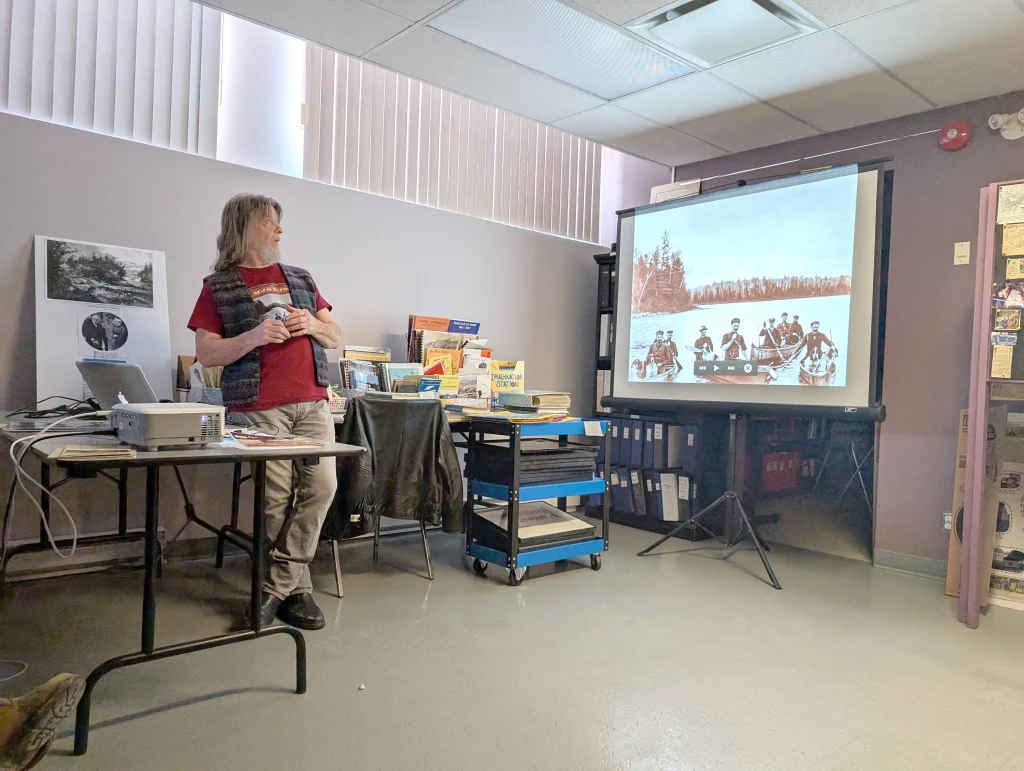
On Wednesday, in a presentation at the Archives, Wills presented a selection of these new images to the public for the first time.
Old photos find new life thanks to volunteer effort
After an initial inspection, Wills and other volunteers found the recovered plates in various states of wholeness. Some were broken. Some had smudged around the edges.
Pontiac Historical Society treasurer Chris Seifried, who worked in the National Film Archives as a photography archivist, put the museum’s summer students at the time in charge of discarding broken plates, cleaning the intact ones with a soft brush and putting them away in envelopes.
“They were old and they weren’t in ideal conditions,” he said of the plates. “They were subject to fluctuations of temperature, fluctuations in humidity, [and] careless handling.”
Last summer, after the plates sat around for a few years, the museum’s summer students began to digitize the collection, placing the negatives on a light box, taking a photo with a phone, and uploading the images to a memory drive.
That drive got lost somewhere along the way, but Wills, determined to preserve these images, started again from square one. He set up his own light table at home to begin chipping away at digitizing the photos.
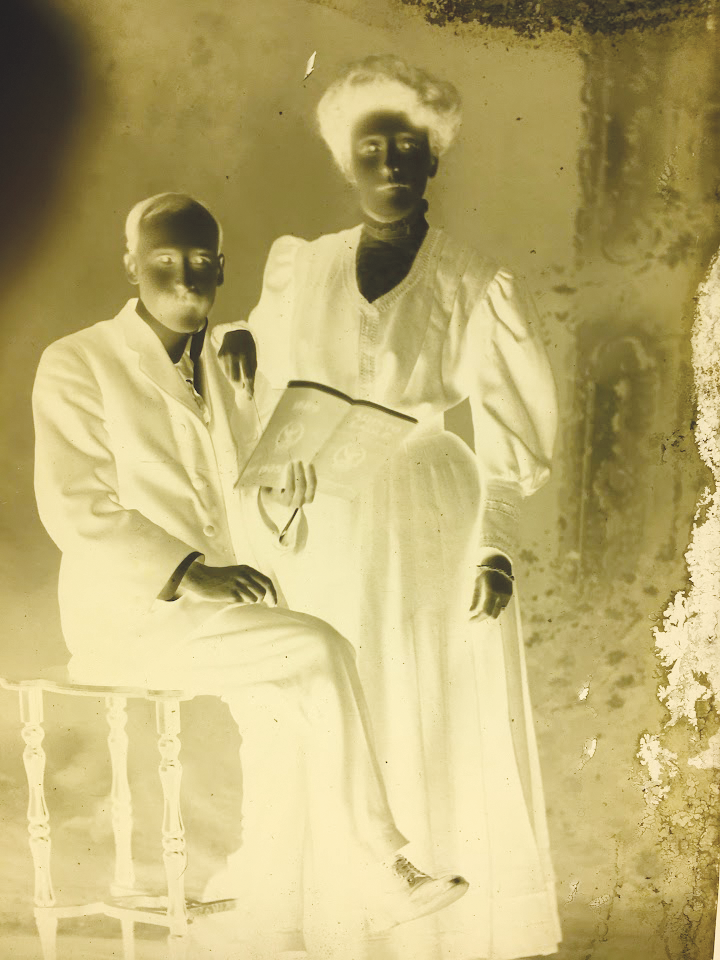
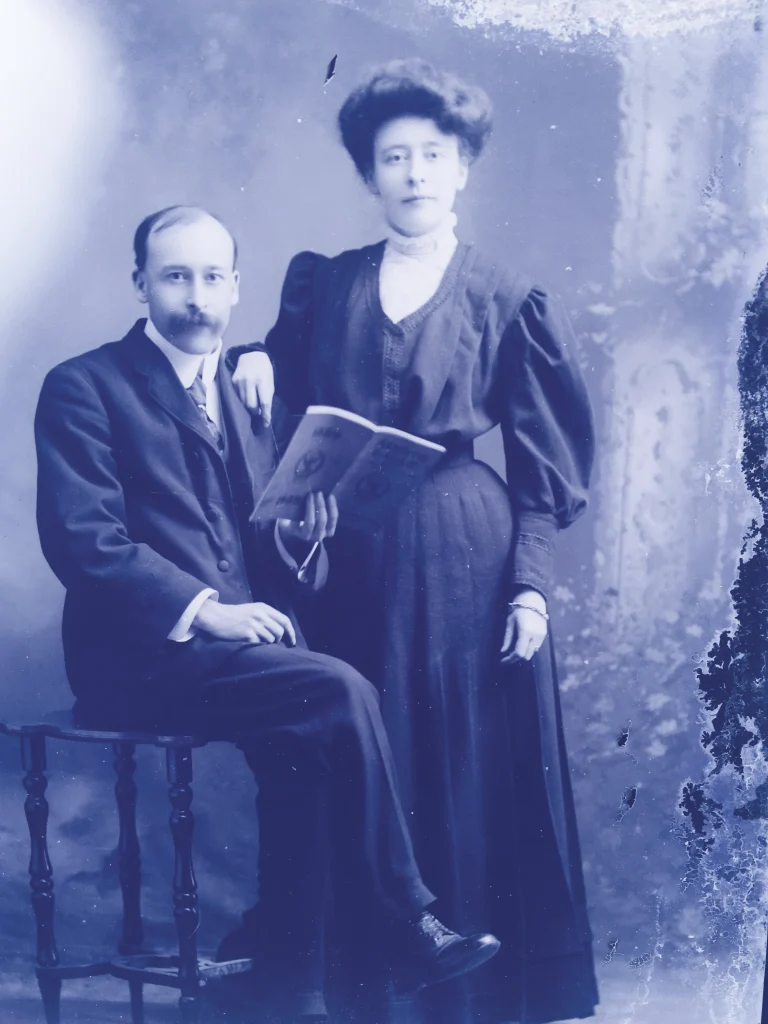
Wills placed each glass plate on the light table and snapped a photo with his phone, which he then uploaded to a website that can transform a photographic negative into a positive, to display the image as it was originally captured.
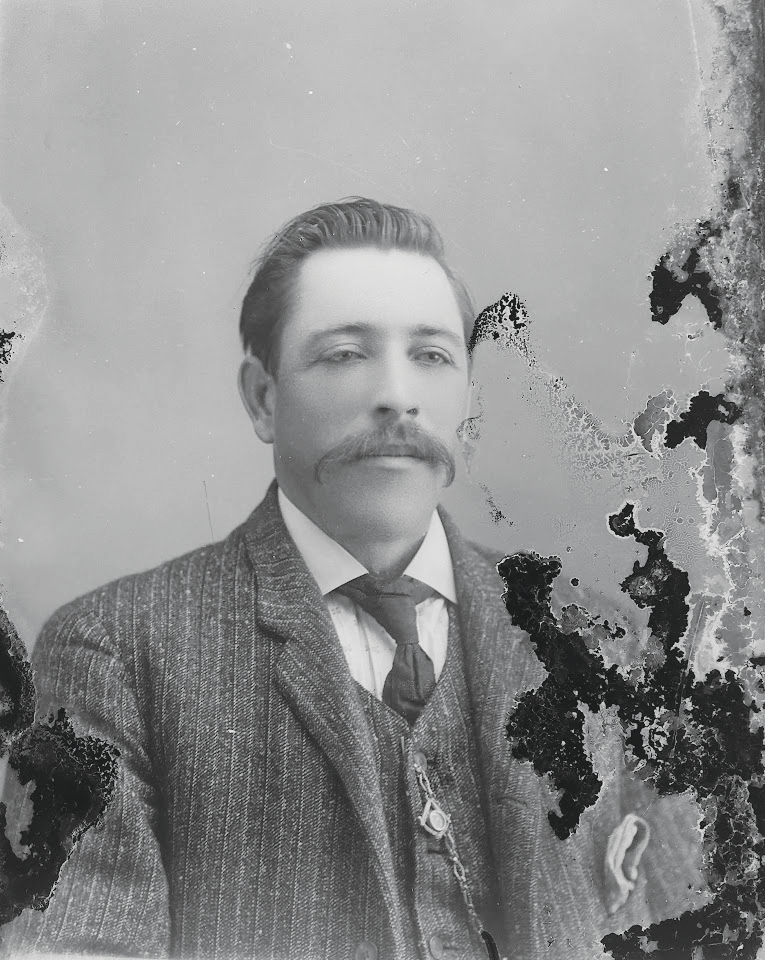
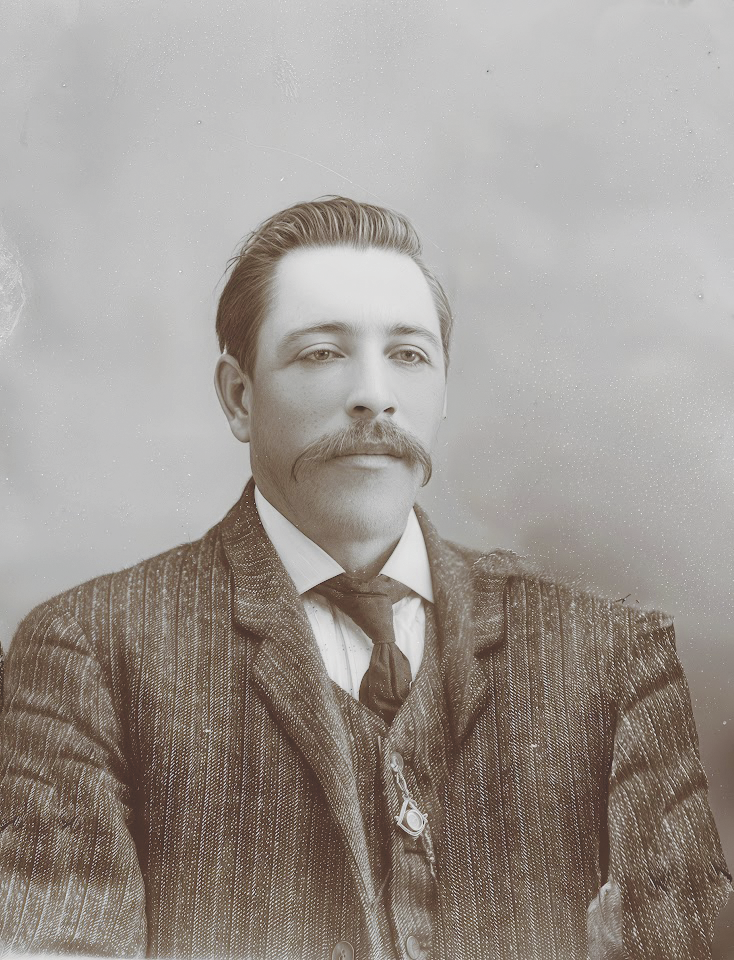
Once the images had been digitized, Seifried took the reins. The emulsion on many of the plates had eroded away over time, creating a sort of bubbling appearance around the edges that obscured parts of the images.
He used a computer program that allowed him to remove the bubbling effect and restore about 20 photos to something close to their former beauty.
In the case of one photo, depicting a suit-wearing man sitting in Imison’s studio, the emulsion had come off entirely, removing the man’s left arm from the photo.
“I copied his right arm and flipped it over, and I put it on the left arm,” Seifried said, referring to the digital restoration process he had undertaken. “I added some creases and I removed some creases, just to improve the aesthetics of the image.”
Lens into another era
The plates are from an era when photos were taken using large, box-shaped cameras.
When it was time to take the photo, the photographer would hit the shutter, exposing the light-sensitive emulsion on the glass plate and capturing a negative version of the image. The image would then have to be processed in a dark room, where it would be turned into a positive and final version of the image.
As Wills made his way through the collection of nearly 300 negatives, he began to recognize some trends.
Most of them were portrait photos, shot in Imison’s studio, which makes sense given the man’s vocation as a portrait photographer.
But a small number of the photos were taken on location, including one of Bryson before the fire of 1914 that engulfed most of the village.
This would have meant lugging a heavy camera from Shawville to Bryson, possibly by horse. But according to THE EQUITY’s archives, Imison was known to own one of Shawville’s first cars, so, depending on the date of the photo it is possible he might have driven.
Perhaps the most impressive photo from a technical perspective, Wills said, is a photo of eight men sitting, paired, in rowboats, with each boat containing two dogs.
“When you consider the slowness of the photographic process at that time, it’s a miracle he could get that, that he could calm the raging waters,” Wills said, adding that photos at that time needed long exposures, which is to say the subjects needed to sit still while the light fully impressed upon the plate’s emulsion.
He said the museum was so enthralled by the photograph they decided to make a t-shirt with the image emblazoned on the front.
Seifried said the discovery of the negatives was an astounding find for the museum’s collection.
“It was a miracle, because they were that close to being taken to the dump,” he said. “This is a collection that preserves the images of people who built our community.”
He said he was glad to have been able to touch up the photos and provide a better look into what Pontiac life was like all those years ago.
“You can take an old image that’s kind of beat up, it’s got a lot of scratches and dust and emulsion missing, and you can make it look like new.”
In his presentation on Wednesday, Wills displayed several of the touched-up portraits, the Bryson photo, and even wore the t-shirt the museum had printed of the boating men with their dogs.
He said he was happy to be able to offer a glimpse through the lens of Shawville’s most famous photographer.
“It’s life that was captured a hundred years ago,” he said. “These people have been sitting in an attic for 50 years, and now they’re springing back into the digital world.”
Most of the envelopes containing Imison’s negative plates are unidentified, and thus the names of people in them are unknown. But Wills said the society would like to change that, by crowdsourcing the public to help them find names.
“That’s the endgame here, is to have a gallery and invite people to identify.”
If you recognize any of the people in these photographs, please write to us at news@theequity.ca, or get in touch with the Pontiac Museum at (819) 647-2535.
Lorsque Robert Wills a ouvert une vieille boîte poussiéreuse à l’arrière du Musée de Pontiac il y a plusieurs années, il savait exactement ce qu’il regardait.
La boîte contenait environ 300 plaques de verre provenant de l’appareil photo du photographe Harry Imison, qui a possédé un studio photo à Shawville pendant plus de 40 ans.
M. Wills avait entendu des rumeurs selon lesquelles une telle cachette pourrait exister quelque part dans l’arrière-pays de Shawville, mais il n’avait pas réalisé qu’elle se trouvait au musée depuis sa donation.
Les plaques négatives en verre, précurseurs du film photographique, sont entrées en possession du musée lorsqu’elles ont été données par un homme chargé de démolir une vieille maison en ville. L’homme ne connaissait rien de l’origine des plaques — seulement qu’elles semblaient vieilles et valaient la peine d’être conservées.
De nombreuses photos d’Imison étaient disponibles depuis longtemps aux Archives de Pontiac et au musée, mais ces négatifs sur plaque de verre offraient une fenêtre inédite sur la vie à Shawville il y a plus d’un siècle.
Depuis cette découverte, M. Wills et d’autres bénévoles du musée ont passé des heures, principalement pendant les mois d’été, à déballer ces enveloppes, à trier les plaques et enfin à les transformer en photographies finies et numérisées.
Mercredi, lors d’une présentation aux Archives, M. Wills a présenté pour la première fois une sélection de ces nouvelles images au public.
De vieilles photos retrouvent une nouvelle vie grâce aux efforts des bénévoles
Après une inspection initiale, M. Wills et d’autres bénévoles ont trouvé les plaques récupérées dans divers états d’intégrité. Certaines étaient brisées. Certaines étaient maculées sur les bords.
Chris Seifried, trésorier de la Société historique de Pontiac, qui a travaillé aux Archives nationales du film en tant qu’archiviste de la photographie, a chargé les étudiants d’été du musée de l’époque de jeter les plaques brisées, de nettoyer celles qui étaient intactes avec une brosse douce et de les ranger dans des enveloppes.
« Elles étaient vieilles et n’étaient pas dans des conditions idéales », a-t-il dit des plaques. « Elles étaient soumises aux fluctuations de température, aux fluctuations d’humidité [et] à une manipulation négligente. »
L’été dernier, après que les plaques soient restées inutilisées pendant quelques années, les étudiants d’été du musée ont commencé à numériser la collection, en plaçant les négatifs sur une table lumineuse, en prenant une photo avec un téléphone et en téléchargeant les images sur une clé USB.
Cette clé s’est perdue en cours de route, mais M. Wills, déterminé à préserver ces images, a recommencé à zéro. Il a installé sa propre table lumineuse à la maison pour commencer à numériser les photos petit à petit.
M. Wills a placé chaque plaque de verre sur la table lumineuse et a pris une photo avec son téléphone, qu’il a ensuite téléchargée sur un site web capable de transformer un négatif photographique en positif, afin d’afficher l’image telle qu’elle avait été initialement capturée.
Une fois les images numérisées, M. Seifried a pris les rênes. L’émulsion sur de nombreuses plaques s’était érodée avec le temps, créant une sorte d’apparence bulleuse sur les bords qui masquait des parties des images.
Il a utilisé un programme informatique qui lui a permis de supprimer l’effet de bulles et de restaurer environ 20 photos pour les rapprocher de leur beauté d’antan.
Dans le cas d’une photo, représentant un homme en costume assis dans le studio d’Imison, l’émulsion s’était entièrement détachée, supprimant le bras gauche de l’homme de la photo.
« J’ai copié son bras droit et je l’ai inversé, puis je l’ai placé sur le bras gauche », a dit M. Seifried, faisant référence au processus de restauration numérique qu’il avait entrepris. « J’ai ajouté des plis et j’en ai enlevé d’autres, juste pour améliorer l’esthétique de l’image. »
Un objectif sur une autre époque
Les plaques datent d’une époque où les photos étaient prises à l’aide de grands appareils photo en forme de boîte.
Lorsque venait le moment de prendre la photo, le photographe actionnait l’obturateur, exposant l’émulsion photosensible sur la plaque de verre et capturant une version négative de l’image. L’image devait ensuite être traitée dans une chambre noire, où elle serait transformée en une version positive et finale de l’image.
Alors que M. Wills parcourait la collection de près de 300 négatifs, il a commencé à reconnaître certaines tendances.
La plupart étaient des portraits, pris dans le studio d’Imison, ce qui est logique étant donné la vocation de l’homme en tant que photographe portraitiste.
Mais un petit nombre de photos ont été prises sur place, dont une de Bryson avant l’incendie de 1914 qui a englouti la majeure partie du village.
Cela aurait signifié transporter un appareil photo lourd de Shawville à Bryson, peut-être à cheval. Mais selon les archives de THE EQUITY, Imison était connu pour posséder l’une des premières voitures de Shawville, donc, selon la date de la photo, il est possible qu’il ait conduit.
La photo la plus impressionnante d’un point de vue technique, a dit M. Wills, est une photo de huit hommes assis, par paires, dans des chaloupes, chaque chaloupe contenant deux chiens.
« Quand on considère la lenteur du processus photographique à cette époque, c’est un miracle qu’il ait pu l’obtenir, qu’il ait pu calmer les eaux déchaînées », a dit M. Wills, ajoutant que les photos à cette époque nécessitaient de longues expositions, c’est-à-dire que les sujets devaient rester immobiles pendant que la lumière s’imprégnait entièrement sur l’émulsion de la plaque.
Il a dit que le musée était tellement captivé par la photographie qu’ils ont décidé de créer un t-shirt avec l’image imprimée sur le devant.
M. Seifried a dit que la découverte des négatifs était une trouvaille stupéfiante pour la collection du musée.
« C’était un miracle, car elles étaient sur le point d’être jetées à la décharge », a-t-il dit. « C’est une collection qui préserve les images des personnes qui ont bâti notre communauté. »
Il a dit qu’il était heureux d’avoir pu retoucher les photos et d’offrir un meilleur aperçu de ce qu’était la vie à Pontiac il y a toutes ces années.
« Vous pouvez prendre une vieille image qui est un peu abîmée, avec beaucoup de rayures, de poussière et d’émulsion manquante, et vous pouvez la faire paraître comme neuve. »
Lors de sa présentation mercredi, M. Wills a exposé plusieurs des portraits retouchés, la photo de Bryson, et a même porté le t-shirt que le musée avait imprimé des hommes en bateau avec leurs chiens.
Il a dit qu’il était heureux de pouvoir offrir un aperçu à travers l’objectif du photographe le plus célèbre de Shawville.
« C’est la vie telle qu’elle a été capturée il y a cent ans », a-t-il dit. « Ces personnes sont restées dans un grenier pendant 50 ans, et maintenant elles reviennent dans le monde numérique. »
La plupart des enveloppes contenant les plaques négatives d’Imison sont non identifiées, et les noms des personnes qui y figurent sont donc inconnus. Mais M. Wills a dit que la société aimerait changer cela, en faisant appel au public pour les aider à trouver les noms.
« L’objectif final ici est d’avoir une galerie et d’inviter les gens à identifier. »
Si vous reconnaissez l’une des personnes sur ces photographies, veuillez nous écrire à news@theequity.ca, ou contacter le Musée de Pontiac au (819) 647-2535.