


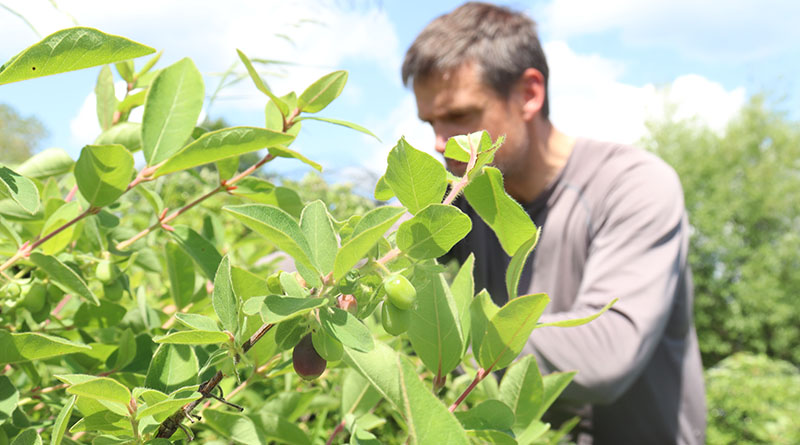



A super fruit mostly adapted to grow in colder climates found its way to the Pontiac out of sheer luck and an openness to adventure.
Embracing a new opportunity, a few years ago Glen Hartle agreed to photograph a friend’s sister’s wedding. In return rather than getting paid he asked his friend’s parents to set him up as a haskap farmer.
“Up until then, I never heard of haskaps in my life,” said Hartle.
For those who are unfamiliar with the fruit, it is a sweet but . . .
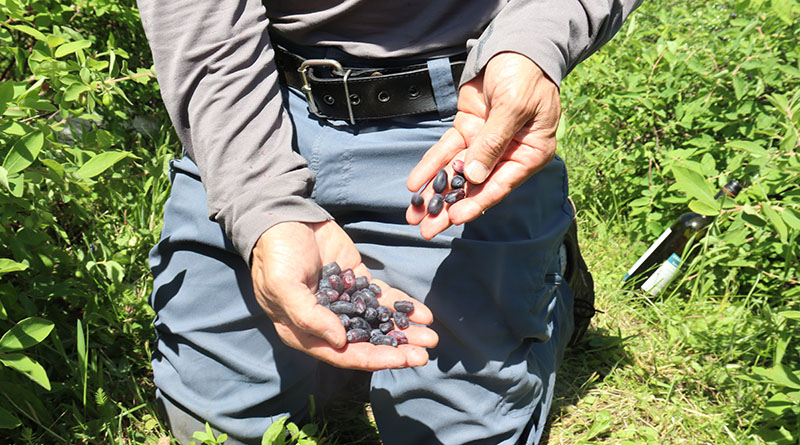
tangy antioxidant-rich, a cold-weather-loving berry native to northern boreal forests in Asia, Europe, and North America. It is mainly found in low-lying wet areas or high in mountains. The Japanese refer to the haskap as the “fruit of longevity.”
The different varieties of haskap have a fresh raspberry/blueberry flavour with a zing common only to haskap. The plant has few pests and is the first fruit crop to ripen each season (earlier than strawberries by a few weeks). The plant has no thorns, needs little pruning in the early years and tends to fruit when very young, according to the University of Saskatchewan.
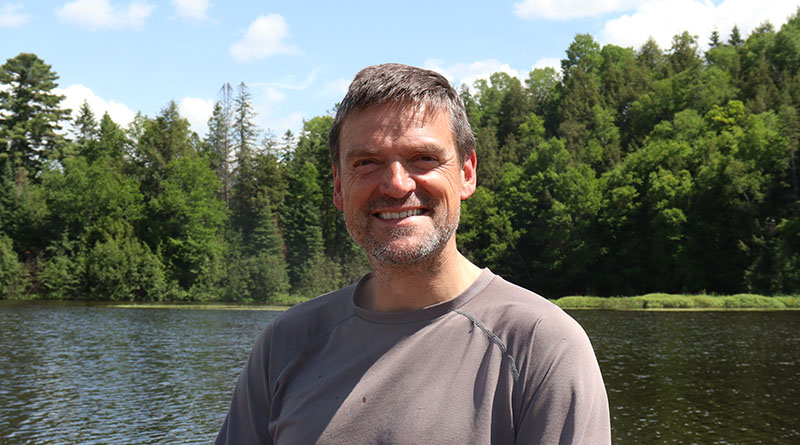
Hartle, a resident of the Pontiac, who many may know from working at the Cafe 349, at the farmers market or as a photographer, decided at the age of 45 to ditch the city life in 2015 and purchased his home by the lake where he grows his haskap bushes.
This year he will be celebrating his seventh year on his cottage farm property where he grows a host of fresh fruit and looks after his chickens, a llama and his two dogs.
When it came time to prepare for growing his haskaps, he had to send soil samples to the University of Guelph to help him improve his soil, which prompted him to put nutrients in the soil, add a watering system and on May 8, 2016, his friend’s parents came to his farm with 150 plugs and proceeded to plant them.
“For the first several years they looked like a carrot stick in the garden,” he said.
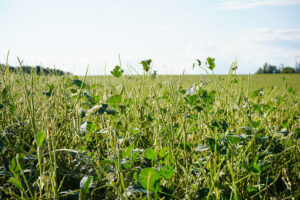
He currently has six varieties of haskaps. Each one tastes different, some have higher sugar content, and some are a little more tart. Once they’re mature the bushes will produce about ten pounds of berries per year. With 150 bushes, that’s plenty of berries Hartle explained.
Hartle used to own his own consulting company in Ottawa where he worked a 9 to 5 job. One day he was on Facebook and saw a property listing that piqued his interest. Hartle called, went the next day to see the property and bought it then and there, he said.
“I think it was just the idea that suddenly came out of nowhere and it just took root in me instantly. I don’t think it was an event in the city that convinced me that I had to do that,” said Hartle.
He pointed out that there wasn’t a moment or an instant that was the precursor to his move but rather he saw a once-in-a-lifetime opportunity and took it. He wasn’t necessarily gravitating to the Pontiac, but rather he discovered it afterwards. For him, he loved how the region is a short drive from Ottawa yet offers everything you need in a rural community.
“Well, this property is a diamond in the rough. Who would expect to find a farmhouse on a lake with geothermal heating at the end of a one-way road against a bush where there’s nobody else that lives there, you’re not gonna find that,” he said.
When he moved to the Pontiac he was looking to slow down from the city life he wanted to come to a place and be part of a community, he said. “So this is my adjustment to slowing down. I love having a smoothie every day it kind of helps keep me grounded as to why I’m here and it’s to enjoy life to experience the fruits of my labour perhaps,” said Hartle.
The novelty of it, and the notion that he had never heard of the berry, is what piqued his interest to jump into this venture he explained. It was also because many were not aware of it because it wasn’t commonly found in grocery stores.
“I’ve never been the conformist in my world. It’s never been my thing just to be another wallflower. I like the idea that I’m doing something that is abnormal. And that gives me a story that people can say, ‘hey are you that haskap guy,’” he said.
One of the reasons it wasn’t sold in many grocery stores is due to how difficult it is to produce on a large scale, he noted. On his farm, Hartle hand picks the berries during harvest season but added that he couldn’t possibly pick and sell the berries to make a living out of them as it is a lot of work.
Every year at the beginning of April he begins mowing the lawn every day to prevent weeds from snagging onto the bushes which could cost him his whole harvest, he pointed out. Because it’s a low bush he has to maintain the grass to be able to pick them as he’s mostly doing it moving around on his knees. Apart from watering it and weeding that’s as much maintenance as the plant needs.
One of the challenges that Hartle faced while growing them was once they were big enough to yield fruit after a few years from when he planted them, a species of birds called the cedar waxwings seemed to be fond of the berries and devoured an entire harvest in minutes. Since then he puts a net over his branches to protect them as much as he can.
Some of the things he enjoys making with the berries are smoothies and all sorts of baked goods. One thing he makes that gives the berry longevity is jam. He finds it is a great gift to give and a way to enjoy the berry off-season because a jar of jam if unopened, can last many years in the cupboard. Haskaps also freeze well.
Hartle never really became a haskap farmer to make a business out of it, he went into it as a lifestyle. With enough to harvest this year he started selling them at the farmers market at R & R farmers market.
“It took a while just to figure out the good and the bad I guess. But as far as turning off the city and turning on the country, you know, that was instant,” said Hartle.
Often times when people want to jump into new ventures they try to find good advice, but people can be discouraging, said Hartle. His advice to anyone thinking of starting something new is to take a chance on yourself because if he had listened to the words of caution he wouldn’t have moved, or grown haskaps.
“So my advice is, follow your dreams. Jump in, and see if you can swim. And if you run into hiccups, adjust,” said Hartle.
He added if you want to get into haskaps get a lot of bushes and cover them with nets or else you won’t have anything to harvest, he laughed.
by Zainab Al-Mehdar