





When some of my older friends (that are over 70) chat at the coffee shop and think back about the big changes that we have had the pleasure to witness in our lifetime, there are some very big changes.
We can remember when most farmers worked with and drove horses both in the fields and to go to town.
My grandpa often mentioned that when the first automobiles passed our farm all the passengers had to get out and . . .
push it up the little hill. Grandpa said that about five minutes later, he could hear them coming back down the little hill, cheering and shouting with glee as the open top car sped down the little hill going about 20 miles per hour. The first cars sold in Shawville were sold out of the grocery and dry goods store by F.G. Hodgins. He also sold gas in five gallon cans because there were no gas stations in town.
All the old-timers started their education in one room schools that usually had a recently graduated school girl as a teacher and the older children helping to teach the younger ones. Then they mention the doctors, lawyers, politicians and community leaders who started their learning in those one room schools.
Then they mention that even in Shawville, the streets were never snowplowed in winter but someone rolled the snow down smooth and hard with a very big and heavy roller that was pulled by a team of heavy, strong horses. The first snow plow in town was a wooden plow mounted on the front of Schwartz’s gas truck.
The first street lights in town were powered by a gas powered generator that was in a little building beside the fire hall. Someone had to arrive at dusk and start the little gas driven generator to light up the town. About midnight, the same person would come back to the generator and darken down the town. The coffee drinkers also spoke about people upsetting their sleigh in winter and dumping the passengers out in the snow.
Sometimes if a man spent too long in the hotel celebrating someone would whitewash his black horse that was quietly waiting in the drive shed beside the hotel. When he finally decided to go home and walked to the drive shed to get the horse he would return to the hotel and exclaim that someone had stolen his beautiful black driver horse.
The guys all remember standing on the sidewalk in front of Emerson Cotie’s store, watching the first TV in town through the window. It was just in 1966, that the first computer came to McGill University and it filled an air conditioned room that was as big as an arena. Today the smartphone in your pocket has more computing power than that arena full of computer did in 1966. We have watched a GPS app on that smart phone replace that big awkward old paper road map. Remember when the glove box was full of those road maps?
We have watched car radios arrive. We watched 78s being replaced by 45s, then eight tracks get replaced by cassettes; then CDs change in size twice and now a memory stick can hold hundreds of songs. We have watched news reports come live from a helicopter. Now a little drone with a camera attached can hover over a news event without anyone aboard. Drones can also be used to scout farmers fields for weeds, wet spots, crop color and development, and now even spraying and aerial seeding.
We are still skeptical of autonomous cars, trucks, tractors and other machinery but they are here and will become more reliable. Now we are witnessing the beginning of electric cars, trucks, tractors and airplanes.

Many are still skeptical that electric may someday replace gas and diesel. My grandfather also thought that automobiles were also a “fad” and said “Don’t sell your horse.”
This COVID-19 pandemic has forced us to switch many jobs, meetings and entertainment from face to face to virtual. We have learned that if technology is properly used our productivity and efficiency can increase.
We have learned that although most people can adapt to this new way of living, there are some who have to have personal interaction or someone looking over their shoulder.
I remember when Maggie Muggins used to end her show by saying “I don’t know what will happen tomorrow, but it will be fun to watch.”
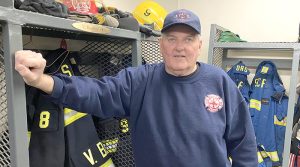
Chris Judd is a farmer in Clarendon on land that has been in his family for generations.
gladcrest@gmail.com