





CALEB NICKERSON
MRC PONTIAC Oct. 28, 2020
At the MRC Pontiac Council of Mayors meeting on Oct. 21, Environmental Coordinator Kari Richardson gave a report on the county’s greenhouse gas emissions.
The MRC had contracted a firm to provide an inventory of greenhouse gas (GHG) emissions for the year 2011, and Richardson’s project was to . . .
follow up with the data from 2017. She said that she had started seeking documentation from the municipalities last
“It’s tricky right? A lot of municipalities [I’m] trying to get data from, and all the hydro bills, all their gas bills, all their fuel bills, it was lengthy,” she said in an interview after the meeting. “A lot of municipalities went to their office to sit down and get the information, some municipalities showed up with the three inch stack of bills for me.”
Richardson’s assessment covered anything that emitted GHG, from arenas to water treatment facilities to municipal vehicles. When it comes to garbage collection, not only is door to door service taken into account, but also the emissions from transporting regional waste to the landfill in Lachute.
While the study assessed municipality’s emissions, her report indicates that the following areas were not included in the inventory: residential sector, institutional and commercial sector, industrial sector, agricultural sector and the solvents and other products sector.
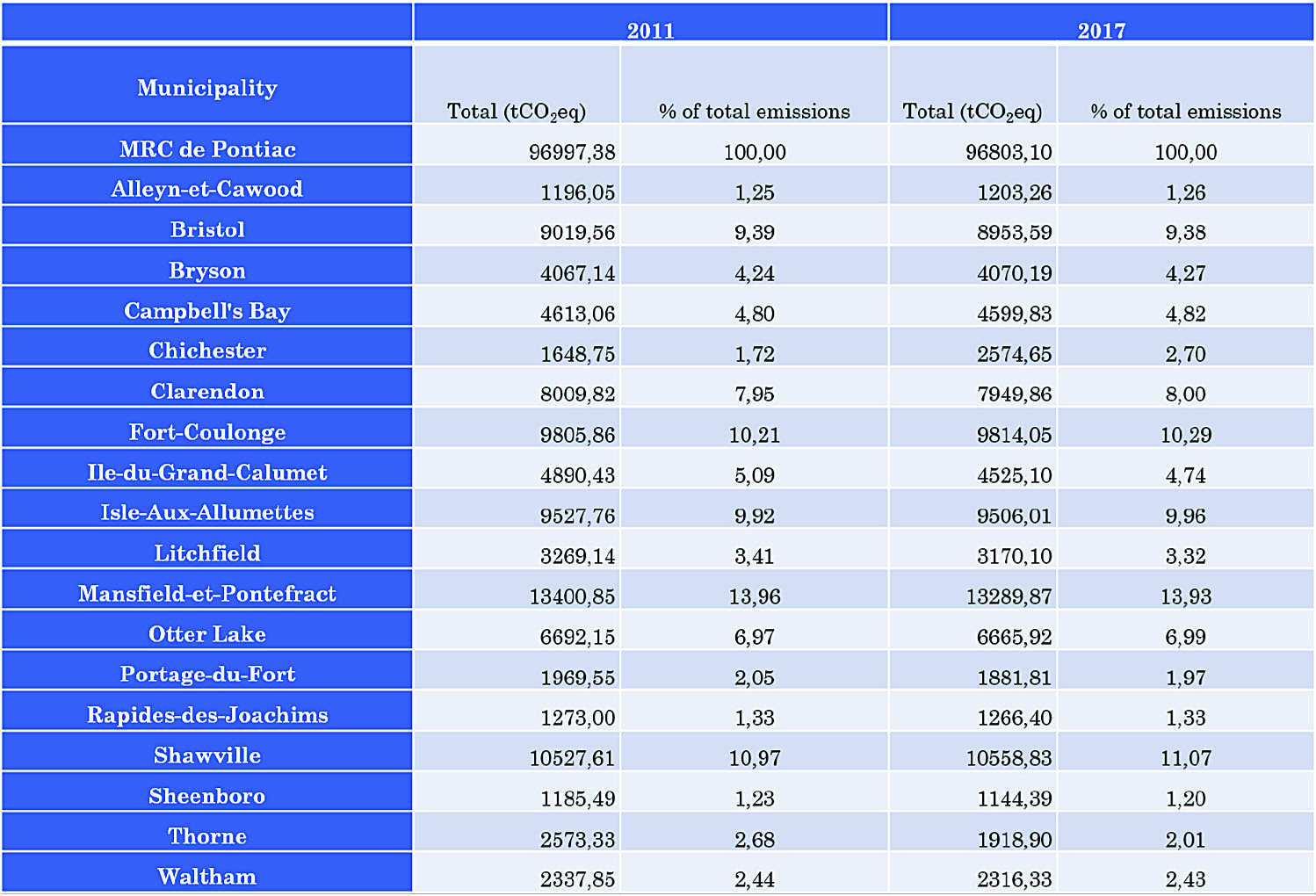
Since not all greenhouse gasses are the same, the results were broken down into equivalent CO2 emissions.
The latest inventory showed that there was not much difference from the assessment in 2011, at least from the municipal side of things. The largest communities in the region, Shawville, Mansfield et Pontefract and L’Isle aux Allumettes, made up the largest proportions of emissions (11.1, 14 and 10 per cent respectively).
The full report offers a breakdown by the cause of emissions, and Richardson pointed out that transportation is by and large the largest contributor.
“Whether it’s their municipal public works or whether it’s their garbage transportation, some kind of transportation is the main cause of emissions in the reports,” Richardson said. “Most of the municipalities haven’t changed since the last inventory. It’s within half a per cent.”
The second part of the project is for Richardson to offer suggestions on how the municipalities could curb their emissions, through a change in actions or the use of different equipment.
Richardson said that she was aiming to present an action plan at the next council meeting on Nov. 25.
“For the next meeting, I hope to have the draft revision of the action plan because back in 2012, there was also an action plan adopted, [where] they did have goals and emission targets,” she said.