





Ours is the first period in human civilization where virtual entertainment has eclipsed the real world. There are so many different platforms and services offering an immersive online experience, to take people out of the real world and create an illusion that is indistinguishable from the real thing.
But not all of the stimuli of the online world are generated by 1s and 0s zipping around in a microprocessor. After all, you need a controller or a set of special goggles to interact with these electronic worlds in the first place
And not all of VR’s applications are trivial entertainment, private and public organizations are looking at the technology as a safe and efficient way to enhance their training regimens.
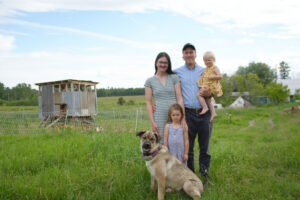
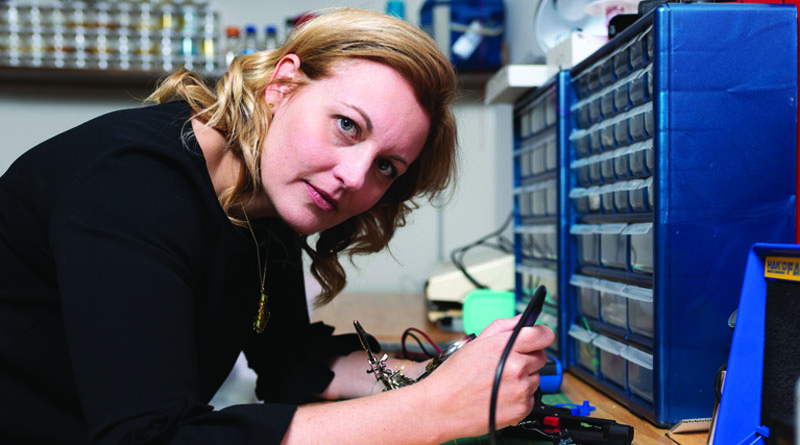
That niche is the realm of Megan Smith, a Shawville native and associate professor of creative technologies at the University of Regina, who is currently working with the RCMP to develop the hardware for their virtual reality training program.
She has been teaching at the university for several years, but her path to the Prairies has been a circuitous one.
After graduating from York University in Toronto, Smith jetted across the Atlantic to obtain her MA and PhD in the UK, at Southhampton and Leeds Metropolitan Universities respectively.
She returned to Shawville for a short time before finding the position in Regina. She said that her early days in the area were a critical influence on her career choice.
“I was definitely inspired growing up in the Pontiac by all the artists in the community,” she said. “Definitely the Pontiac Artists Association helped me. As I went through high school and university they were a great help to me and a help in making me understand what professional artists do.”
She said that technology has always been a part of her creative process.
“Somewhere along the line, I guess in university, that was when digital cameras started to come out and I became inspired by the digital world as well as the internet and combining creative practice or being an artist with digital tools and the internet,” she explained. “I’ve been working for a number of years in an area called physical computing, which is using micro controllers to activate and build projects and sculptures and installations.”
One of her previous projects at the University of Regina involved her pedalling a stationary bike across a virtual Canada, using Google Street View. She noted that she actually passed through Shawville on her route.

“That had a bit of media attention,” she said. “One meeting I was at, at the university, I met the director of innovation and training at the RCMP and … we got into a really good conversation about different methods for learning at the RCMP. The training depot is based here in Regina so all the cadets come to Regina to train here.”
From there she began a series of contract jobs with Mounties, working through the Collaborative Centre for Justice and Safety, a research institution at the university.
“They have incredible simulators here at the RCMP depot,” she said. “I went and looked at all of these and eventually over time the RCMP came back to me and said, ‘We’re curious about looking into virtual reality research, we need a creative individual on our team to help us understand the technology and see what we can do with it in terms of innovating our training.’ That led to two and a half years working together, collaborating on designing new tools for the RCMP training centre.”
Smith said that a part of her job is keeping up with the latest trends in the industry. She said her goal is to create a cheap, effective system solely for law enforcement, not your average consumer product.
“The commercial industry is leading the whole industry in terms of both hardware and software and content,” she said. “That’s great for the commercial industry and the entertainment industry. It’s not so good if … very serious training centres, like paramilitary and military, need to rely on the commercial industry for our tools. The commercial industry, they have a different purpose.”
“The technology moves so swiftly I just need to keep researching and seeing the route that VR is going to take before I go full out to build these [prototypes] into a product,” she added.
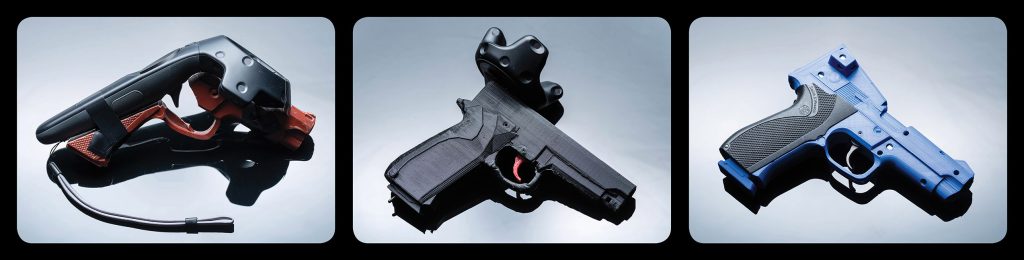
Smith works designing and building the hardware used in the VR simulator, and is currently refining a prototype service pistol and Conducted Energy Weapon (CEW), commonly known as a Taser. She said they take great pains to make sure the weapons are as close to the real thing as possible, like adding real grips and the same trigger as their standard issue Smith and Wesson.
“VR is very immersive but putting a plastic object in their hand that just kind of feels like a pistol, like a toy pistol, that can break presence,” she said. “Those small details keep people immersed in the situation.”

She said that the CEW was presenting her and her partners with some challenges, since the coils and barbs it shoots act differently than bullets from a firearm.
“Emulating the physics of that is something we’re working on to solve,” she said. “There’s lots of interesting challenges.”
Next up will be transferring her electronics to the C8 Carbine, as well as developing a baton and OC spray controllers, Smith said. She added that they would also be looking at improving the immersiveness of the simulator by adding in environmental factors such as smell and wind.
“It’s not just the hardware that needs to be added to the VR environment, it’s the sensory immersion experience as a whole, so when you’re in VR what kind of physical cues help our cadets learn better,” she said.
She said that she takes pride in the public service aspect of her job, putting her skills to use for the greater good.
“I like that I’m able to be creative in my job and I love that I’m able to effect positive change,” she said. “Everything I’ve acquired along the way is actually going towards something that has benefit to Canadian society. That’s probably one of the most rewarding things about my job.”