





Have you ever been lost in the woods while hunting? Have you been a farmer going through a severe drought, like we had in 2012 or 1964, financially distressed enough to walk down the road kicking stones and wondering if you could ever provide for your family. Or sick enough to wonder if you might live or die? If you have, you realize that when things are really tough, your priorities change a lot.
So far in life, I have never been lost in the woods. In 2012, I had the opportunity to work with some very dedicated people to help bring some hay that was donated by our western friends into our area during the drought.
I witnessed farmers thinning or completely dispersing their herds because feed was either not available at all or so costly that it would cost more to feed an animal than the animal would be worth the following spring.
Some farmers even threw in the towel and quit farming. Established farmers might have went farther in debt to buy feed to survive the drought but younger farmers who had just started had very few options. The group I worked with were very concerned about the future of the young farmers who would be the future of farming in our area.
Every day this time of the year we get phone calls, letters, emails or are confronted with TV ads encouraging you to send them money. We know that there are millions of people in the world who are living in a drought stricken country. There are refugees trying to flee famine or oppression from someone. Maybe they are an orphan with no living parent or relative. In countries where the majority of the world’s population live, the farms are very, very small. More than half of the people in the world, who are hungry, are farmers.
Thirty-five years ago, a few farmer members of a church in western Canada visited one of these countries in Africa that was experiencing a drought that had gone on for several years. When these farmers returned home they organized the planting of a little field of grain in western Canada. That fall, everyone pitched in to harvest and bag the grain and ship it off to help feed a few people in this starving country.
Thirty-five years later this Canadian Food Grains Bank (CFGB) has grown to include 30 different denominations, 17,000 churches and parishes, over 1,000 businesses, and thousands of Canadians who support the project. Last year 16,000 acres were planted for grain to be donated to the Canadian Food Grain Bank.
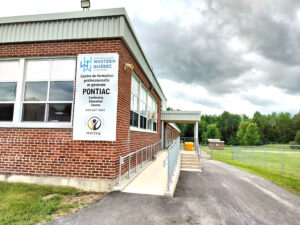
The only field in Quebec to be planted and harvested in 2018 was in Pontiac County by a small dedicated group of farmers spearheaded by Ralph Lang.
A lot has changed in the way the CFGB helps these countries with thousands of starving people. In some of these countries; the integrity of their government is questionable and not all the grain donated and shipped got delivered to the starving people.
If the grain was turned into dollars and the dollars sent, not all the dollars got to the needy either. In some of these countries with an unstable government a lot of money and food is required to maintain their armies.
In cases of flash rains, it can be necessary but sometimes not very expensive, to divert small streams into holding areas where water can be used later to add to drought — stricken fields. Often a small stream can be cheaply and easily diverted with readily available stones.
The alternative would be the small stream turning into a river and washing topsoil with the water into the ocean as it flooded fields, houses and even small towns with it. Sometimes a simple soil test can help a farmer grow twice as much on his field and hence the people in his town will not starve.
Often sending a Canadian farmer to visit foreign farms can give what seems like a common sense solution to deliver a life saving increase in yield in a field near a small starving town.
It is not just the money or food aid collected that will help avert famine. It is important that the dollars, food aid, and help get to those who need it.
Some humanitarian agencies seem to get nearly all of their donations delivered effectively to those who need it most while some agencies seem to need a lot of money for administration.
There are millions of starving people who desperately need help. Please check out the group that you might donate to before trusting them to get your donation to those who really need it!
We must encourage more farmers to help start a Canada Food Grain Bank project in their community. There are millions in our world who are now in survival mode. Let’s all get our priorities straight.
Chris Judd is a farmer in Clarendon on land that has been in his family for generations. gladcrest@gmail.com