





CALEB NICKERSON
GATINEAU July 13, 2018
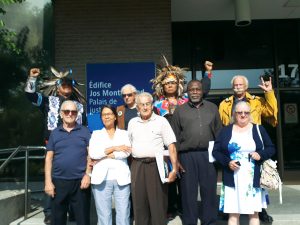
On July 13, charges against six Indigenous activists, including Fort Coulonge resident and provincial Green Party candidate Roger Fleury, were dropped by the City of Gatineau.
The charges stemmed from a protest back in 2014, where the group sought to protect an Aboriginal archaeological site in Gatineau that was slated for development.
The City of Gatineau, along with the National Capital Commission (NCC), had planned for a $43 million waterfront development project along rue Jacques Cartier.
In the spring of 2014, an archaeological contractor began a dig at the intersection of Jacques Cartier and rue Saint Antoine, uncovering a large collection of ancient arrowheads, knives and other tools, dating back at least 3,000 years.
After the group completed the dig in July of that year, their report to the city claimed that nothing on the site could be declared sacred, a claim that Fleury disputes. He also claims that since the site is located at the intersection of two major rivers like Gatineau and Ottawa, the artifacts found there are likely to be far older than the archeologists estimate.
He and several other activists started occupying the site on Aug. 7, 2014, sleeping in teepees and keeping a sacred fire burning 24 hours a day.
After a 44-day standoff, the city won an injunction to evict the protestors in mid-September, arresting six and charging them with mischief. After a brief appearance before a judge on July 13, 2018, all charges against the protestors were dropped.
Fleury said that even though the city’s case was dropped, much of the damage has already been done.
“We’re going to take further action … but they can wield the courts so easily,” he said, noting that the site has already been covered up and currently looks like any other street corner. “They can come in for four years and say anything, put the entire state against you and then walk away. That’s what the sad part is.”
He added that the criminal charges meant that his movements were restricted and he was hassled by police and at the border.
“It was as if I was a drug dealer or something,” he said.
It is Fleury’s hope that local Indigenous elders be consulted when such sites are uncovered, and that they also have a say in what becomes of the artifacts that are uncovered.
“They’re going to take all the native artifacts and so forth and put them in [a museum]. But it’s not up to them to decide,” he said. “I don’t know the sacredness of all this. What we want to do is bring in the elders to tell us the significance of this [site]. They blew it away needlessly and knowingly.”