The third legal challenge to the giant Ottawa River radioactive waste dump, the “NSDF”, will be heard in Federal Court, on Feb. 5 and 6 in Ottawa. Two previous challenges were heard in July and Nov. of 2024 and decisions are pending on those.
The current legal challenge was launched by Kebaowek First Nation, Concerned Citizens of Renfrew County and Area, the Canadian Coalition for Nuclear Responsibility and the Sierra Club Canada Foundation. The applicants say Environment and Climate Change Canada (ECCC) erred when granting a Species at Risk Permit to destroy endangered species and their residences during construction of the NSDF.
This case shines a spotlight on the location for the giant radioactive waste dump beside the Ottawa River in unceded Algonquin territory, 180 km north-west of Ottawa on the Chalk River Laboratories property. The location is the prime concern of many who oppose the dump, including ten Algonquin First Nations, the Assembly of First Nations and more than 140 municipalities downstream who take their drinking water out of the Ottawa River, which is less than one kilometer from the dumpsite. The dump is expected to leak during operation and break down due to erosion after a few hundred years.
The location of the NSDF is also smack dab in the middle of irreplaceable wildlife habitat that is home to many species at risk. As a restricted area for 80 years, there has been very little human movement through most of the 3,700-hectare CRL property. Some forests have acquired old growth characteristics from lack of disturbance. The property is dotted with lakes and wetlands that, combined with proximity to the Ottawa River, provide habitats and feeding grounds for many species at risk and large mammals. A Biodiversity review for the NSDF project notes that 50 species at risk have the potential to be present on the CRL site and 26 have been confirmed to be present.
The NSDF site is even richer in biodiversity than the Chalk River Laboratories site as a whole. It is located on a densely forested hillside that rises 260 feet above five named wetlands at its base. The wetlands drain through Perch Creek and Perch Lake into the Ottawa River. The forest stands have old growth characteristics and provide prime habitat for endangered bats and songbirds. The concentration of suitable bat roost trees on the NSDF site is greater than anywhere else on the CRL property. The adjacent wetlands and water bodies offer abundant food for songbirds, bats and many other species.
Endangered species that make their homes in NSDF forest stands and associated wetlands include the iconic Canada Warbler and the rare Golden-winged Warbler as well as three species of bats, and Blanding’s Turtles. Ground truthing in the NSDF footprint by Kebaowek First Nation found three active bear dens, which are protected by provincial legislation, and evidence of extensive use of the site by threatened Eastern Wolves. Both bears and wolves are species of great cultural importance to Algonquin peoples.
To create a flat surface area for the NSDF, clear cutting and extensive blasting would convert 28 hectares of forested hillside into 170,000 cubic metres of rock, with unknown but likely adverse effects on the surrounding wetlands. More than 10,000 mature trees would be cut down, including provincially-endangered Black Ash trees, observed on the site by Kebaowek First Nation.
According to Canada’s Species at Risk Act, it is illegal to harm or destroy the residences of threatened or endangered species without a permit. Permits are supposed to only be granted if the project proponent has carefully considered all possible alternatives and chosen the option with the least impact on endangered species.
The applicants for judicial review say there is no evidence the location was chosen to minimize impact on species at risk. They present evidence that the dump proponent, Canadian Nuclear Laboratories, owned by a multinational consortium of SNC-Lavalin and two US-based engineering firms, chose the location for convenience and proximity to existing waste management areas on the CRL property, and failed to consider other federal lands further from the Ottawa River and less rich in biodiversity.
Canada’s Species At Risk Act is supposed to protect endangered species, in recognition of the fact that when species go extinct, the web of life on which we all depend is degraded. If the legal challenge is successful, the Minister of ECCC will have another chance to set a good example and protect endangered species and irreplaceable wildlife habitat at Chalk River Laboratories.
Lynn Jones is a founding member of the Ottawa River Institute, a non-profit, charitable organization based in the Ottawa Valley. ORI’s mission is to foster sustainable communities and ecological integrity in the Ottawa River watershed.

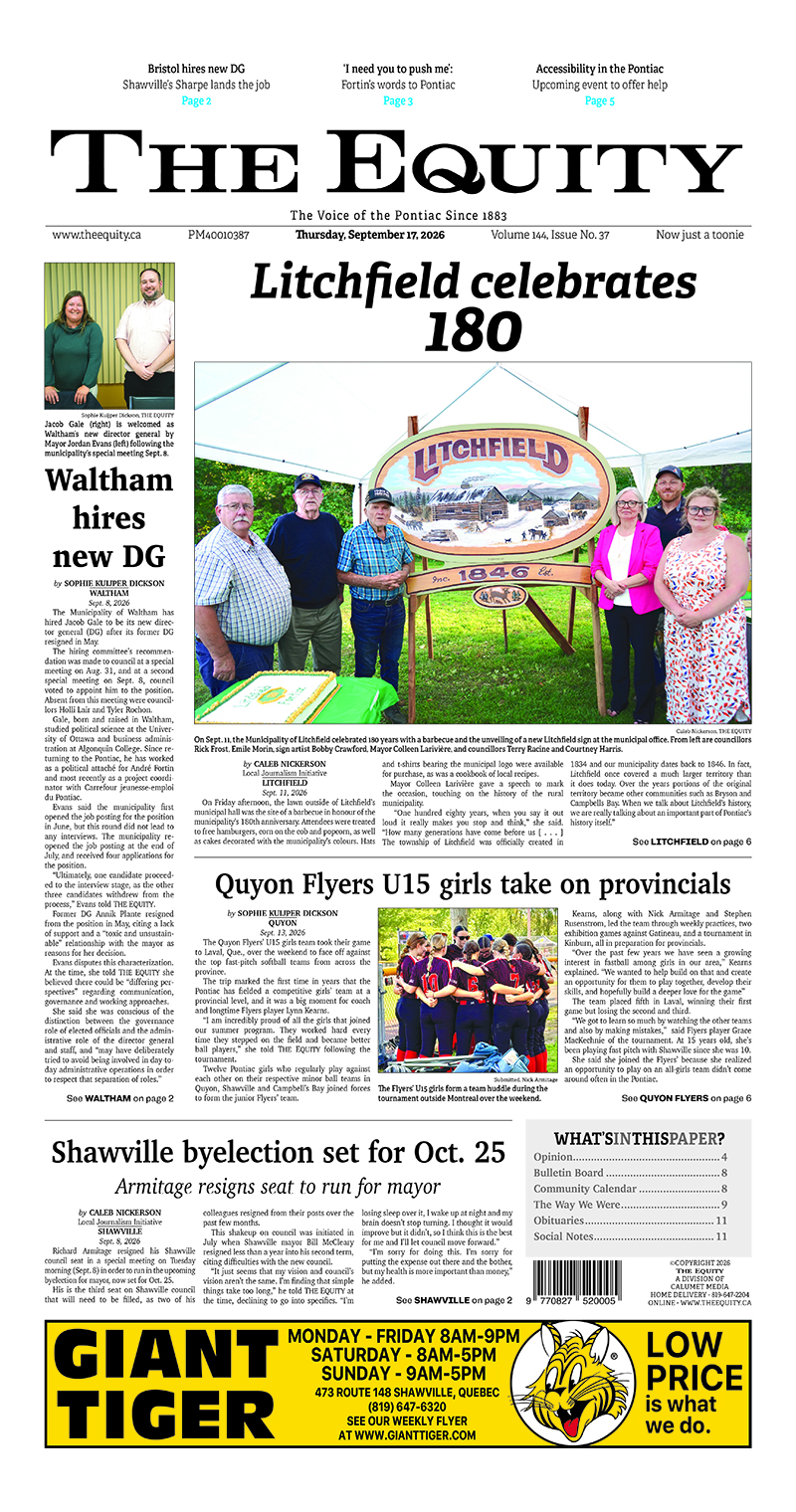




Third legal challenge to Ottawa River radioactive waste dump
Third legal challenge to Ottawa River radioactive waste dump
Quebec court orders Élections Québec to send bilingual voter reminder cards
Women’s Institute celebrates Winnie-the-Pooh’s 100th
Upcoming Connexions event aims to make the Pontiac more accessible
Quyon Flyers U15 girls take on provincials
Alleyn-et-Cawood council: Resolution passed decrying long bus times, agreement reached with shares
Waltham hires new DG
Fortin holds Shawville campaign event: ‘I need you guys to push me’
Otter Lake installs four little free libraries
Community Day brings fireworks to Quyon
Litchfield celebrates 180
Sharpe appointed as Bristol DG
Shawville byelection set for Oct. 25, Armitage resigns council seat to run for mayor
The third legal challenge to the giant Ottawa River radioactive waste dump, the “NSDF”, will be heard in Federal Court, on Feb. 5 and 6 in Ottawa. Two previous challenges were heard in July and Nov. of 2024 and decisions are pending on those.
The current legal challenge was launched by Kebaowek First Nation, Concerned Citizens of Renfrew County and Area, the Canadian Coalition for Nuclear Responsibility and the Sierra Club Canada Foundation. The applicants say Environment and Climate Change Canada (ECCC) erred when granting a Species at Risk Permit to destroy endangered species and their residences during construction of the NSDF.
This case shines a spotlight on the location for the giant radioactive waste dump beside the Ottawa River in unceded Algonquin territory, 180 km north-west of Ottawa on the Chalk River Laboratories property. The location is the prime concern of many who oppose the dump, including ten Algonquin First Nations, the Assembly of First Nations and more than 140 municipalities downstream who take their drinking water out of the Ottawa River, which is less than one kilometer from the dumpsite. The dump is expected to leak during operation and break down due to erosion after a few hundred years.
The location of the NSDF is also smack dab in the middle of irreplaceable wildlife habitat that is home to many species at risk. As a restricted area for 80 years, there has been very little human movement through most of the 3,700-hectare CRL property. Some forests have acquired old growth characteristics from lack of disturbance. The property is dotted with lakes and wetlands that, combined with proximity to the Ottawa River, provide habitats and feeding grounds for many species at risk and large mammals. A Biodiversity review for the NSDF project notes that 50 species at risk have the potential to be present on the CRL site and 26 have been confirmed to be present.
The NSDF site is even richer in biodiversity than the Chalk River Laboratories site as a whole. It is located on a densely forested hillside that rises 260 feet above five named wetlands at its base. The wetlands drain through Perch Creek and Perch Lake into the Ottawa River. The forest stands have old growth characteristics and provide prime habitat for endangered bats and songbirds. The concentration of suitable bat roost trees on the NSDF site is greater than anywhere else on the CRL property. The adjacent wetlands and water bodies offer abundant food for songbirds, bats and many other species.
Endangered species that make their homes in NSDF forest stands and associated wetlands include the iconic Canada Warbler and the rare Golden-winged Warbler as well as three species of bats, and Blanding’s Turtles. Ground truthing in the NSDF footprint by Kebaowek First Nation found three active bear dens, which are protected by provincial legislation, and evidence of extensive use of the site by threatened Eastern Wolves. Both bears and wolves are species of great cultural importance to Algonquin peoples.
To create a flat surface area for the NSDF, clear cutting and extensive blasting would convert 28 hectares of forested hillside into 170,000 cubic metres of rock, with unknown but likely adverse effects on the surrounding wetlands. More than 10,000 mature trees would be cut down, including provincially-endangered Black Ash trees, observed on the site by Kebaowek First Nation.
According to Canada’s Species at Risk Act, it is illegal to harm or destroy the residences of threatened or endangered species without a permit. Permits are supposed to only be granted if the project proponent has carefully considered all possible alternatives and chosen the option with the least impact on endangered species.
The applicants for judicial review say there is no evidence the location was chosen to minimize impact on species at risk. They present evidence that the dump proponent, Canadian Nuclear Laboratories, owned by a multinational consortium of SNC-Lavalin and two US-based engineering firms, chose the location for convenience and proximity to existing waste management areas on the CRL property, and failed to consider other federal lands further from the Ottawa River and less rich in biodiversity.
Canada’s Species At Risk Act is supposed to protect endangered species, in recognition of the fact that when species go extinct, the web of life on which we all depend is degraded. If the legal challenge is successful, the Minister of ECCC will have another chance to set a good example and protect endangered species and irreplaceable wildlife habitat at Chalk River Laboratories.
Lynn Jones is a founding member of the Ottawa River Institute, a non-profit, charitable organization based in the Ottawa Valley. ORI’s mission is to foster sustainable communities and ecological integrity in the Ottawa River watershed.
More Local News
Quebec court orders Élections Québec to send bilingual voter reminder cards
Women’s Institute celebrates Winnie-the-Pooh’s 100th
Upcoming Connexions event aims to make the Pontiac more accessible
Quyon Flyers U15 girls take on provincials
Alleyn-et-Cawood council: Resolution passed decrying long bus times, agreement reached with shares
Waltham hires new DG
Fortin holds Shawville campaign event: ‘I need you guys to push me’
Otter Lake installs four little free libraries
Community Day brings fireworks to Quyon
Litchfield celebrates 180
Sharpe appointed as Bristol DG
Shawville byelection set for Oct. 25, Armitage resigns council seat to run for mayor
Quebec court orders Élections Québec to send bilingual voter reminder cards
Women’s Institute celebrates Winnie-the-Pooh’s 100th
Upcoming Connexions event aims to make the Pontiac more accessible
Quyon Flyers U15 girls take on provincials
Alleyn-et-Cawood council: Resolution passed decrying long bus times, agreement reached with shares
Waltham hires new DG
Fortin holds Shawville campaign event: ‘I need you guys to push me’
Otter Lake installs four little free libraries
Community Day brings fireworks to Quyon
Litchfield celebrates 180
Sharpe appointed as Bristol DG
Shawville byelection set for Oct. 25, Armitage resigns council seat to run for mayor
Third legal challenge to Ottawa River radioactive waste dump