






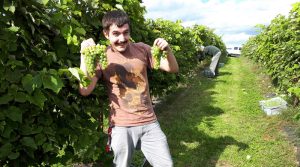
I had responded to an open call for hands to pick grapes at the Little Red Wagon Winery in Clarendon, and I had no idea what to expect as I puttered down chemin du Calumet Ouest.
I’d done some basic research at the office while sipping my morning coffee, but that’s kind of like taking a theoretical Phys. Ed. class. Some things you have to experience first-hand.
According to Wikiped – er, the host of reputable wine sites I read, I would be taking part in what the French call a ‘vendange’, one of the most crucial steps in the winemaking process. Apparently, this harvest is traditionally a community event, bringing out friends and neighbours to throw out their backs and blow out their knees, together.
As I pulled up on the edge of the vines, I recalled my shameful coverage of last year’s harvest, where I traipsed around with my camera, chewed the fat for a time with owners Scott Judd and Jennifer Dale and ducked out before anyone could put a pair of shears in my hand. I was determined to get the full experience this time, in spite of my aversion to manual labour and the sun.
As luck would have it, the sky was littered with clouds, but there was enough residual heat from summer to be comfortable in short sleeves.
I was a little surprised when I asked Jenn if there was any trick to this harvesting business.
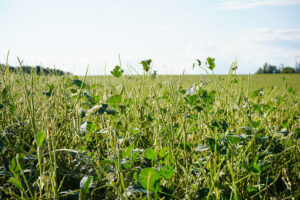
“Just pick of the worst looking ones, try and shake off the worst of the bugs,” she instructed, noting that the grapes near the end of the rows were more likely to be ravaged by the birds.
With that, she handed me a tray and left me to my own devices.
‘That’s it?’ I thought.
I appreciate people that doesn’t waste their words, but this is wine we’re talking about here. I had envisioned something more… precise, elaborate maybe.
Looking back, these are likely preconceived notions I formed as a drinker of cheap swill. Wine, to me, is something elegant and refined, whether it’s served in crystal or a red solo cup. I hadn’t been here a minute and my mind was already expanding.
Though there were a handful of people down at the opposite end of the row, I stayed by myself, wanting to build up a little dexterity with the shears before I embarrassed myself in front of more experienced harvesters. I used the time to think up overwrought descriptions for the story I was supposed to be getting.
I hadn’t thought to bring gloves, so pretty soon my picking hand smelled worse than the return bin at a discount liquor store, somewhere between the musty, brown grapes you find at the bottom of the bag and the smell I imagine prison toilet hooch gives off.
After a couple hours, I had progressed a good length into my row and my back was reminding me that I was an office worker, not built for toiling in a field. I switched between sitting, kneeling, squatting, and half-standing almost constantly.
Before we knew it, the bins were full and it was time for lunch. Before we headed in, Jenn let us sample some of the table grapes they had yet to harvest, which were insanely sweet.
Wine, cheese, charcuterie and some of the best pea soup I’ve had was a welcome respite, but it sure made it difficult to get back into harvesting mode once we got up from the Judd’s table.
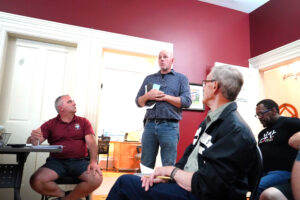
Scott took us down to the lab below the winery where us grunts got to see how the grapes made it from the vine to the bottle. We dumped the bins one-by–one into a machine that looked like a small woodchipper, and it spit out stems from one end and pulpy green slop from the other.
Scott’s dad and local legend, Chris Judd, helped unload the bins from the back of his truck and scanned the produce carefully for insects and other debris. He confirmed my suspicions that bugs don’t taste great, even when crushed and mixed with grape juice.
Another volunteer hand transferred the slop to the press. Scott explained that an inflatable water bag sits in the centre of the press and expands to push the mash against a perforated exterior. He filled a couple glasses with the runoff for us to try before hooking up the hose. He added that some wineries only use the “free run” as opposed to the pressed juice, as it has a different flavour profile.
I had waited all day to find out about the nitty, gritty, hairsplitting detail of winemaking that I had anticipated, and boy, was it ever a rabbit-hole.
By the time we had dumped our grapes, Scott had filled my head with all kinds of fermentation factoids. Some I’ll likely only need for Trivial Pursuit or impersonating a sommelier, but I like esoteric topics as much as the next guy.
Did you know that red wine is fermented with the skins? Neither did I, but it piqued my interest enough that I may go back to see the difference in processes.
The afternoon’s harvesting was much slower than the morning and I reflected on one of my first days working outside since high school. Despite my aching joints and stinky fingers, I was pretty thrilled with how it went.
Winemaking certainly wasn’t the complicated chore I’d anticipated, nor was it like any gardening I’d ever experienced. As an office worker living in a rural community, the opportunity to get my hands dirty and learn from local farmers was outstanding.
And the wine was pretty good, too.