





Zainab Al-Mehdar
MRC des Collines Dec. 22
Hundreds of people gathered in Chelsea on Dec. 14 to express their outrage and show their solidarity for the Grade 3 teacher that was not allowed to teach in her classroom, becase of Quebec’s Bill 21.
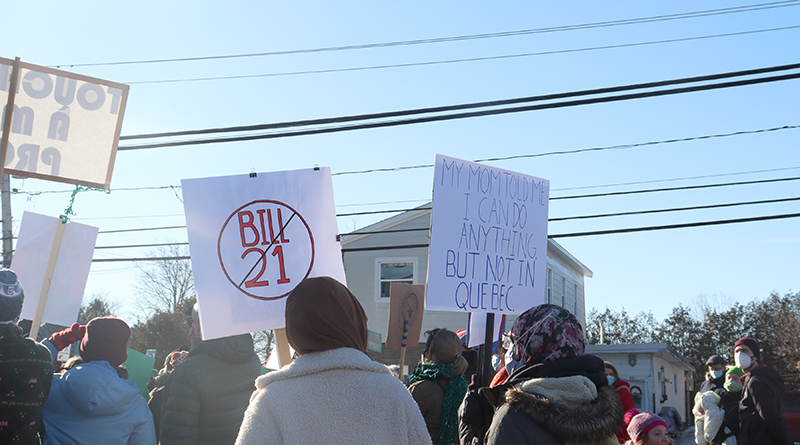
Community members, parents, and kids all rallied outside the office of Robert Bussière, the MNA for Gatineau, with signs that read “her head, her choice” or “fight against Bill 21” in support of Fatemeh Anvari.
“It’s not this abstract law that we heard about. It touches actual people, people who bring value to our communities. It’s not okay,” said Lina El Bakir, Quebec advocacy officer with the National Council of Canadian Muslims.
Being among the protestors she highlights the fact that people are showing up to the rally and supporting this cause debunks the narrative that all Quebecois agree with Bill 21, and the proof was the crowd of Canadians from every background, colour and creed. “I think we need to deconstruct that, and I think we need to push for the fact that Quebecers believe that this is unfair.”
Hafsa Saloojee, a 9th-grade protestor who was there with her elder sister, noted the hypocrisy of the secular law. “I think freedom of religion is very important in a supposed free country and one that says that it’s very advanced in terms of equality and paints other countries as not being equal or free.” The two both held up signs, one of them read, “my mom told me I can do anything, but not in Quebec.”
For El Bakir who was raised in Montreal, Quebec became a place she can call home, but she said, “when Bill 21 passed, it shattered me because I felt like the nation that opened its arm to me and my family rejected me, rejected us.”
Navigating through this difficult reality, El Bakir at the time felt like she needed to choose between her identity as a Muslim woman and her Quebecois identity.
The impact of Bill 21, resulted in Anvari losing her teaching position because she was wearing a hijab, and what ensued was an uproar from the community since the story broke to the media. Anvari is currently being reassigned to a different role at Chelsea Elementary school.
Under Bill 21, often referred to as the Quebec secularism law, all Quebec civil servants in positions of authority, including teachers, are prohibited from wearing religious symbols such as hijabs, kippas, crucifixes and turbans. The law was officially passed in June 2019.
One community member felt hopeful to see such a big turnout and people supporting this issue but with a heavy heart Dale Allen said, “I realized that this could still fall on deaf ears and so I hold onto both the sadness and hope at the same time.”
She added that when it comes to creating such laws, it has to be created with a lot more empathy and a conscious understanding of which groups of people are impacted and that wasn’t the case with this law. When there is a group of people making decisions for a whole nation, “It’s very tricky to have people feel empowered and respected and also heard,” said Allen.
The alternative is the province losing out on talent, as people fear getting into a certain line of education but never being able to follow their passion because of their choice to wear religious symbols. El Bakir has seen that in her own circle of friends, who have pursued other careers to avoid the hardships of getting a teaching job.
Amy Pitkethly, a concerned parent and organizer of the protest told the Equity, “This is a human rights issue. This is not something that we’re gonna stand by, and this is not Quebec values.”
When asked what she hopes the outcome after the protest she said that the government has the power to change their laws, and although it is just one protest, she said “we have to keep moving forward and communicating our opinions on this issue.”
Caryl Green, former MRC des Collines warden, echoes the same sentiment and points out that it was important to show up to the rally and stand in solidarity with Anvari, who has been touched by this action and to also “call for further examination of the law.”
In her speech, Green addressed the crowd and urged everyone to write to their MNA and make their voices heard, and the outcome she hopes to see, “is recognizing that Quebec is a society of many different cultures, religions, and that respect of the diversity is good for us.”
Another protester said this bill is “against every Canadian standard,” and that people should be able to express themselves freely, said Mary Hutton.
When asked if she felt heard by the government, with optimism in her voice Saloojee said “I think we will be at some point if we keep trying, eventually, we will be.”
“We hope that this community mobilization will weigh our leaders in the right direction,” said El Bakir.