





Zainab Al-Mehdar
Pontiac Jan. 26, 2022
After what was a challenging two years for the agriculture and food industry, the economics team at Farm Credit Canada (FCC) has been paying close attention. On Jan. 11 they released their “crystal” charts which forecast what’s in store in 2022.
“We try to analyze what we think are the most relevant things to monitor. We don’t have a crystal ball right? I’m not pretending that I know what exactly the future is gonna look like, but here are . . .
the things that I would watch,” said J.P. Gervais, FCC’s chief economist.
The FCC highlighted five key trends that industry producers and processors should keep an eye out for, they are as follows: inflation and interest rates, ongoing supply chain challenges, labour shortages, supply-demand imbalances and strength in meat demand.
Gervais noted that an area that should be looked into closely is management. “What would really help when you look at this uncertainty is to be crystal clear about the ‘what if’ scenarios,” he said. Because there can be a lot of unknown factors that can impact agriculture, he explained that producers and suppliers should be looking ahead and planning further down the line because there is no way of knowing the impact the pandemic will continue to have on the farming industry.
Doing risk assessment allows farmers or producers to understand the financial risk exposure they have on their business, pointed out Gervais.
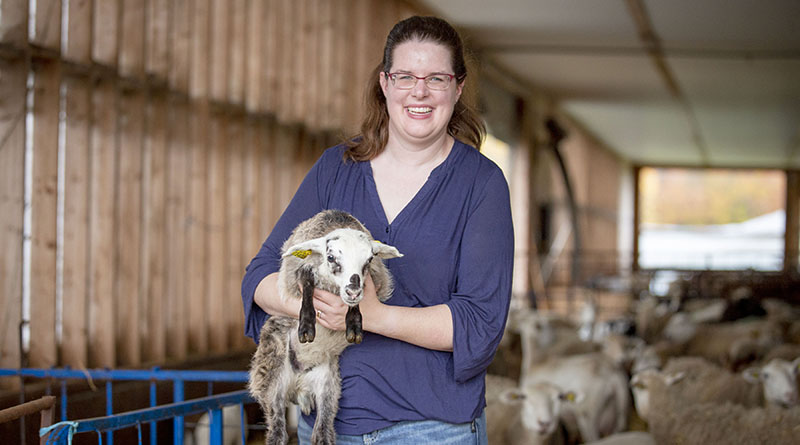
Ursina Studhalter, a sheep farmer in western Quebec, is no stranger to planning ahead but pointed out with all the supply chain issues, you have to pre-buy or anticipate if things will break down before they do to ensure farm operations do not get interrupted.
“It used to be, you’d plan out three to six months but now you’re definitely trying to plan almost 12 months,” said Studhalter.
And conversations with suppliers are different, more urgent. She pointed out that it isn’t uncommon to pre-book supplies but because suppliers anticipate a supply problem they are encouraging their customers to get ahead of it.
The young farmer had more insights to share as she is also a chartered professional accountant, and through teaching herself the business side of things to run her own farm, she later started helping her neighbors when they needed assistance.
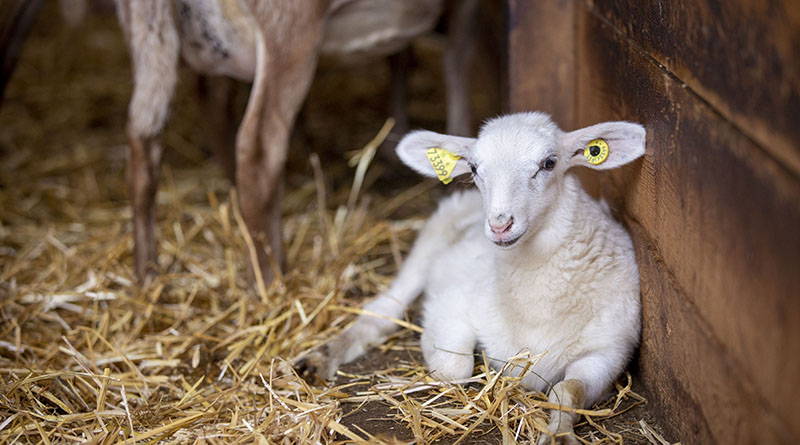
Together with her partner Andrew, they run 300 commercial ewes and 65 acres of forages. Growing up with a farming background herself, starting a farm was not outside her wheelhouse. “It was just something we really wanted to do. And well, we try not to make too many costly mistakes,” said Studhalter.
After reading the report herself, Studhalter noted that she wasn’t that surprised with the findings but one item that did stand out for her was the stagnation of meat consumption. She highlighted that she was aware, but hadn’t realized the whole sector had been facing challenges. The FCC ‘crystal charts’ article reported the shift in meat consumption was due to food service closures and consumer purchases–with low income and job losses families are cutting back on expensive meals.
Although she wasn’t surprised to read that inflation is going up, she said that she understands how it can be a major concern. As a farmer herself she has noticed the price of things like fertilizer go up and almost double in cost. “There is a global chain for fertilizer because it’s held by a very limited number of farms. So it affects everybody.”
In the Pontiac, farmers are being told that they need to pre-book their fertilizer needs for the spring from local suppliers, because they can not guarantee they can deliver. “We’ve already pre-bought and had to commit to our fertilizer well into the summer. But the bare minimum that I need for my operation we’ve had to commit and pay for that upfront. Just to make sure that we’ll get it,” noted Studhalter.
One other issue Studhalter elaborated on was parts for equipment and farm machinery. In the past two years, parts that could normally be bought and delivered within weeks are taking months due to manufacturing issues and major backlogs. “Not only are they harder to get, they’re harder to find,” she said.
Some of the forecasts from the article stated that, “we’re seeing inflation subsiding in the second half of 2022, but at a slow pace. We think that interest rates will go up by 125 points in 2022,” explained Gervais. Other forecasts include a continuing trend toward higher shipping and transportation costs, labour shortages in the food processing sector, which could also contribute to higher food costs. Supply shortages as mentioned is an issue that is ongoing in these pandemic times. Overall price increases on oil, gas and global agriculture, but commodity supplies are not expected to weaken before mid-year, according to the FCC.
Having to navigate through these tumultuous times, many farmers have had to adapt to the changes and adjust the way they operate, purchase and run their business. For Studhalter and her partner, “there’s a lot more increased thinking about all the worst case scenarios for stuff that we never even dreamed would happen,” she said. She recalled being faced with interprovincial border closures and no one to come pick up her sheep, and learning how to use an ultrasound machine. She added that a lot of things had to be done in house, part of adjusting to obstacles you never thought you would have to face.
When asked about other concerns that may be of concern in 2022, Studhalter mentioned the unpredictability of weather concerns, and that its impact will be front of mind. She added that a labour shortage is also an issue, “finding employees who want to work on farms is a challenge. And I know it’s been a challenge locally, probably before the pandemic too. But especially in the pandemic.”
This year Studhalter is hoping for good weather, it is the one thing that is out of peoples control, but also the one that has the biggest impact on farms. “If we don’t get good weather with a decent amount of rain, there’s no pre-planning in the world that can save you from that.”
For her own farm she hopes they can produce as many lambs and that there are no droughts and their feed supply is “reliable,” said Studhalter.
If there was one word that would describe this industry it is resilience, Gervais told The Equity, he added “I’m super optimistic that we can grow in 2022 as soon as we can put this wave behind us hopefully as soon as possible. I think we’re gonna see some growth again in this sector.” He believes it is possible because there is domestic demand in Canada as well as external demand for products from this sector.
“I hope that the most stringent and the worst part of it is behind us and that our adaptive strategies work,” said Studhalter.