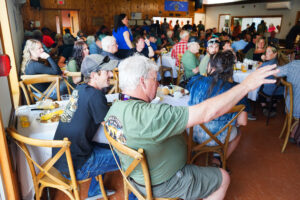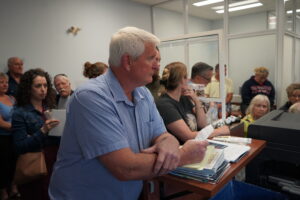






On Thursday evening, about 50 people attended a public hearing put on by the Bureau d’audiences publiques sur l’environnement (BAPE) regarding a proposed Atlantic salmon farming operation planned for Litchfield.
The BAPE is an impartial public body that is responsible for informing, consulting, investigating projects that have a major impact on the environment, and advising the environment ministry if necessary.
A video of the event as well as all relevant documentation is available on the BAPE’s website.
The master of ceremonies for the evening was Christophe Marquis of the BAPE, who introduced his organization, and the meeting’s format. The evening was entirely bilingual, and participants had an opportunity to ask questions online and in-person.
The project
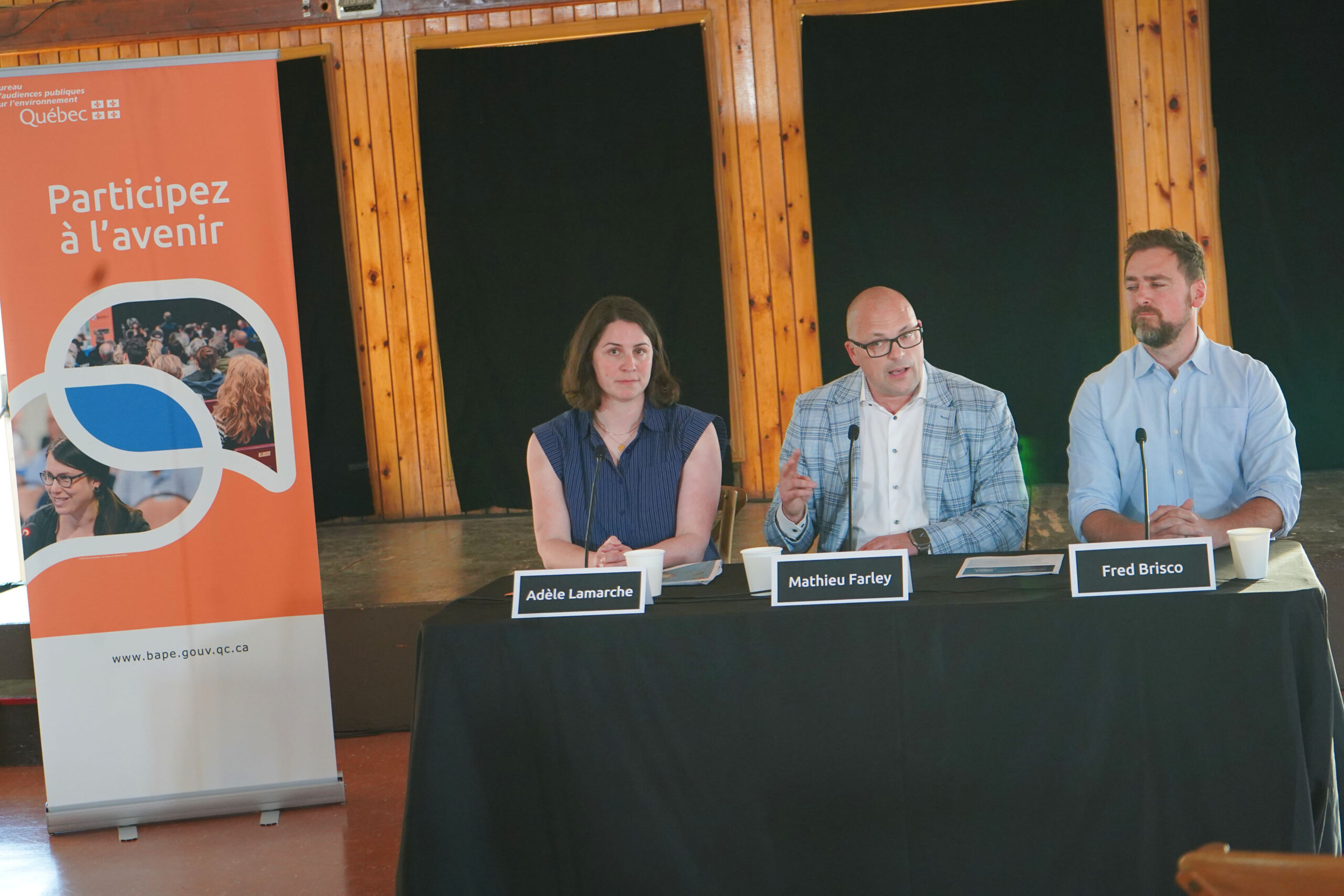
The project was introduced by a team of three people who were there in person at the meeting: Samonix president Mathieu Farley and technical director Fred Brisco, along with Adèle Lamarche of Groupe Conseil UDA, a consultant who worked on the environmental assessment.
The Samonix project is aiming to harvest roughly 10,000 metric tons of Atlantic salmon annually, with a maximum capacity of 12,000 metric tons. Company documents presented at the meeting state that the nearly three million fish harvested every year to meet these metrics would be farmed on land in a 5.6 hectare facility. The overall project cost is estimated at $300 million USD (roughly $418 million CAD).
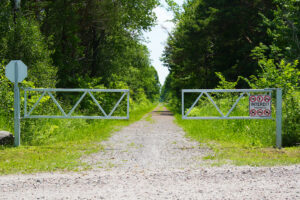
The facility’s location is planned for the Litchfield industrial site, in an area that was previously used as a log storage site when the Smurfit-Stone mill was still operational.
Farley said that Samonix is aiming to submit its application for ministerial approval this year, and if it is approved, finalize the financing and designs next year, to start construction in 2028. He said if they stick to this timeline, their first harvest would come in 2031, as it takes just under two years to raise a salmon to maturity.
Company documents note that the closest groundwater wells are more than two kilometres away from the site, and the nearest river water intake is more than five kilometres away.

The site uses a water recirculating system (RAS) and Brisco said that they were aiming to not use any antibiotics on their fish, instead relying on strict sanitation and sterilization procedures.
“The way we achieve that is through very, very strict bio-security procedures,” he said. “The entire facility is broken up into five parallel, individual RAS systems that don’t exchange water with each other. So if there were to be any pathogen or contaminant, it would at least in theory be isolated to one of those five compartments.”
Farley said he believed there was an opportunity to produce seafood closer to large urban markets in Toronto, Montreal and even the east coast of the United States.
Questions
Several questions were asked related to the impacts of the project on the water of the Ottawa River, such as from the effluent pipe that would emit the treated waste water from the facility.
Brisco gave a detailed explanation of the effluent pipe and the diffuser at its exit, which are designed to dilute the effluent water as quickly as possible. The pipe would have four two-inch ports oriented up on a 45 degree angle at the bottom of the river.
“We took historically low water levels, modeled the river exactly as it would have been that day, with our diffuser, and our effluent, and within two metres, the water levels diluted beyond anything that would have an impact on any of the wildlife within the river,” Brisco explained, showing diagrams of the diffusers location and orientation in the river. He also said that the intake and discharge pipes would be installed using directional drilling as opposed to dredging.
He said that the water entering and exiting the facility would be treated extensively, comparing their setup to a municipal water treatment facility. He said that they will be constantly monitoring effluent as well with guidelines from the Ministry of Environment.

One resident asked about the waste produced by the facility, and Farley said that during full production, they estimated they would have two 18-wheel trucks per day of waste that would be shipped to a biomethanization plant in Montérégie for processing, mainly made up of fish excrement and processing waste.
Brisco also responded to a question about water usage.
“When we’re at full capacity we will be taking approximately 2,300 cubic metres of water per day and emitting almost the same, just a little bit less, because of course there’s some water, some moisture that goes out with the sludge and some things that are going to biomethanization,” he said. “In comparison, the pulp and paper mill at the time was taking 70,000 cubic metres a day. So it’s significantly less than the previous project on that site.”
Next steps
Members of the public have until June 26 to put forward a request for a public review. If no requests are received, the role of the BAPE will conclude and the project will continue on its course.
If the ministry receives a request (or more than one) that it deems admissible, it may mandate either a public hearing, targeted consultation or mediation, which have four-, three- and two-month timespans respectively.
Regardless of the route, the BAPE will submit a report to the minister, which will be publicly released within 15 days. The minister makes recommendations to cabinet, which has the final say on the project’s progress.
Any questions about the Samonix project or the BAPE and its mandate can be directed to Marquis at ferme-aquacole-pontiac@bape.gouv.qc.ca.
Jeudi soir, une cinquantaine de personnes ont assisté à une audience publique organisée par le Bureau d’audiences publiques sur l’environnement (BAPE) concernant un projet de ferme d’élevage de saumons de l’Atlantique prévu à Litchfield.
Le BAPE est un organisme public impartial chargé d’informer, de consulter, d’enquêter sur les projets ayant un impact majeur sur l’environnement et de conseiller le ministère de l’Environnement si nécessaire.
Une vidéo de l’événement ainsi que toute la documentation pertinente sont disponibles sur le site web du BAPE.
Le maître de cérémonie de la soirée était Christophe Marquis du BAPE, qui a présenté son organisation et le format de la réunion. La soirée était entièrement bilingue et les participants ont eu l’occasion de poser des questions en ligne et en personne.
Le projet
Le projet a été présenté par une équipe de trois personnes présentes en personne à la réunion : le président de Samonix, Mathieu Farley, et le directeur technique, Fred Brisco, ainsi qu’Adèle Lamarche de Groupe Conseil UDA, une consultante qui a travaillé sur l’évaluation environnementale.
Le projet Samonix vise à récolter environ 10 000 tonnes métriques de saumon de l’Atlantique par an, avec une capacité maximale de 12 000 tonnes métriques. Les documents de l’entreprise présentés lors de la réunion indiquent que près de trois millions de poissons récoltés chaque année pour atteindre ces chiffres seraient élevés sur terre dans une installation de 5,6 hectares. Le coût total du projet est estimé à 300 millions $ US (environ 418 millions $ CA).
L’emplacement de l’installation est prévu sur le site industriel de Litchfield, dans une zone qui était auparavant utilisée comme site de stockage de billes lorsque l’usine Smurfit-Stone était encore en activité.
Farley a déclaré que Samonix vise à soumettre sa demande d’approbation ministérielle cette année et, si elle est approuvée, à finaliser le financement et les conceptions l’année prochaine, pour commencer la construction en 2028. Il a dit que s’ils respectent ce calendrier, leur première récolte aurait lieu en 2031, car il faut un peu moins de deux ans pour élever un saumon jusqu’à maturité.
Les documents de l’entreprise indiquent que les puits d’eau souterraine les plus proches se trouvent à plus de deux kilomètres du site, et la prise d’eau de rivière la plus proche est à plus de cinq kilomètres.
Le site utilise un système d’aquaculture en recirculation (SAR) et Brisco a déclaré qu’ils visaient à ne pas utiliser d’antibiotiques sur leurs poissons, s’appuyant plutôt sur des procédures strictes d’assainissement et de stérilisation.
« Nous y parvenons grâce à des procédures de biosécurité très, très strictes », a-t-il dit. « L’ensemble de l’installation est divisé en cinq systèmes SAR parallèles et individuels qui n’échangent pas d’eau entre eux. Ainsi, s’il devait y avoir un agent pathogène ou un contaminant, il serait au moins en théorie isolé dans l’un de ces cinq compartiments. »
Farley a déclaré qu’il pensait qu’il y avait une opportunité de produire des fruits de mer plus près des grands marchés urbains à Toronto, Montréal et même sur la côte est des États-Unis.
Questions
Plusieurs questions ont été posées concernant les impacts du projet sur l’eau de la rivière des Outaouais, notamment celles concernant le tuyau d’effluent qui évacuerait les eaux usées traitées de l’installation.
Brisco a donné une explication détaillée du tuyau d’effluent et du diffuseur à sa sortie, qui sont conçus pour diluer l’eau d’effluent le plus rapidement possible. Le tuyau aurait quatre orifices de deux pouces orientés vers le haut à un angle de 45 degrés au fond de la rivière.
« Nous avons pris des niveaux d’eau historiquement bas, modélisé la rivière exactement telle qu’elle aurait été ce jour-là, avec notre diffuseur et notre effluent, et à moins de deux mètres, les niveaux d’eau se sont dilués au-delà de tout ce qui pourrait avoir un impact sur la faune de la rivière », a expliqué Brisco, montrant des diagrammes de l’emplacement et de l’orientation des diffuseurs dans la rivière. Il a également déclaré que les tuyaux d’admission et de décharge seraient installés par forage dirigé plutôt que par dragage.
Il a dit que l’eau entrant et sortant de l’installation serait traitée de manière approfondie, comparant leur installation à une usine municipale de traitement de l’eau. Il a ajouté qu’ils surveilleront constamment les effluents, en respectant les directives du ministère de l’Environnement.
Un résident a posé une question sur les déchets produits par l’installation, et Farley a déclaré qu’en pleine production, ils estimaient avoir deux camions de 18 roues par jour de déchets qui seraient expédiés à une usine de biométhanisation en Montérégie pour traitement, principalement composés d’excréments de poisson et de déchets de traitement.
Brisco a également répondu à une question sur la consommation d’eau.
« Lorsque nous serons à pleine capacité, nous prélèverons environ 2 300 mètres cubes d’eau par jour et en émettrons presque la même quantité, juste un peu moins, car bien sûr il y a de l’eau, de l’humidité qui s’en va avec les boues et certaines choses qui partent à la biométhanisation », a-t-il dit. « En comparaison, l’usine de pâtes et papiers de l’époque prélevait 70 000 mètres cubes par jour. C’est donc significativement moins que le projet précédent sur ce site. »
Prochaines étapes
Les membres du public ont jusqu’au 26 juin pour déposer une demande de révision publique. Si aucune demande n’est reçue, le rôle du BAPE se terminera et le projet poursuivra son cours.
Si le ministère reçoit une ou plusieurs demandes qu’il juge admissibles, il peut mandater soit une audience publique, une consultation ciblée ou une médiation, qui ont respectivement une durée de quatre, trois et deux mois.
Quelle que soit la voie choisie, le BAPE soumettra un rapport au ministre, qui sera rendu public dans les 15 jours. Le ministre formule des recommandations au Conseil des ministres, qui a le dernier mot sur l’avancement du projet.
Toute question concernant le projet Samonix ou le BAPE et son mandat peut être adressée à Marquis à l’adresse ferme-aquacole-pontiac@bape.gouv.qc.ca.