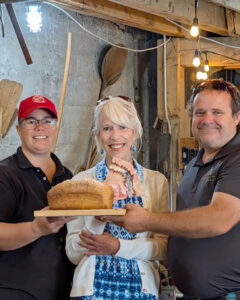



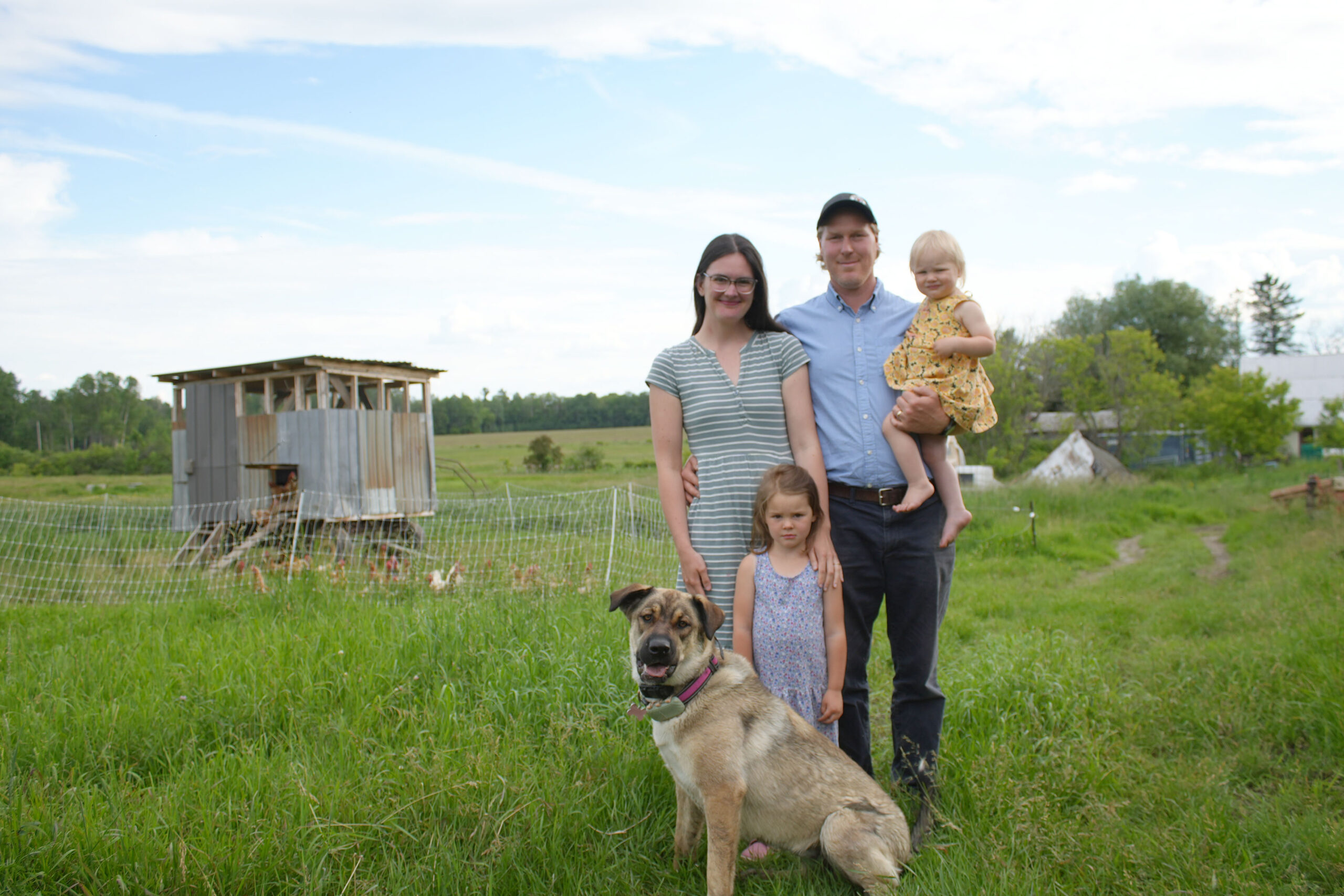



A new family farm has sprouted just outside of Campbell’s Bay, where its two owners are trying to bring local food to the Pontiac.
Behind Innishill Farm are a young couple, Scott and Eryn Brown, who moved to the Pontiac three years ago from Southern Ontario to start a new life with their two daughters.
On their property the pair are already raising pastured-raised pork, chickens (for meat and eggs) and vegetables. This year, their third on the farm, they are preparing to launch a full-time market garden where they will sell vegetables in the very same field where they are grown.
The couple weren’t always farmers – far from it. Scott, from Point Edward, Ont. was a career boilermaker while Eryn, from Toronto, was a child and youth care practitioner and a holistic nutritionist. Scott said the couple started learning how to grow food in their backyard, gradually producing more as they learned more techniques and read more about it.
“Can we do 100 feet of potatoes, or 50 feet? Can we try this? How about this? And we just started playing around, reading more literature. I read a book called The New Farm [ . . . ] and they started farming because they wanted to feed communities that didn’t have access to the healthiest food for a good price point.”
Farming isn’t just a job for the couple – it also allows them to feed healthy and naturally produced food to their kids and to the community. Eryn said her focus on nourishing food as central to wellbeing began at an organization called The Stop in Toronto, which brings in professional chefs to cook gourmet meals for people in need.
“I thought I was going to go into social work, and that was kind of where my interest was. But then food and helping people kept meshing together in every avenue I was going. And we kept coming back to that, so it was only natural to get into food somehow,” she said.
Now with two kids of their own, Eryn said the health aspect of farming has become even more important. When she worked in social services, she saw the food that was being served to kids who were about to go into group homes or medical institutions, and she wanted to provide a better alternative for her own kids.
“There would be like Wonder Bread, Hamburger Helper, and green Jell-O. And I was looking at the food thinking, ‘How is this conducive to health and healing? This is so backwards. I can’t do this. When we decided we were going to have a family of our own, it was just natural that food had to be first and foremost,” she said.
While providing healthy food for their own children was a major motivation, the Browns say they also want their farm to contribute to the long-term health of the wider community. They said they hope the Pontiac, like other small communities, can be strong by attracting more young people.
“They’re the future of a small community. If you don’t keep them there, then the roots disappear. We want to feed young people really good food. We want to offer employment for young people to keep them involved in their food and to keep them in the community,” Eryn said.
The pair count themselves lucky to be able to afford farmland, as the price of land across the country skyrockets. They say they are hoping to show that operating a small family farm is still possible, without the social media presence that some young farmers now are leveraging as income.
“We want not to prove but to show that you don’t need to be a top influencer on social media to have a successful farm. Your farm should be selling food, not t-shirts and coffee cups,” Scott said.
Eryn said that like many others who were dreaming of what life would be like on a family farm, she had a somewhat romantic notion of what it would be like – a notion that was promptly squashed upon moving here.
“I did subscribe to all the homesteaders on YouTube. I loved that. So I had a vision that we were going to walk into a life kind of like that [ . . . ] I dreamed of walking through fields in a sundress with a basket, but mostly I’m covered in manure and mud and I have a kid strapped on my back who’s screaming because I’m an hour late for dinner.”
This summer will mark the Browns’ first season full-time on the farm – a year Scott said will be spent developing some of the infrastructure for their farm, such as water lines, electricity and fencing.
They hope to open the market garden later this year, where customers will be able to purchase dozens of varieties of vegetables directly from the farm. Along with pork, chicken and eggs, the couple hopes to continue expanding the variety of food they can offer while keeping production at a scale they can manage as a family. Eventually, they hope to add beef to their offerings
For the Browns, success isn’t measured by becoming a large commercial operation. Instead, they hope to show that a small family farm can provide healthy, locally grown food while remaining financially sustainable.
“We are not a hobby farm. We are not homesteading,” Scott said. “We are trying to build a business here that can be passed on to another generation.”
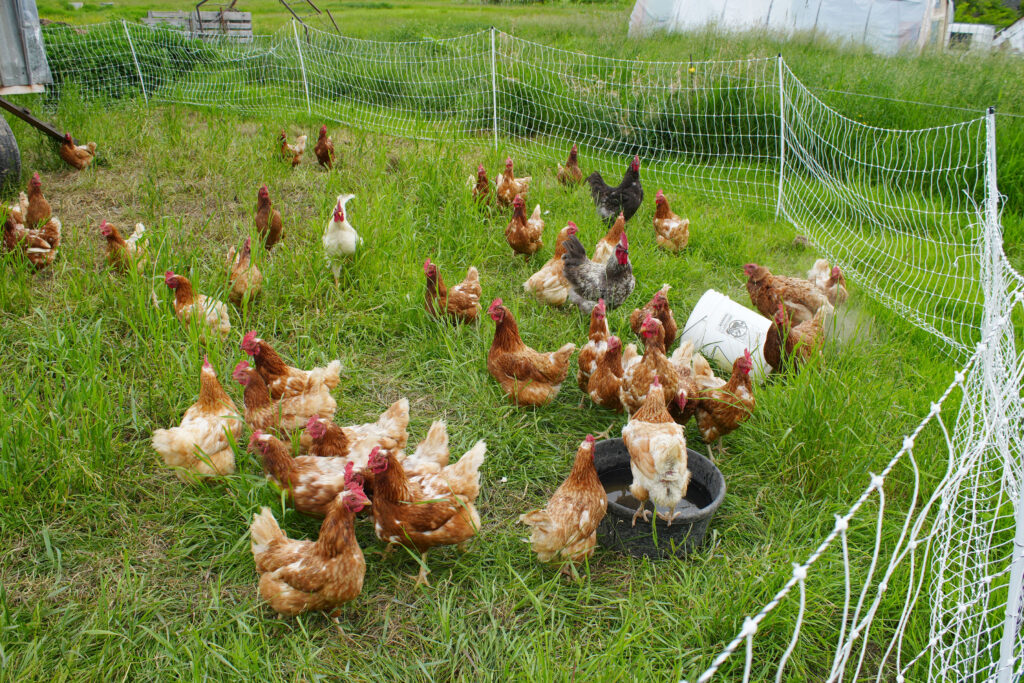
Une nouvelle ferme familiale a vu le jour juste à l’extérieur de Campbell’s Bay, où ses deux propriétaires tentent d’offrir des aliments locaux au Pontiac.
Derrière la ferme Innishill se cache un jeune couple, Scott et Eryn Brown, qui a déménagé dans le Pontiac il y a trois ans, depuis le sud de l’Ontario, pour entamer une nouvelle vie avec leurs deux filles.
Sur leur propriété, le couple élève déjà des porcs en pâturage, des poulets (pour la viande et les œufs) et cultive des légumes. Cette année, leur troisième à la ferme, ils se préparent à lancer un jardin-marché à temps plein où ils vendront des légumes dans le même champ où ils sont cultivés.
Le couple n’a pas toujours été agriculteur, loin de là. Scott, originaire de Point Edward, en Ontario, était chaudronnier de carrière, tandis qu’Eryn, de Toronto, était éducatrice spécialisée auprès des enfants et des jeunes, ainsi que nutritionniste holistique. Scott a raconté que le couple a commencé à apprendre à cultiver des aliments dans leur cour arrière, produisant graduellement plus à mesure qu’ils apprenaient de nouvelles techniques et lisaient davantage à ce sujet.
« Pouvons-nous faire 100 pieds de pommes de terre, ou 50 pieds? Pouvons-nous essayer ceci? Et cela? Nous avons juste commencé à expérimenter, à lire davantage de littérature. J’ai lu un livre intitulé The New Farm [ . . . ] et ils ont commencé à cultiver parce qu’ils voulaient nourrir des communautés qui n’avaient pas accès aux aliments les plus sains à un bon prix. »
L’agriculture n’est pas seulement un travail pour le couple – cela leur permet également de donner des aliments sains et produits naturellement à leurs enfants et à la communauté. Eryn a déclaré que son intérêt pour une alimentation nutritive, essentielle au bien-être, a commencé au sein d’une organisation appelée The Stop à Toronto, qui fait appel à des chefs professionnels pour cuisiner des repas gastronomiques pour les personnes dans le besoin.
« Je pensais que j’allais faire du travail social, et c’était en quelque sorte là où se trouvait mon intérêt. Mais ensuite, l’alimentation et l’aide aux gens n’ont cessé de s’entremêler dans toutes les voies que j’empruntais. Et nous y sommes toujours revenus, il était donc naturel de nous lancer dans l’alimentation d’une manière ou d’une autre, » a-t-elle affirmé.
Maintenant, avec deux enfants à eux, Eryn a déclaré que l’aspect santé de l’agriculture est devenu encore plus important. Lorsqu’elle travaillait dans les services sociaux, elle a vu la nourriture servie aux enfants qui étaient sur le point d’intégrer des foyers de groupe ou des institutions médicales, et elle voulait offrir une meilleure alternative pour ses propres enfants.
« Il y aurait comme du pain Wonder, du Hamburger Helper et de la Jell-O verte. Et je regardais la nourriture en pensant : « Comment cela peut-il favoriser la santé et la guérison? C’est tellement arriéré. Je ne peux pas faire ça. Quand nous avons décidé d’avoir notre propre famille, il était tout simplement naturel que l’alimentation soit la priorité absolue, » a-t-elle dit.
Bien que fournir des aliments sains à leurs propres enfants soit une motivation majeure, les Brown affirment qu’ils souhaitent également que leur ferme contribue à la santé à long terme de la communauté au sens large. Ils ont dit espérer que le Pontiac, comme d’autres petites communautés, puisse être fort en attirant davantage de jeunes.
« Ils sont l’avenir d’une petite communauté. Si vous ne les gardez pas là, alors les racines disparaissent. Nous voulons nourrir les jeunes avec de très bons aliments. Nous voulons offrir des emplois aux jeunes pour les maintenir impliqués dans leur alimentation et les garder dans la communauté, » a dit Eryn.
Le couple s’estime chanceux de pouvoir s’offrir des terres agricoles, alors que le prix des terrains monte en flèche à travers le pays. Ils disent espérer montrer qu’exploiter une petite ferme familiale est toujours possible, sans la présence sur les réseaux sociaux que certains jeunes agriculteurs utilisent maintenant comme source de revenus.
« Nous ne voulons pas prouver, mais montrer que vous n’avez pas besoin d’être un influenceur de premier plan sur les réseaux sociaux pour avoir une ferme prospère. Votre ferme devrait vendre de la nourriture, pas des t-shirts et des tasses à café, » a déclaré Scott.
Eryn a dit que, comme beaucoup d’autres qui rêvaient de ce que serait la vie dans une ferme familiale, elle avait une vision quelque peu romantique de ce que cela serait – une notion qui a été rapidement écrasée dès leur déménagement ici.
« Je m’étais abonnée à tous les « homesteaders » sur YouTube. J’adorais ça. J’avais donc une vision que nous allions entrer dans une vie un peu comme ça [ . . . ] Je rêvais de me promener dans les champs en robe d’été avec un panier, mais le plus souvent je suis couverte de fumier et de boue et j’ai un enfant attaché sur mon dos qui crie parce que j’ai une heure de retard pour le souper. »
Cet été marquera la première saison à temps plein des Brown à la ferme – une année, a dit Scott, qui sera consacrée au développement de certaines infrastructures de leur ferme, comme les conduites d’eau, l’électricité et les clôtures.
Ils espèrent ouvrir le jardin-marché plus tard cette année, où les clients pourront acheter des dizaines de variétés de légumes directement à la ferme. Outre le porc, le poulet et les œufs, le couple espère continuer à élargir la variété d’aliments qu’il peut offrir tout en maintenant une production à une échelle qu’il peut gérer en famille. À terme, ils espèrent ajouter du bœuf à leurs offres.
Pour les Brown, le succès ne se mesure pas en devenant une grande exploitation commerciale. Au lieu de cela, ils espèrent montrer qu’une petite ferme familiale peut fournir des aliments sains et cultivés localement tout en restant financièrement viable.
« Nous ne sommes pas une ferme-loisir. Nous ne faisons pas d’« homesteading », » a déclaré Scott. « Nous essayons de bâtir une entreprise ici qui peut être transmise à une autre génération. »