


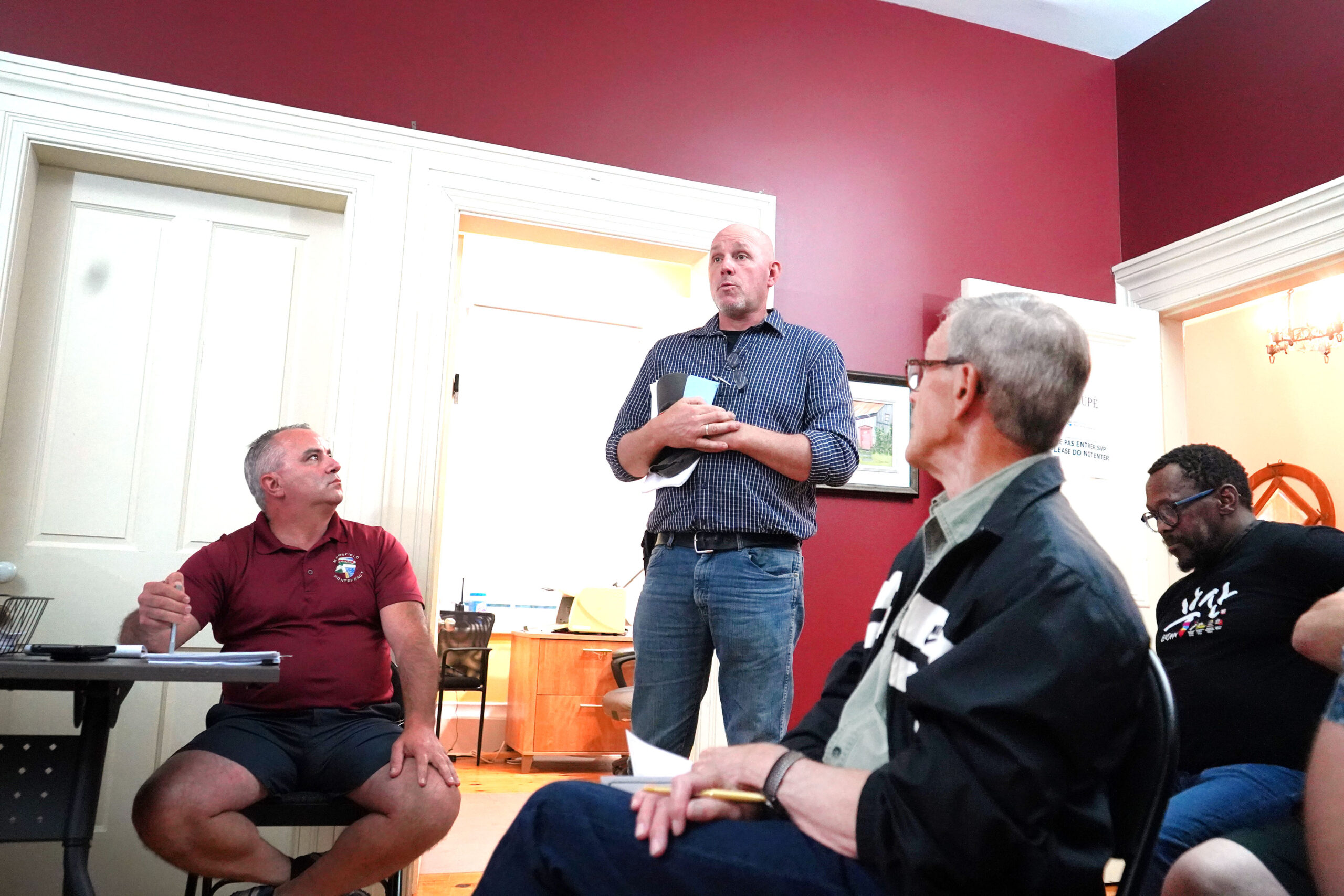



The Mansfield-et-Pontefract municipal council meeting on Aug. 13 saw an unexpected presentation from an Ottawa businessman with a big vision for the Davidson industrial site.
Luc Laplante, owner of Ottawa Cedar Lumber Inc. in Cumberland, Ont., requested a resolution from council in support of his plans to reopen a lumber processing operation at the Davidson site, along with a cogeneration power plant that would use biomass to produce electricity that would then be sold to Hydro-Québec.
The mill, currently owned by brothers Bruno and Hubert St-Cyr, has been inactive since 2010, when it closed after losing its client for wood chips in Gatineau, according to Bruno St-Cyr.
Laplante, the spokesperson for the group of developers working on this plan, said he does have a contract in place with Hydro-Québec for the sale of electricity generated at the site, but does not yet have a wood supply guarantee from the Quebec government for the sawmill or the cogen plant.
He also emphasized that the feasibility of his plan would be greater if the new Hydro-Québec substation planned for Mansfield-et-Pontrefact would be built on the west side of the Coulonge River, closer to the industrial site, rather than on the east site, where current plans put it.
He was the second person to raise this issue at the council meeting. First to speak during the question period was resident Frank Doyle.
“It seems to me that if our municipality is ever going to have some kind of industrial development west of the Coulonge River, it should have good infrastructure, including hydroelectricity,” he said.
Mansfield mayor Sandra Armstrong said councillors would have to learn more about Laplante’s project and discuss amongst themselves before passing any resolution of support.
“We’re very open to this,” she said. “What worries me a lot is [where you’ll get] the wood supply.”
Regarding the location of the future substation, she said council had already passed a resolution in July to request it be moved west of the Coulonge River to support industrial development in the municipality. Simon Desjardins, community relations advisor with Hydro-Québec, confirmed the company had received the request from the municipality, but was unable to provide comment before this newspaper’s print deadline.
When Laplante was asked how he planned to supply Hydro-Québec with the power generated if the substation remains at the site currently proposed, he said he would find a way to have the line to the industrial site built privately.
“We’re really going to ask council to push [to have the substation moved],” Laplante told THE EQUITY following the meeting. “I think it would be beneficial to the whole community that the electricity goes right up past the river, because most of the industrial park is on that side.”
Regarding concerns raised around obtaining enough wood supply to keep the mill open, he said he would source wood from the Ontario side if needed.
“The way I see it is that there will be private people that will bring wood in, and then the question is going to be, is the Quebec government going to give us some wood? If not then we’ll have to go to the Pembroke side.”
He said he wasn’t prepared to disclose how far along discussions were with the St-Cyr brothers, nor details about what his specific requests will be for support from council. He did say his sawmill in Cumberland is currently for sale.
“There’s a lot of wheels turning, we just have to align everything
[ . . . ] There’s a lot of stuff I’m not prepared to talk about yet,” Laplante said.
“We just want to make sure that when I get here I won’t be fighting the council or the citizens to try to do something. If they would have said no, I would have left, that would have been the end of it.”
Laplante’s vision is not unlike that launched by current owner Bruno St-Cyr in an attempt to reopen the mill after it closed in 2010.
Énergie Davidson, as it was known, was his plan to reopen the sawmill as well as a cogeneration plant, which would use wood otherwise destined for pulp, as well as scraps from the mill, to generate electricity and heat.
At a rally for the project in 2020, St-Cyr said he already had the cutting rights for pulp wood in addition to an agreement with Hydro-Québec to sell electricity back into the grid, but that the project was being held up by a lack of cutting rights (known by their French acronym GA) for the pine needed for the sawmill. The mill never reopened.
La réunion du conseil municipal de Mansfield-et-Pontefract, le 13 août, a vu la présentation inattendue d’un homme d’affaires d’Ottawa ayant une grande vision pour le site industriel de Davidson.
Luc Laplante, propriétaire d’Ottawa Cedar Lumber Inc. à Cumberland, en Ontario, a demandé une résolution du conseil en appui à ses plans pour rouvrir une exploitation de transformation du bois sur le site de Davidson, ainsi qu’une centrale de cogénération qui utiliserait la biomasse pour produire de l’électricité qui serait ensuite vendue à Hydro-Québec.
La scierie, actuellement propriété des frères Bruno et Hubert St-Cyr, est inactive depuis 2010, année de sa fermeture après avoir perdu son client de copeaux de bois à Gatineau, selon Bruno St-Cyr.
M. Laplante, porte-parole du groupe de développeurs travaillant sur ce plan, a déclaré qu’il avait bien un contrat en place avec Hydro-Québec pour la vente d’électricité produite sur le site, mais ne dispose pas encore d’une garantie d’approvisionnement en bois du gouvernement du Québec pour la scierie ou la centrale de cogénération.
Il a également souligné que la faisabilité de son plan serait accrue si la nouvelle sous-station d’Hydro-Québec prévue pour Mansfield-et-Pontefract était construite sur la rive ouest de la rivière Coulonge, plus près du site industriel, plutôt que sur le site est, où les plans actuels la situent.
Il a été la deuxième personne à soulever cette question lors de la réunion du conseil. Le premier à prendre la parole pendant la période de questions fut le résident Frank Doyle.
« Il me semble que si notre municipalité doit un jour avoir une forme de développement industriel à l’ouest de la rivière Coulonge, elle devrait avoir de bonnes infrastructures, y compris l’hydroélectricité », a-t-il dit.
La mairesse de Mansfield, Sandra Armstrong, a déclaré que les conseillers devraient en apprendre davantage sur le projet de M. Laplante et en discuter entre eux avant d’adopter une résolution de soutien.
« Nous sommes très ouverts à cela », a-t-elle dit. « Ce qui m’inquiète beaucoup, c’est l’approvisionnement en bois. »
Concernant l’emplacement de la future sous-station, elle a déclaré que le conseil avait déjà adopté une résolution en juillet pour demander qu’elle soit déplacée à l’ouest de la rivière Coulonge afin de soutenir le développement industriel dans la municipalité. Simon Desjardins, conseiller en relations avec les collectivités chez Hydro-Québec, a confirmé que l’entreprise avait reçu la demande de la municipalité, mais n’a pas été en mesure de fournir de commentaires avant la date limite d’impression de ce journal.
Lorsque M. Laplante a été interrogé sur la façon dont il prévoyait d’approvisionner Hydro-Québec en électricité produite si la sous-station restait sur le site actuellement proposé, il a déclaré qu’il trouverait un moyen de faire construire la ligne vers le site industriel de manière privée.
« Nous allons vraiment demander au conseil de faire pression [pour que la sous-station soit déplacée] », a déclaré M. Laplante à THE EQUITY après la réunion. « Je pense que ce serait bénéfique pour toute la communauté que l’électricité aille juste après la rivière, car la majeure partie du parc industriel est de ce côté-là. »
Concernant les inquiétudes soulevées quant à l’obtention d’un approvisionnement en bois suffisant pour maintenir la scierie ouverte, il a déclaré qu’il s’approvisionnerait en bois du côté ontarien si nécessaire.
« La façon dont je vois les choses est qu’il y aura des particuliers qui apporteront du bois, et puis la question sera : le gouvernement du Québec va-t-il nous donner du bois ? Sinon, nous devrons aller du côté de Pembroke. »
Il a déclaré qu’il n’était pas prêt à divulguer l’avancement des discussions avec les frères St-Cyr, ni les détails de ses demandes spécifiques de soutien au conseil. Il a toutefois mentionné que sa scierie à Cumberland est actuellement en vente.
« Il y a beaucoup de rouages en marche, nous devons juste tout aligner
[ . . . ] Il y a beaucoup de choses dont je ne suis pas encore prêt à parler », a déclaré M. Laplante.
« Nous voulons juste nous assurer qu’en arrivant ici, je ne serai pas en conflit avec le conseil ou les citoyens pour essayer de faire quelque chose. S’ils avaient dit non, je serais parti, cela aurait été la fin. »
La vision de M. Laplante n’est pas sans rappeler celle lancée par l’actuel propriétaire Bruno St-Cyr dans une tentative de rouvrir la scierie après sa fermeture en 2010.
Énergie Davidson, comme on l’appelait, était son plan pour rouvrir la scierie ainsi qu’une centrale de cogénération, qui utiliserait du bois autrement destiné à la pâte, ainsi que des résidus de la scierie, pour générer de l’électricité et de la chaleur.
Lors d’un rassemblement pour le projet en 2020, M. St-Cyr a déclaré qu’il avait déjà les droits de coupe pour le bois de pâte en plus d’un accord avec Hydro-Québec pour revendre l’électricité au réseau, mais que le projet était bloqué par un manque de garanties d’approvisionnement (GA) pour le pin nécessaire à la scierie. La scierie n’a jamais rouvert ses portes.