





A local information session about a lesser known but serious women’s health risk drew some attention on Feb. 13.
Activist group Citizens of the Pontiac organized an online presentation about women’s heart and vascular disease, which was streamed to audiences gathered at both the Community Lodge in Shawville and the Mansfield CLSC.
The presentation, given by Nadine Elias from the Canadian Women’s Heart Health Alliance, was hosted in conjunction with Wear Red Canada day to raise awareness about the rise and risks of this condition, and the challenges for women when it comes to getting it diagnosed.
“Many Canadian women die prematurely because they had not known the signs of heart disease nor did they know that heart disease behaves differently in men than it does in women,” wrote Citizens of the Pontiac spokesperson Judith Spence in an invitation to the event.
In her presentation, Elias said despite the fact that more women than men now die of heart disease, and that five times as many women die from heart disease as do from breast cancer, it is still severely under-researched, under-diagnosed and under-treated in women.
“Significant sex- and gender-related differences and disparities exist, affecting the awareness, the disease progression, and the diagnosis and treatment.”
She highlighted the fact that despite women accounting for just over half the population, two thirds of heart disease research has been historically focused on men. Because of this, diagnostic and treatment strategies have been based on how heart disease shows up in middle-aged white men, which can be quite different from how it shows up in women.
“This gap in research has contributed to a lack of understanding of the sex-specific symptoms and treatment responses in women,” Elias said.
One of the consequences of this is that early heart attack signs are missed in 78 per cent of women, and misdiagnosis is especially common in younger women who often don’t experience the more common symptoms like extreme chest pain. Doctors often focus on other possible causes without ruling out heart problems.
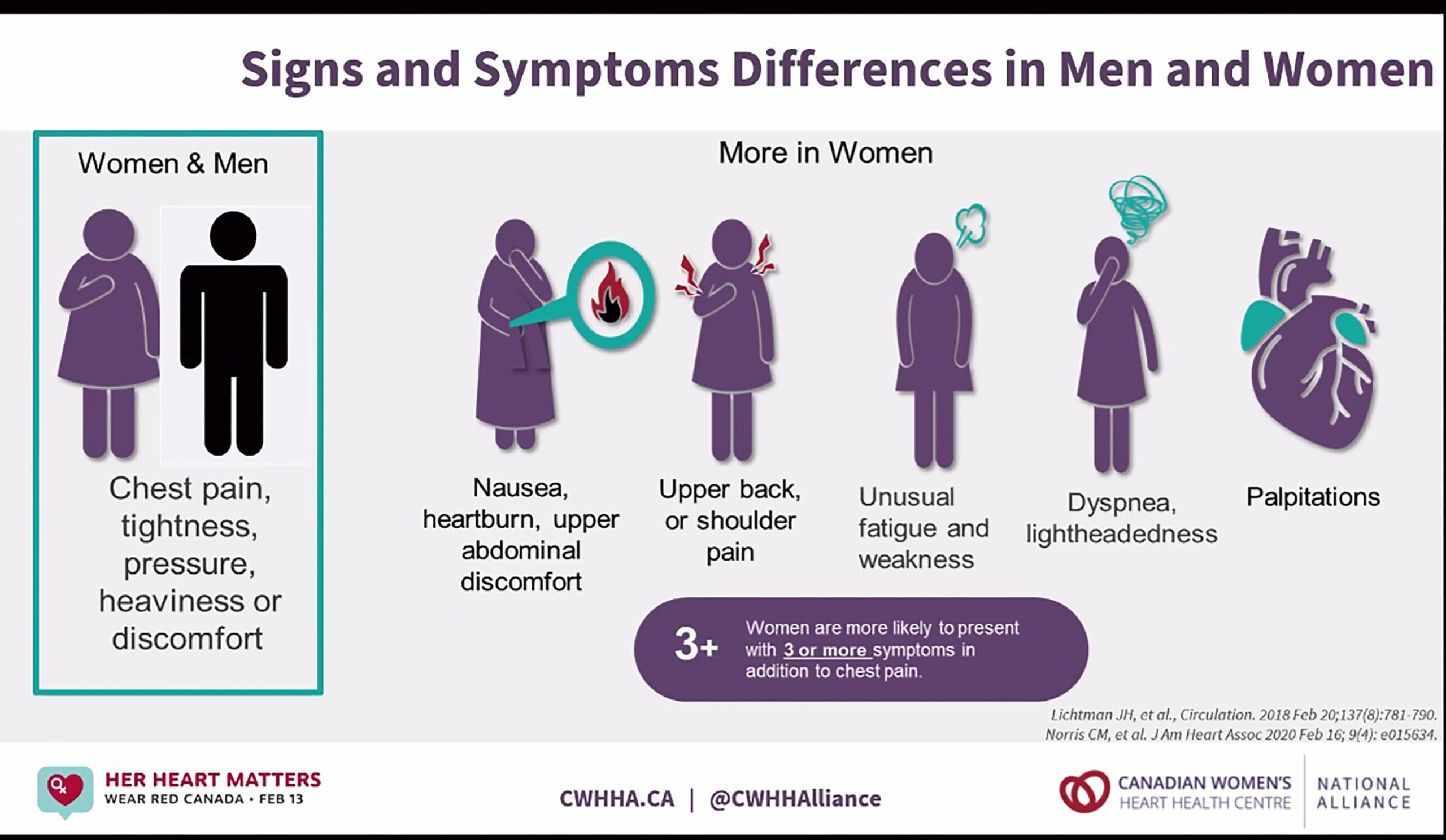
Part of the challenge, she said, is that women and men show different symptoms of heart disease. Beyond sharp chest pain or tightness, women also experience more subtle symptoms like nausea or heartburn, pain in the jaw, neck, right arm or back, extreme sweating, shortness of breath, unusual fatigue and weakness, lightheadedness and heart palpitations.
Importantly, women are more likely to present with three or more symptoms in addition to chest pain.
“Usually women will experience a few symptoms at the same time, but when in doubt, check it out,” Elias said.
The lack of awareness of the possible connection between these symptoms and heart disease means many women don’t consider that they may be at risk, especially because women may develop forms of heart disease that are less common in men.
The most common types of heart and vascular disease include cholesterol build-up in the heart’s blood vessels (coronary artery disease), leaky or stiff heart valves affecting blood flow (valvular heart disease), and an irregular or rapid heartbeat (arrhythmia).
But women are also prone to other heart and vascular challenges, including a tear in the heart’s large blood vessels, a tightening of the heart’s large blood vessels, small vessel disease, a weakened heart due to a stressful event, or a weakened heart during or after pregnancy.
Female-specific risk factors
Elias pointed to several conditions that lead to a greater risk of heart disease in women, including certain pregnancy complications, menopause before the age of 45, ovarian cysts and hormonal imbalances, and inflammatory and autoimmune disorders.
The more common risk factors including diabetes, obesity and smoking cigarettes are more likely to cause heart disease in women than they are in men. Female smokers, for example, have a three times higher risk of heart attack than men.
But Elias was adamant in emphasizing that 80 per cent of heart disease is preventable and can be changed by managing risks including diet, cholesterol, blood pressure and mental health.
She recommended reducing chronic stress, getting at least 30 minutes of exercises a day, cooking more meals at home to avoid processed foods, limiting alcohol and tobacco consumption, and getting regular check-ups with your doctor.
She said everyone who is over the age of 40 or post-menopausal should have an assessment done every five years.
“And if you are having symptoms, demand that a heart attack be ruled out,” Elias said.
Une séance d’information locale sur un risque moins connu, mais grave pour la santé des femmes a attiré l’attention le 13 février.
Le groupe militant Citizens of the Pontiac a organisé une présentation en ligne sur les maladies cardiaques et vasculaires chez les femmes, qui a été diffusée à des auditoires réunis à la fois au Community Lodge à Shawville et au CLSC de Mansfield.
La présentation, donnée par Nadine Elias de l’Alliance canadienne pour la santé cardiaque des femmes, a eu lieu conjointement avec la journée Portez-Rouge Canada pour sensibiliser à l’augmentation et aux risques de cette maladie, et aux défis auxquels les femmes sont confrontées en matière de diagnostic.
« Beaucoup de femmes canadiennes meurent prématurément parce qu’elles n’ont pas connu les signes des maladies cardiaques, ni su que les maladies cardiaques se manifestent différemment chez les hommes que chez les femmes », a écrit Judith Spence, porte-parole de Citizens of the Pontiac, dans une invitation à l’événement.
Dans sa présentation, Nadine Elias a déclaré que malgré le fait que plus de femmes que d’hommes meurent désormais de maladies cardiaques, et que cinq fois plus de femmes meurent de maladies cardiaques que de cancer du sein, cette maladie est toujours gravement sous-étudiée, sous-diagnostiquée et sous-traitée chez les femmes.
« Il existe d’importantes différences et disparités liées au sexe et au genre, qui affectent la sensibilisation, la progression de la maladie, ainsi que le diagnostic et le traitement. »
Elle a souligné le fait que bien que les femmes représentent un peu plus de la moitié de la population, les deux tiers de la recherche sur les maladies cardiaques ont toujours été axés sur les hommes. De ce fait, les stratégies de diagnostic et de traitement ont été fondées sur la façon dont les maladies cardiaques se manifestent chez les hommes blancs d’âge moyen, ce qui peut être très différent de la façon dont elles se manifestent chez les femmes.
« Cette lacune dans la recherche a contribué à un manque de compréhension des symptômes spécifiques au sexe et des réponses au traitement chez les femmes », a dit Elias.
L’une des conséquences est que les signes précoces de crise cardiaque sont ignorés chez 78 % des femmes, et les erreurs de diagnostic sont particulièrement fréquentes chez les jeunes femmes qui ne ressentent souvent pas les symptômes plus courants comme une douleur thoracique extrême. Les médecins se concentrent souvent sur d’autres causes possibles sans exclure les problèmes cardiaques.
Une partie du défi, a-t-elle dit, est que les femmes et les hommes présentent des symptômes différents des maladies cardiaques. Au-delà des douleurs thoraciques aiguës ou des sensations d’oppression, les femmes éprouvent également des symptômes plus subtils comme des nausées ou des brûlures d’estomac, des douleurs à la mâchoire, au cou, au bras droit ou au dos, une transpiration excessive, un essoufflement, une fatigue et une faiblesse inhabituelles, des étourdissements et des palpitations cardiaques.
Fait important, les femmes sont plus susceptibles de présenter trois symptômes ou plus en plus de la douleur thoracique.
« Habituellement, les femmes ressentiront plusieurs symptômes en même temps, mais en cas de doute, consultez », a déclaré Elias.
Le manque de sensibilisation au lien possible entre ces symptômes et les maladies cardiaques signifie que de nombreuses femmes ne se considèrent pas à risque, d’autant plus que les femmes peuvent développer des formes de maladies cardiaques moins courantes chez les hommes.
Les types de maladies cardiaques et vasculaires les plus courants comprennent l’accumulation de cholestérol dans les vaisseaux sanguins du cœur (maladie coronarienne), des valvules cardiaques qui fuient ou sont rigides, affectant le flux sanguin (cardiopathie valvulaire), et un rythme cardiaque irrégulier ou rapide (arythmie).
Mais les femmes sont également sujettes à d’autres problèmes cardiaques et vasculaires, notamment une déchirure des gros vaisseaux sanguins du cœur, un rétrécissement des gros vaisseaux sanguins du cœur, la maladie des petits vaisseaux, un cœur affaibli en raison d’un événement stressant, ou un cœur affaibli pendant ou après la grossesse.
Facteurs de risque spécifiques aux femmes
Elias a souligné plusieurs conditions qui entraînent un risque accru de maladies cardiaques chez les femmes, notamment certaines complications de la grossesse, la ménopause avant l’âge de 45 ans, les kystes ovariens et les déséquilibres hormonaux, et les troubles inflammatoires et auto-immuns.
Les facteurs de risque plus courants, y compris le diabète, l’obésité et le tabagisme sont plus susceptibles de causer des maladies cardiaques chez les femmes que chez les hommes. Les femmes fumeuses, par exemple, ont un risque de crise cardiaque trois fois plus élevé que les hommes.
Mais Elias a insisté sur le fait que 80 % des maladies cardiaques sont évitables et peuvent être modifiées en gérant les risques, notamment l’alimentation, le cholestérol, la tension artérielle et la santé mentale.
Elle a recommandé de réduire le stress chronique, de faire au moins 30 minutes d’exercice par jour, de cuisiner davantage de repas à la maison pour éviter les aliments transformés, de limiter la consommation d’alcool et de tabac, et de faire des bilans de santé réguliers avec votre médecin.
Elle a dit que toute personne de plus de 40 ans ou post-ménopausée devrait subir une évaluation tous les cinq ans.
« Et si vous avez des symptômes, exigez qu’une crise cardiaque soit écartée », a déclaré Elias.