



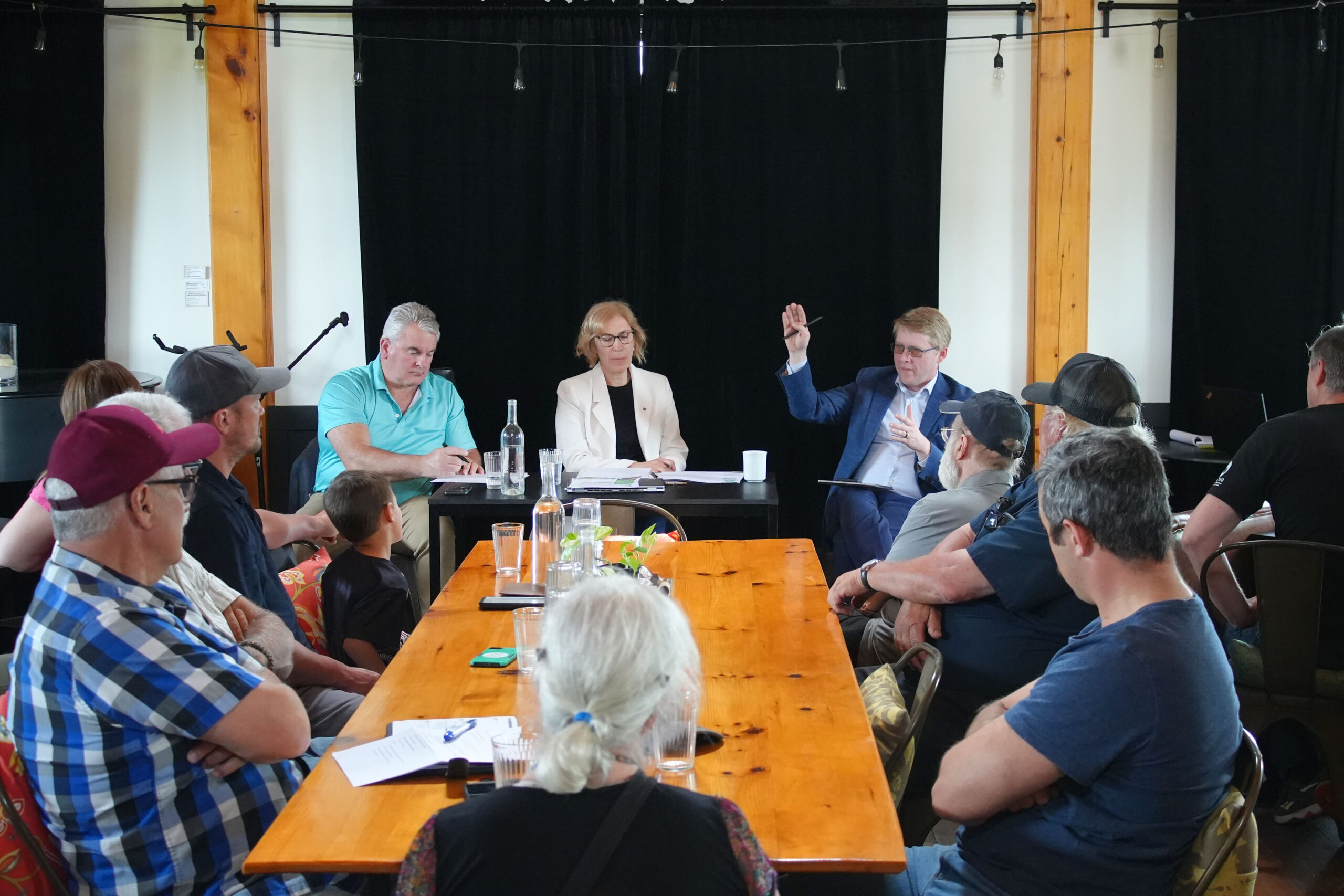



Pontiac farmers and others involved in local food production gathered at the Little Red Wagon Winery on Friday afternoon for a three-hour discussion about the future of Canada’s agricultural industry.
The discussion was facilitated by Pontiac-Kitigan Zibi MP Sophie Chatel as part of the nationwide consultations underway with farmers about what needs to be prioritized in the federal government’s next agricultural policy framework. This framework will serve as the main federal, provincial and territorial strategy for supporting Canada’s agriculture and agri-food sector from 2028-2033.
The conversation was co-hosted by Tyler McCann, director of the Canadian Agri-Food Policy Institute, and Stéphane Alary, president of the Outaouais-Laurentides chapter of the Union des Producteurs Agricoles (UPA).
The meeting was held under Chatham House Rule, meaning participants could not be quoted directly unless they gave explicit permission.
The first question put to the room asked what the biggest risks are to the industry at this moment, and what kind of government support could help manage these risks.
Feedback shared included concerns about the aging demographic of farmers, many of whom don’t have people to replace them; challenges around succession, including the financial toll of the capital gains tax when a farm is passed down to the next generation; challenges around access to low-interest capital needed for any farm development projects, including purchasing land; the importance of access to the Ontario market for selling local agricultural products; the need for investment in focused, outcome-driven agricultural research; and rising input costs, particularly in light of the Iran war.
In a follow-up interview, Chatel highlighted two priorities she heard come out of this conversation.
“Two main things that were discussed that I think are very good areas for the government to work on are increasing the capital gains exemption to take into consideration the fact that agricultural land has gone up significantly,” she said.
“But another one I think is even more critical is giving young farmers access to capital, because again the price of land has increased significantly, and it’s very hard for a young farmer that wants to start farming to buy a farm.”
The second half of the discussion focused on what kind of policies or support should be built into the National Food Security Strategy that the federal government is now in the final stages of drafting.

“How do we help Canadians have access to food that is affordable, and how do we reinforce the supply chain so that we have more affordable food?” asked Chatel, prompting conversation.
In response, McCann said he was pleased to see the Prime Minister commit to a National Food Security Strategy in February.
“There’s this potential to look at food security from our own supply issues, our own value-added and processing issues, and I think we’re all waiting to see how far the government is going to go, and how much of it will be grounded in addressing food processing, addressing supply chain issues, addressing critical inputs like fertilizer,” he said.
“We’re all very eager with high hopes and expectations for this to be something that goes beyond what the policy framework does, and really has the federal government planting a stake where agriculture and food is a strategic asset.”
Part of this discussion focused on the need to change the language used to talk about food affordability to challenge the belief that locally produced food is unaffordable and educate consumers about the real cost of food, with the goal of shifting the amount consumers are willing to spend on food.
Another part of the discussion focused on the need for local transformation facilities, such as the much anticipated abattoir, and regional markets where producers can get their products to consumers efficiently and at low cost to the producer – both key components to a food economy that is less dependent on trade.
But this conversation also came back to the need to support farmers in ensuring proper succession of ownership, and such that succession doesn’t bankrupt the next generation when it comes time to pay the capital gains tax. As one participant expressed it, if the government doesn’t look at how to keep people on the land, forget about writing agricultural policies.
Dairy farmer Justin Alary of Luskville’s Ferme Stépido is the second generation to run the farm. He said he feels it’s important to participate in consultations like these to ensure the survival of Canada’s shrinking agricultural industry.

“We need to voice our opinions, and we’re not that many producers when you look at it. If no producers go, they’re going to tell us what to do,” he said. “Everything [raised in the meeting] was important, because it impacts every level of production – big, small, vegetables, beef, grain, whatever, so everything was important.”
Les agriculteurs du Pontiac et d’autres acteurs de la production alimentaire locale se sont réunis au vignoble Little Red Wagon vendredi après-midi pour une discussion de trois heures sur l’avenir de l’industrie agricole canadienne.
La discussion a été animée par la députée de Pontiac-Kitigan Zibi, Sophie Chatel, dans le cadre des consultations nationales en cours avec les agriculteurs sur les priorités à intégrer dans le prochain cadre stratégique agricole du gouvernement fédéral. Ce cadre servira de principale stratégie fédérale, provinciale et territoriale pour soutenir le secteur agricole et agroalimentaire du Canada de 2028 à 2033.
La conversation a été coanimée par Tyler McCann, directeur de l’Institut canadien des politiques agroalimentaires, et Stéphane Alary, président de la section Outaouais-Laurentides de l’Union des Producteurs Agricoles (UPA).
La réunion s’est déroulée sous la règle de Chatham House, ce qui signifie que les participants ne pouvaient pas être cités directement à moins qu’ils n’aient donné une permission explicite.
La première question posée aux participants était de savoir quels sont les plus grands risques pour l’industrie à l’heure actuelle, et quel type de soutien gouvernemental pourrait aider à gérer ces risques.
Les commentaires partagés incluaient des préoccupations concernant le vieillissement démographique des agriculteurs, dont beaucoup n’ont personne pour les remplacer; les défis liés à la succession, y compris le coût financier de l’impôt sur les gains en capital lorsqu’une ferme est transmise à la génération suivante; les défis liés à l’accès à des capitaux à faible taux d’intérêt nécessaires pour tout projet de développement agricole, y compris l’achat de terres; l’importance de l’accès au marché ontarien pour la vente de produits agricoles locaux; le besoin d’investir dans une recherche agricole ciblée et axée sur les résultats; et l’augmentation des coûts des intrants, en particulier à la lumière de la guerre en Iran.
Dans une entrevue de suivi, Mme Chatel a souligné deux priorités qu’elle a retenues de cette conversation.
« Deux points principaux qui ont été abordés et qui, je pense, sont d’excellents domaines sur lesquels le gouvernement peut travailler sont l’augmentation de l’exonération des gains en capital afin de prendre en considération le fait que les terres agricoles ont considérablement augmenté », a-t-elle déclaré.
« Mais un autre point, et je pense qu’il est encore plus critique, est de donner aux jeunes agriculteurs accès au capital, car le prix des terres a encore une fois considérablement augmenté, et il est très difficile pour un jeune agriculteur qui veut démarrer une exploitation d’acheter une ferme. »
La deuxième partie de la discussion a porté sur le type de politiques ou de soutien qui devraient être intégrés à la Stratégie nationale de sécurité alimentaire que le gouvernement fédéral est maintenant en phase finale de rédaction.
« Comment aidons-nous les Canadiens à avoir accès à des aliments abordables, et comment renforçons-nous la chaîne d’approvisionnement afin d’avoir des aliments plus abordables? » a demandé Mme Chatel, suscitant la conversation.
En réponse, M. McCann a déclaré qu’il était ravi de voir le premier ministre s’engager en février à élaborer une Stratégie nationale de sécurité alimentaire.
« Il y a ce potentiel d’examiner la sécurité alimentaire sous l’angle de nos propres problèmes d’approvisionnement, de nos problèmes de valeur ajoutée et de transformation, et je pense que nous attendons tous de voir jusqu’où le gouvernement ira, et dans quelle mesure cela sera fondé sur le traitement des aliments, la résolution des problèmes de chaîne d’approvisionnement, la gestion des intrants essentiels comme les engrais », a-t-il déclaré.
« Nous sommes tous très impatients et nourrissons de grands espoirs et attentes que cela aille au-delà de ce que fait le cadre stratégique, et que le gouvernement fédéral s’engage véritablement là où l’agriculture et l’alimentation sont un atout stratégique. »
Une partie de cette discussion a porté sur la nécessité de modifier le langage utilisé pour parler de l’abordabilité des aliments afin de remettre en question la croyance selon laquelle les aliments produits localement sont inabordables et d’éduquer les consommateurs sur le coût réel des aliments, dans le but de modifier le montant que les consommateurs sont prêts à dépenser pour l’alimentation.
Une autre partie de la discussion a porté sur la nécessité d’installations de transformation locales, telles que l’abattoir tant attendu, et de marchés régionaux où les producteurs peuvent acheminer leurs produits aux consommateurs efficacement et à faible coût pour le producteur – deux éléments clés pour une économie alimentaire moins dépendante du commerce.
Mais cette conversation est également revenue sur la nécessité de soutenir les agriculteurs pour assurer une succession adéquate de la propriété, et pour que la succession ne ruine pas la prochaine génération lorsqu’il s’agit de payer l’impôt sur les gains en capital. Comme l’a exprimé un participant, si le gouvernement ne s’intéresse pas à la manière de maintenir les gens sur leurs terres, oublions l’élaboration de politiques agricoles.
Justin Alary, producteur laitier de la Ferme Stépido de Luskville, est la deuxième génération à diriger l’exploitation. Il a déclaré qu’il estimait important de participer à de telles consultations pour assurer la survie de l’industrie agricole canadienne en déclin.
« Nous devons exprimer nos opinions, et nous ne sommes pas si nombreux quand on y pense. Si aucun producteur n’y va, ils vont nous dire quoi faire », a-t-il déclaré. « Tout ce qui a été soulevé [lors de la réunion] était important, car cela a un impact sur tous les niveaux de production – grands, petits, légumes, bœuf, céréales, peu importe, donc tout était important. »