






MRC Pontiac staff are reminding the public of the proper storage and disposal of batteries to prevent fires and keep the harmful waste out of the regular garbage and recycling streams.
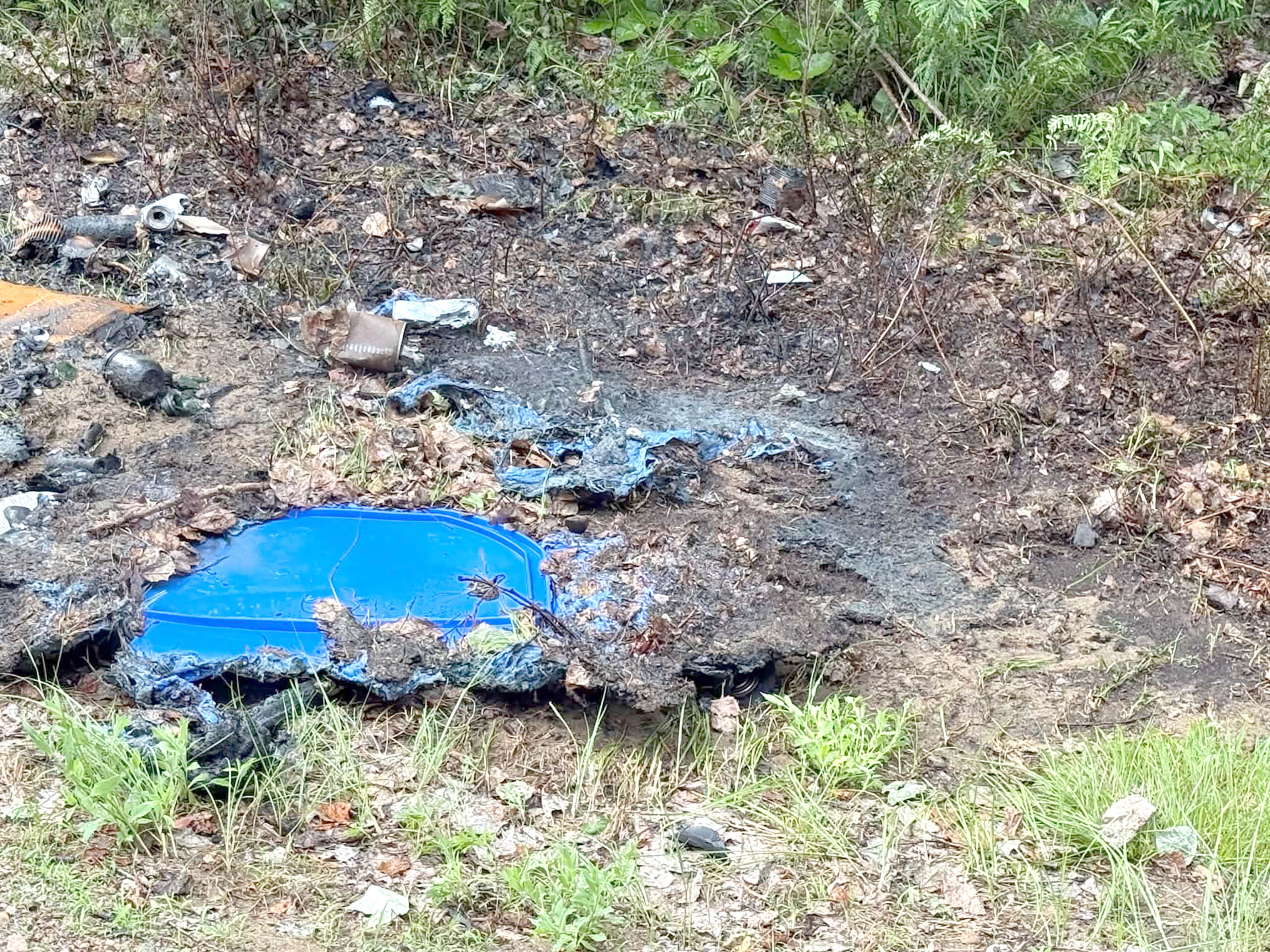
MRC environmental coordinator for waste, Nina Digioacchino, said that the idea was inspired in part by a fire that occurred on L’Isle-aux-Allumettes in June, where a blue bin was destroyed by a battery fire.
Pontiac Ouest fire chief Glynn Fleury said that luckily the bin wasn’t in a garage or near a building when it ignited.
“By the time we got there it was all destroyed, but we found evidence of batteries being disposed of improperly,” he said.
According to Recyc-Québec’s website, lithium-ion batteries are one of the main causes of fires in sorting centres in recent years, as they can catch fire or explode when subjected to friction or compaction.
Fleury said that while it’s not a commonly recurring issue in the territory his department covers, he hopes residents take it as a warning that batteries need to be thrown away properly.
“It only happened once. [We] don’t want it to happen all the time,” he said. “Blue bins are stored next to structures before they’re put out by the road, it could create a structure fire too. [ . . . ] Dispose of them properly through your local transfer site, they take all kinds of batteries and dispose of them correctly.”
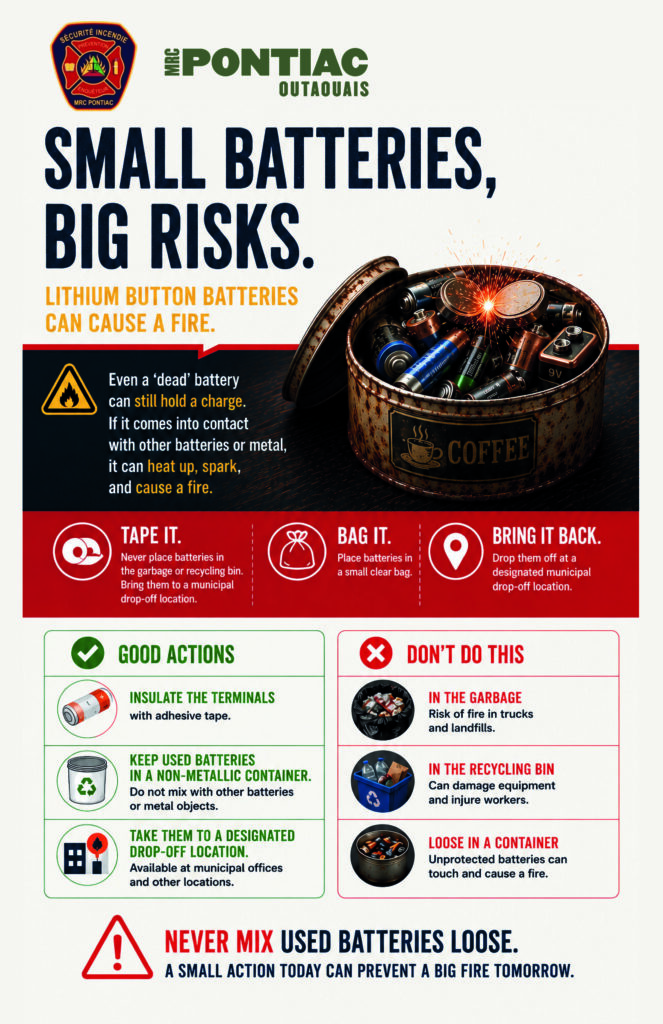
Digioacchino said that when storing old batteries at home it’s also important to tape over the terminals to prevent them from coming into contact with anything, and store them in a non-metallic container or bag, as opposed to an old coffee tin.
“A dead battery is not a safe battery, there’s still potentially charge left over,” she said.
An infographic distributed by the MRC’s fire protection warns that batteries shouldn’t be left to charge on a bed, couch or under a pillow. It also warns to stop using a battery immediately if it swells, changes colour or becomes damaged.
Digioacchino said that there are currently boxes for safe battery disposal at local transfer sites and she’s also distributed some to municipal offices and libraries as well, which can take batteries up to the size commonly used in drills and hand power-tools.
“It didn’t used to be problematic, they were only in watches but now they’re everywhere,” she said.
She pointed out that there’s a provincial website called Ça va où? (It goes where?) which offers waste disposal and recycling tips for all kinds of materials, and has maps for where local drop-off points are as well.
Le personnel de la MRC de Pontiac rappelle au public l’importance de bien entreposer et éliminer les piles et les batteries afin de prévenir les incendies et d’éviter que ces déchets dangereux ne se retrouvent dans les circuits de collecte d’ordures ménagères et de recyclage habituels.
Nina Digioacchino, coordonnatrice environnementale de la MRC pour la gestion des matières résiduelles, a déclaré que l’idée avait été inspirée en partie par un incendie survenu à L’Isle-aux-Allumettes en juin, où un bac bleu a été détruit par un feu de batterie.
Le chef des pompiers de Pontiac Ouest, Glynn Fleury, a déclaré qu’heureusement, le bac ne se trouvait pas dans un garage ou près d’un bâtiment lorsqu’il s’est enflammé.
« Quand nous sommes arrivés, tout était détruit, mais nous avons trouvé des preuves d’élimination inappropriée de piles », a-t-il dit.
Selon le site web de Recyc-Québec, les batteries au lithium-ion sont l’une des principales causes d’incendies dans les centres de tri ces dernières années, car elles peuvent s’enflammer ou exploser lorsqu’elles sont soumises à la friction ou à la compaction.
M. Fleury a indiqué que bien que ce ne soit pas un problème récurrent courant sur le territoire couvert par son service, il espère que les résidents le prendront comme un avertissement que les piles et batteries doivent être jetées correctement.
« Ça n’est arrivé qu’une seule fois. Nous ne voulons pas que ça arrive tout le temps », a-t-il dit. « Les bacs bleus sont entreposés à côté de structures avant d’être déposés en bord de route, cela pourrait aussi provoquer un incendie de bâtiment. [ . . . ] Éliminez-les correctement via votre site de transbordement local, ils acceptent toutes sortes de piles et les éliminent correctement. »
Mme Digioacchino a déclaré que lors de l’entreposage de vieilles piles à la maison, il est également important de recouvrir les bornes avec du ruban adhésif pour éviter tout contact, et de les ranger dans un contenant ou un sac non métallique, par opposition à une vieille boîte de café.
« Une pile morte n’est pas une pile sécuritaire, il reste encore potentiellement de la charge », a-t-elle dit.
Une infographie distribuée par le service de protection incendie de la MRC avertit que les batteries ne devraient pas être laissées en charge sur un lit, un divan ou sous un oreiller. Elle avertit également d’arrêter d’utiliser une batterie immédiatement si elle gonfle, change de couleur ou est endommagée.
Mme Digioacchino a déclaré qu’il existe actuellement des boîtes pour l’élimination sécuritaire des piles et batteries dans les sites de transbordement locaux et qu’elle en a également distribué à des bureaux municipaux et des bibliothèques, qui peuvent accepter les piles et batteries jusqu’à la taille couramment utilisée dans les perceuses et les outils électriques portatifs.
« Ce n’était pas problématique avant, elles n’étaient que dans les montres, mais maintenant elles sont partout », a-t-elle dit.
Elle a souligné qu’il existe un site web provincial appelé Ça va où ? (Où ça va ?) qui offre des conseils sur l’élimination des déchets et le recyclage pour toutes sortes de matériaux, et propose également des cartes indiquant les points de dépôt locaux.