


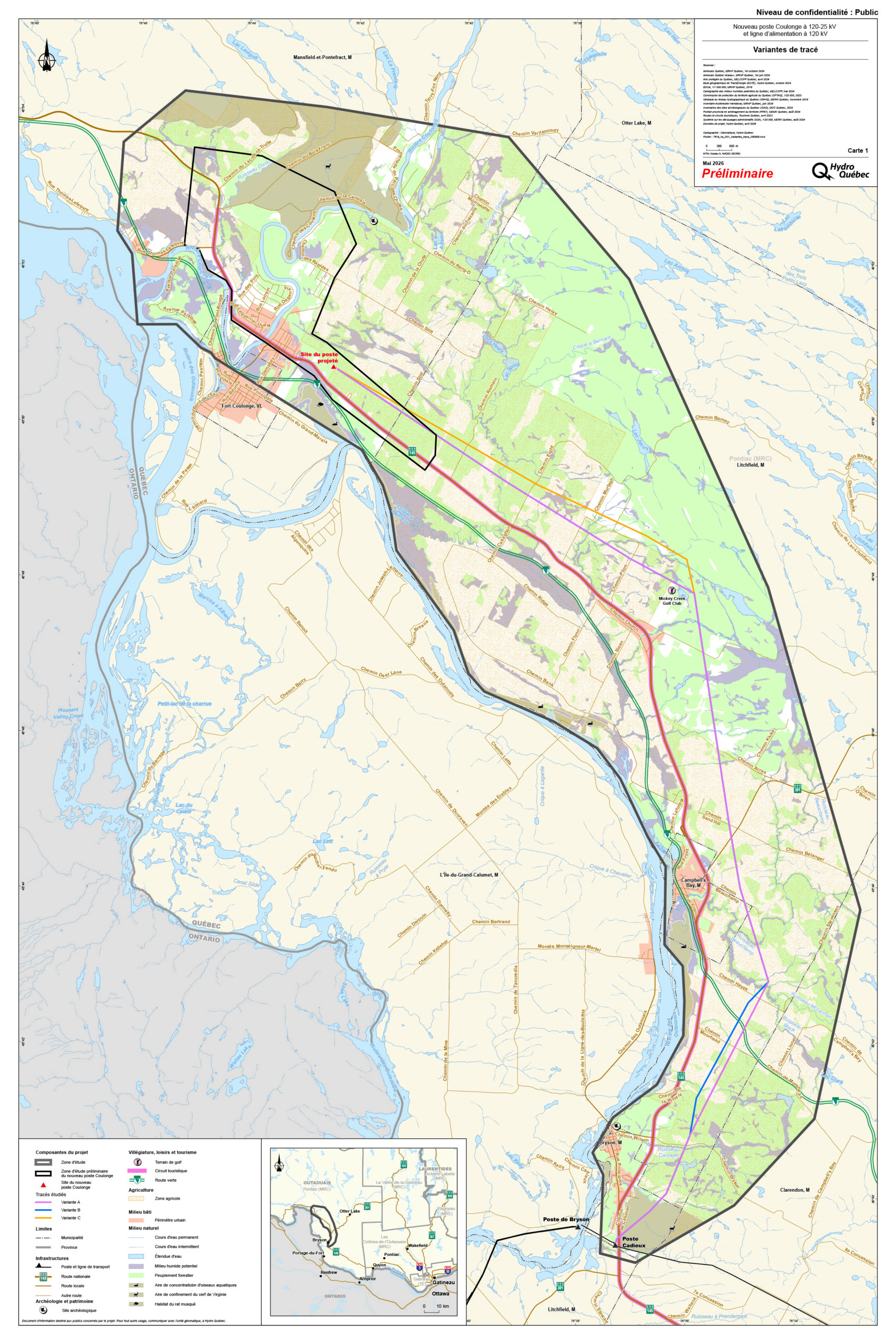



Hydro-Québec has put forward a proposal for where it will build the new transmission lines that will connect the Cadieux substation to the new substation it plans to build in Mansfield-et-Pontefract.
Last May, the hydro provider announced plans to build a 120-25 kV substation near Fort-Coulonge, as well as rebuild the Cadieux substation in Bryson and update 30 kilometres of supply lines between the two. There will also be new distribution lines put up between the Coulonge substation and the existing Waltham generating station.
Currently, residents east of Mansfield get their electricity from lower voltage distribution lines coming from the Cadieux station in Bryson, while residents in the upper Pontiac are dependent on the Waltham generating station for their power. There are no high voltage transmission lines west of Bryson.
The planned upgrades will shorten the distance the distribution lines have to cover to get power to upper Pontiac homes after leaving the substation and connect residents to Quebec’s grid, making their power supply far more reliable.
In a community consultation hosted last Wednesday (May 20) in Fort-Coulonge, representatives from the utility provider shared a map of the route it is suggesting for these supply lines and took questions and feedback from residents on the larger project.
Leaving the Cadieux station, the route (displayed here) travels just east of Highway 148 through Bryson and Litchfield to Fort-Coulonge, clipping a corner of Campbell’s Bay on its way through.
The route is designed, in part, to offer the lines the longest possible stretch of straight corridor before having to change direction, and makes only two pivots before it gets to the Coulonge substation.
The towers carrying the lines will be between 24.25 metres and 47 metres tall. A 56-metre wide clearing will need to be maintained along the entire route of the power lines to ensure no trees obstruct them.
In the first and third legs of the route, Hydro-Québec offers a variant to the primary course, and says it is seeking resident feedback to determine which option will be least intrusive.
“In one of the options, we pass along the bottom of the properties. We’d like to prioritize this option over the one that passes through the middle of the properties,” said Hydro-Québec community relations advisor Simon Desjardins.
He said Hydro-Québec will not be purchasing the needed land, but will have a right of way to it. He said there is compensation available for property owners depending on how much land will be used by the infrastructure, and how much forested land needs to be cleared.
“We have to find the route with the least impact,” said Johanne Savard, another Hydro-Québec communications advisor, noting representatives of the corporation had already met with many of the landowners affected.
Campbell’s Bay residents Scott Brown and Eryn Darling were among the property owners surprised to learn their land would likely soon have large transmission lines cutting through it.
They moved to the region from southern Ontario about three years ago to raise their young family and start an organic farm business.
“We wanted to feed people and we couldn’t find farmland. After seven years, we finally planted our feet here,” Brown told THE EQUITY Thursday, the day after the consultation.
“We didn’t know about [the lines] going through the farm until someone came and knocked on our door yesterday and said, ‘Hey, it’s going through mine, I see it’s going through yours.’ We had a lot to discuss last night but in the end we were just heartbroken, was the only thing we could come up with.”
Brown said he understands this infrastructure upgrade is long overdue for the region, but says the current proposal for the route of the lines will have an impact on his business and the future he and his wife had imagined for themselves.
Brown and Darling have pasture-raised chickens, goats, cows, and pigs on their farm, and this year are starting a market garden.
“We are looking for more agritourism in the area,” Brown said. “We’ve been pushing to get approval to have camping, especially with the market garden being installed, but I know I wouldn’t want to camp there, with lack of aesthetics, and massive towers right above your head.”
He and Darling are but one of the many dozens of property owners who will be affected by these power lines. Last week, Hydro-Québec representatives still had a handful of landowners to meet with.
“It’s a public service, so the owner will not be richer, but our main concern is that they do not lose money,” said Benoit Charette, another Hydro-Québec representative.
Once the consultation period is over at the end of this year, the final plan will be announced, proper permits will be secured, and construction work is scheduled to begin in 2028.
Hydro-Québec a présenté une proposition pour l’emplacement des nouvelles lignes de transport qu’elle construira et qui relieront le poste Cadieux au nouveau poste qu’elle prévoit construire à Mansfield-et-Pontefract.
En mai dernier, le fournisseur d’électricité a annoncé son intention de construire un poste 120-25 kV près de Fort-Coulonge, ainsi que de reconstruire le poste Cadieux à Bryson et de moderniser 30 kilomètres de lignes d’alimentation entre les deux. De nouvelles lignes de distribution seront également installées entre le poste de Coulonge et la centrale existante de Waltham.
Actuellement, les résidents à l’est de Mansfield reçoivent leur électricité par des lignes de distribution à basse tension provenant du poste Cadieux à Bryson, tandis que les résidents du Haut-Pontiac dépendent de la centrale de Waltham pour leur alimentation. Il n’y a pas de lignes de transport à haute tension à l’ouest de Bryson.
Les améliorations prévues réduiront la distance que les lignes de distribution doivent parcourir pour acheminer l’électricité aux foyers du Haut-Pontiac après avoir quitté le poste et relieront les résidents au réseau québécois, rendant leur approvisionnement en électricité beaucoup plus fiable.
Lors d’une consultation communautaire tenue mercredi dernier (20 mai) à Fort-Coulonge, des représentants du fournisseur d’électricité ont partagé une carte du tracé qu’il suggère pour ces lignes d’alimentation et ont recueilli les questions et les commentaires des résidents sur l’ensemble du projet.
En partant du poste Cadieux, le tracé (présenté ici) passe juste à l’est de l’autoroute 148, à travers Bryson et Litchfield jusqu’à Fort-Coulonge, frôlant un coin de Campbell’s Bay sur son passage.
Le tracé est conçu, en partie, pour offrir aux lignes le plus long tronçon possible de corridor droit avant de devoir changer de direction, et ne fait que deux pivots avant d’atteindre le poste de Coulonge.
Les pylônes portant les lignes mesureront entre 24,25 mètres et 47 mètres de haut. Un corridor de 56 mètres de largeur devra être maintenu le long de l’ensemble du tracé des lignes électriques afin de s’assurer qu’aucun arbre ne les obstrue.
Dans les première et troisième sections du tracé, Hydro-Québec propose une variante au tracé principal et affirme solliciter les commentaires des résidents pour déterminer quelle option sera la moins intrusive.
« Dans l’une des options, nous passons en bas des propriétés. Nous aimerions prioriser cette option plutôt que celle qui passe au milieu des propriétés », a déclaré Simon Desjardins, conseiller en relations avec le milieu chez Hydro-Québec.
Il a indiqué qu’Hydro-Québec n’achètera pas les terrains nécessaires, mais disposera d’un droit de passage. Il a mentionné qu’il existe une compensation pour les propriétaires fonciers selon la superficie de terrain utilisée par l’infrastructure et la quantité de terres boisées à défricher.
« Nous devons trouver le tracé ayant le moins d’impact », a déclaré Johanne Savard, une autre conseillère en communications d’Hydro-Québec, précisant que des représentants de la société avaient déjà rencontré plusieurs des propriétaires fonciers concernés.
Scott Brown et Eryn Darling, résidents de Campbell’s Bay, comptaient parmi les propriétaires fonciers surpris d’apprendre que de grandes lignes de transport traverseraient bientôt leurs terres.
Ils ont déménagé dans la région du sud de l’Ontario il y a environ trois ans pour élever leur jeune famille et lancer une entreprise agricole biologique.
« Nous voulions nourrir les gens et nous ne trouvions pas de terres agricoles. Après sept ans, nous avons enfin trouvé notre place ici », a dit Brown à THE EQUITY jeudi, le lendemain de la consultation.
« Nous ne savions pas que [les lignes] traverseraient la ferme jusqu’à ce que quelqu’un vienne frapper à notre porte hier et dise : « Hé, ça passe par chez moi, je vois que ça passe par chez vous. » Nous avons eu beaucoup à discuter hier soir, mais au final, nous étions simplement navrés, c’est la seule chose à laquelle nous pouvions penser. »
Brown a dit qu’il comprend que cette mise à niveau de l’infrastructure est attendue depuis longtemps dans la région, mais il affirme que la proposition actuelle pour le tracé des lignes aura un impact sur son entreprise et sur l’avenir qu’il avait imaginé pour lui et sa femme.
Brown et Darling élèvent des poulets, des chèvres, des vaches et des porcs en pâturage sur leur ferme, et cette année, ils démarrent un jardin maraîcher.
« Nous cherchons à développer davantage l’agrotourisme dans la région, » a dit Brown. « Nous avons fait pression pour obtenir l’approbation d’avoir du camping, surtout avec l’installation du jardin maraîcher, mais je sais que je ne voudrais pas camper là, avec le manque d’esthétique et des pylônes massifs juste au-dessus de ma tête. »
Lui et Darling ne sont qu’un des nombreux dizaines de propriétaires fonciers qui seront touchés par ces lignes électriques. La semaine dernière, des représentants d’Hydro-Québec devaient encore rencontrer quelques propriétaires fonciers.
« C’est un service public, donc le propriétaire ne s’enrichira pas, mais notre principale préoccupation est qu’il ne perde pas d’argent », a déclaré Benoit Charette, un autre représentant d’Hydro-Québec.
Une fois la période de consultation terminée à la fin de cette année, le plan final sera annoncé, les permis nécessaires seront obtenus et les travaux de construction devraient commencer en 2028.