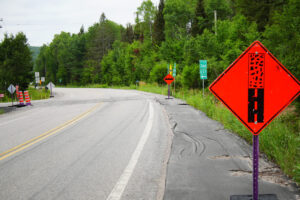






Have you ever paid a speeding ticket? There are the regular maximum speed signs on most roads, but then there are school zones, construction zones, and sometimes speed zones that change several times on the same street. Use of photo radar is usually marked with warning signs before you get there. The largest fine that I ever paid was issued because I was going too fast through a construction zone after dark on a major six-lane highway following a line of traffic many miles long all going about 40 kilometres over the limit, all caught on photo radar. I could only imagine how many million dollars were made in a few rush hours at that one place. But if the photo radar is lifted, accidents and deaths will increase very fast.
We have recently been warned about an anticipated El Niño forming in the Pacific Ocean, which could trigger a very hot and dry summer over most of mid-America, including southern Canada, this year. An early wildfire and flooding season has already begun. For farmers, maintaining and improving water-holding capacity of our soil is the best way to avoid water runoff, store extra rain for dry time ahead, and prepare for the coming heat.
Our farmers have been told several times that buffer strips beside creeks, lakes, and rivers must be maintained with permanent grass and brush or trees to prevent water erosion during extended wet times. Farmers have recently been reminded that maintaining and improving the water-holding capacity of our soil is even more important. A drive through the country after a rainy spring or a heavy rain in the summer will soon show which field has good water holding capacity and the others will be flooding that “brown water” turned brown with some top soil washing away with the water.
I recently studied a dairy farmer in Wisconsin who milked 700 cows (large for Canada but average for the U.S.). He had an average milk production of 105 lbs. per cow per day, and fed a 40 per cent grain, 60 per cent forage ration. This can only be accomplished with excellent quality forages, high nutrient density, and a perfectly balanced ration. He had spent twenty years weaning his farm off chemical fertilizers, chemical crop sprays, and GMO crops. He also watched the earth worm count in the soil and other life in the soil, like micro bacteria, protozoa, etc..
He also used a penetrometer to check the hardness of the soil. Soil is made up of air, water, organic matter, soil life, and mineral content. A hard soil is too hard for water to infiltrate, low in air, and low in soil life (worms, and other miniature soil animals). A healthy soil has a billion miniature micro-animals in one teaspoon of topsoil who aerate the soil and break down organic matter and mineral particles into a solution that can be used as fertilizer for plant growth. He insisted that the success of his herd was only possible with very close attention to the soil and the life in it.
The most successful farm in our county just announced that it will no longer be using chemical fertilizers. I was also reminded lately that GMO crops are higher in lignans and take more power to chop with more frequent knife sharpening. A longer digestion rate also reduces the amount of nutritious feed that an animal can eat per hour, hence lower production.
I was surprised that a pharmaceutical company just announced that it would no longer guard the patent on the world’s most used herbicide ingredient. Only a year ago it threatened the U.S. that it might quit manufacturing the world’s most used herbicide because of legal action against it. Since 1990 I have wondered why wild birds and animals don’t eat GMO plants or grains and now I think I know. Unfortunately, for the last three generations of farmers, most colleges and universities have been preaching that modern agriculture, and the use of chemicals, will be the future of our planet. Actually today, just over half of the food produced in the world is actually eaten by our population. A lot of it gets wasted. Actually the most dangerous problem with that very popular herbicide ingredient is that it is also patented as a bactericide that kills those micro-bacteria in the soil and the micro-bacteria that make up the biome in our digestive system who not only help digest our food, but help repair little tears, and holes in our gut. Don’t forget to watch for signs. rove mental health. What is really important in your life?
Chris Judd is a farmer in Clarendon on land that has been in his family for generations. gladcrest@gmail.com