





Connor Lalande
Pontiac May 15, 2023
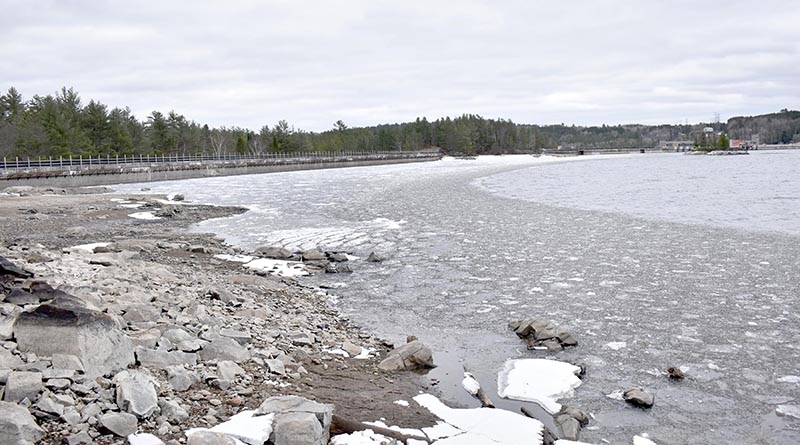
Another spring has come, and with it, another year of flooding along the Ottawa River and its tributaries. The waters began receding from peak levels in early-May, but in their wake they’ve left property damage, high stress levels, and many questions about how the Ottawa River watershed is managed.
In what increasingly seems to be an almost annual occurrence, municipal officials, first responders and property owners banded together to stave off the damaging and dangerous effects of the Pontiac’s surging rivers.
With each year the Ottawa River and its tributaries flood – putting people and property alike in harm’s way – frustration builds. “Why does this keep happening?” is a common refrain echoed throughout the region.
Hydro-Quebec Community relations advisor, Alain Paquette, attributes recent flooding along the Ottawa River to weather conditions rather than the management of the reservoirs.
“Recent spring thaws brought effectively higher water levels and debits [water flows] in the Ottawa watershed,” Paquette said in an email sent to THE EQUITY.
“Snow cover during winter was higher than usual these same years. It is particularly true for 2017, 2019 and 2023. To add to that heavy snow cover, precipitation during these years were also important, precisely at a moment when snow cover had not melted yet on the territory,” he explained.
“Also, the ground was not completely unfrozen, so its capacity to absorb water was absent these three years. When these three ingredients are added (snow, rain, frozen ground), that makes a lot of water to manage for all reservoir owners on the Ottawa river.”
The Ottawa River has five reservoirs, owned and operated by four different organizations: Ontario Power Generation (OPG), Hydro-Québec (HQ), Ministère de l’Environnement et de la Lutte contre les changements climatiques of Quebec (MELCC), and Public Services and Procurement Canada (PSPC).
Each reservoir is regulated by a dam and has the capacity to store over 200 million cubic meters of water.
The Ottawa River Regulation Planning Committee (ORRPC) is the umbrella organization that integrates the management of the reservoirs into one process. In doing so, decision making is collectivized amongst management stakeholders, although each operator is responsible for decision making at their facilities.
Management of the reservoir system has a direct impact on water levels along the Ottawa River.
Self-taught flood tracking hobbyist Dan Poole said that increased flooding along the Ottawa River and its tributaries is causing residents mental and financial stress, leading many to seek out information and come to their own opinions on the causes of the flooding.
Poole administers a flood tracking Facebook group called Northern Reservoirs, Ottawa River Flood and Tornado Watch Group where members share open-source flood data and anecdotal experiences related to flooding within the Ottawa River watershed.
“Just the past 11 years we had floods in 2013, 2014, 2017, 2019 and 2023,” Poole said.
“That’s way higher than the past average so something is happening and people are really worried about what’s happening. Many people bought and purchased properties legally with the municipalities full permission only now to find out that frequent flooding is costing them dearly in stress and financial ruin due to frequent flooding issues.”
According to Poole, it is the outdated Ottawa River reservoir system, in conjunction with changing weather conditions, that is leading to increased flood risks within the watershed. Poole believes reservoir managers including Hydro-Quebec are doing the best they can within the existing framework of the reservoir system.
Nevertheless, Poole says changing weather conditions and an antiquated reservoir system are contributing to a persistent flooding issue that needs to be addressed.
“We need a water management inquiry to see what is really happening,” Poole said. “Is management responsible for not finding solutions or is it a dual problem with no political will involved? After three out of the last seven years of record flooding, the public deserves answers and solutions.”
Larissa Holman is the director of science and policy at Ottawa Riverkeeper, a local charity that works to protect and advocate for the Ottawa River.
Holman said that while climate change may be a contributing factor to the recent flooding events along the Ottawa River and its tributaries, it is not yet conclusive as further studies are needed.
Nevertheless, Holman pointed to tangible ways in which flood effects can be mitigated on a legislative level.
“When you start talking about climate change as a possible part of these equations, people feel very disempowered. They feel like they can’t do anything about it. But I would encourage people to consider things like what is happening with development in their communities? Are wetlands being protected and conserved? Are our riparian zones being respected? By maintaining this natural infrastructure, we can help mitigate the effects of flooding when it does happen,” Holman said. “We’re seeing that the protections for wetlands and riparian zones are slowly getting taken away.”
Flooding along the Ottawa River and its tributaries is not a new phenomenon. According to a Government of Canada report entitled Flooding Events in Canada: Quebec, “Spring snowmelt accompanied by rainfall is the major cause of flooding in Quebec. This was the case for many Quebec rivers in 1974 and 1976, particularly in the Ottawa River basin and the Montreal region.”
While adjacent communities have experienced flooding in the past, there is a common sentiment that flooding along the Ottawa River and its tributaries is increasing in regularity and severity. Some residents point to the destructive floods of 2017 and 2019, as well as recurrent high water and flow warnings that seem to occur annually, as evidence of this.
Holman said that the terminology we use to conceptualize flooding along the Ottawa River is important to understanding the broader context of what is happening.
“When we use a term like “one in 100 year flood,” the idea is that it’s a statistical possibility,” Holman said. “It’s not that they happen once every 100 years.”