





Brett Thoms
Pontiac May 18 2022
Pontiac MNA André Fortin expects Bill 96 to become law during this week’s sitting of the National Assembly, despite concerns of Quebec’s English-speaking communities.
“When parliament resumes next week, it’s likely going to pass because it has support from every party except for ours, it has been studied for the last year and . . .
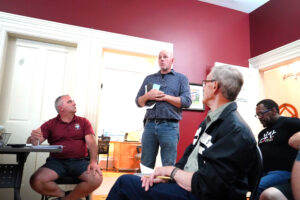
there isn’t any mechanism to halt the progress from a parliamentary standpoint,” said Fortin at last week’s MRC Council of Mayors.
As a part of his remarks about the bill, Fortin said that he felt it was his duty to try to explain how the bill is going to impact his English-speaking constituents, especially concerning the most controversial aspects of the bill to the anglophone community, which include how it will affect their access to healthcare, government services and their protection from warrantless search and seizure.
“It is a tricky bill to explain. It has 240 different articles, so it’s not necessarily easy to understand,” said Fortin.
On healthcare, Premier Legault emphasized at a press conference that Bill 96 will not affect anglophone’s access to healthcare in any way and said that critics of the bill are spreading disinformation.
“I want to be very clear, there is no change at all in the actual situation of services given to anglophones and immigrants in English in our health-care system,” said Legault in Laval on May 17.
However, Fortin said that anglophone access to healthcare will be negatively affected by Bill 96 in two ways.
“First they’re putting a cap on the number of students that can go to Heritage College,” said Fortin. “You will be preventing people who want to go into the nursing program at Heritage College from attending it. Those people might turn to Algonquin College, or they might turn to other places to get their education and if they don’t get trained in Heritage College, if they get trained in Ontario, they are not going to work in the healthcare system in Quebec. So, to me, that’s a way in which we are going to lose health care professionals in this region. It may not be the case in Montreal or in other places. But in this region, it’s going to have a direct effect on the number of nurses that we train, recruit and keep in our region.”
Another concern Fortin has about what Bill 96 means in terms of access to healthcare was the requirement in the bill that employers must be able to explain to the Quebec government why they need to hire bilingual employees.
“If any employer in Bill 96 is forced to explain why they need a bilingual position, every time they post a job opportunity, the healthcare system may decide not to post bilingual positions and at that point in time it can become harder for an anglophone to have access to service in their language in hospitals or in CLSCs,” said Fortin.
Fortin stressed that receiving healthcare in a language you understand is very important.
“You want to understand everything that’s going on. You want to know exactly what the healthcare professional is telling you,” he said. “You want to know exactly what prescription they’re recommending to you, the treatment options, what’s happening to your body. And unfortunately, there may be people who will not understand what’s being told to them in the healthcare services.”
Bill 96 also requires that Quebec residents prove they are a so-called historic anglophone in order to be eligible to receive services from the province.
“Well, the government’s explanation as to who is a historic anglo is those who have the right for an English education in Quebec,” said Fortin. “So there is already a definition based on who has access to education in English in Quebec. If your parents had an English education in the province or in the country, you can be educated in the province in English. But the problem is now you’re going to be asking 60-year-olds to go back and get the documents that they need in order to prove every time they want to talk to somebody in the government. So, if an anglophone wants to talk to Revenue Quebec, Hydro Quebec or Parks Quebec, or whatever it might be, they’ll have to go to their old school board to get that documentation. It’s asking a lot for very simple services. People may be willing to do it for their child to be educated in English in the province, but if you have to do that to report an outage in your area with Hydro Quebec, it’s excessive.”
Fortin explained that this applies to service recived at the provincial level. Municipalities with over a 50 per cent anglophone population will still be allowed to offer municipal services in English without any requirement.
However, municipalities with under 50 per cent anglo population, like the Municipality of Pontiac, will be required to pass a resolution in their council every three years to affirm they want to continue to offer their population services in English. Fortin went on to say that if that resolution is not repeatedly renewed on a three-year basis for whatever reason, then they lose the right to provide their citizens services in English permanently.
Another concern discussed by Fortin was the powers given to Office québécois de la langue française (OQLF) to investigate businesses that aren’t conducting operations in French.
“They are giving more powers to the OQLF inspectors than to police officers, ‘’ said Fortin. “Police officers who are investigating people for all sorts of crimes do not have powers to search and seize without judges mandates.”
“OQLF inspectors will have those powers,” said Fortin. “Will they use them? We’ll see but they will have those powers according to Bill 96. I get why people are worried. Once you give someone the power, you know that some will use it to the letter of the law.”
The final concern outlined by Fortin was the CAQ’s invocation of the notwithstanding clause in the bill.
The notwithstanding clause, or section 33 of the Charter of Rights and Freedoms allows the House of Commons or provincial legislatures to override charter protections and prevent bills from facing legal challenges. Once the notwithstanding clause is invoked, it must be renewed every five years.
“The government blanketed the bill in the notwithstanding clause which is an unprecedented way of doing things in this country,” said Fortin. “It’s never happened that a bill is fully blanketed in the notwithstanding clause in order to prevent court challenges. It’s a way of protecting its bill making sure that the French language bill basically trumps the Charter of Rights and Freedoms. And there simply is no reason to do that other than the government knowing that they are taking rights and freedoms away.”
Fortin encourages people concerned over exactly what their rights will be after the bill passes to contact his office. He says he hopes to clarify some information so people know what their rights still are.
“There’s a lot of information about the bill,” said Fortin. “Some of it is true, some of it is iffy and some it is still up for debate because we don’t know where the regulations are going to land.”
Warden of the MRC Pontiac Jane Toller said she is concerned about the impending passage of Bill 96, specifically over the impact it will have on people coming to live and invest money in the area.
“I’m going to tell the premier who I hope to see soon that I’m concerned about this,” said Toller. “I think it could be proven to be harmful to the province of Quebec, because I do believe it will limit the investment from other countries in this province. However, as long as we can remain bilingual, we can keep the sign out saying everyone is welcome in the Pontiac and we encourage immigration here and we encourage the use of both languages.”
For his part, Premier Legault said that despite the consequences it may have for anglophones, the bill is necessary to protect the French language in Quebec.
“In Quebec we need to protect French,” said Legault. “There will always be an attraction to English in North America, and we have to be careful if we want our children and grandchildren to speak French.”
Brett Thoms
Pontiac 18 mai 2022
Le député de Pontiac, André Fortin, s’attend à ce que le projet de loi 96 soit adopté cette semaine à l’Assemblée nationale, malgré les préoccupations des communautés d’expression anglaise du Québec.
« Lorsque le Parlement reprendra la semaine prochaine, il sera probablement adopté parce qu’il a le soutien de tous les partis, sauf le nôtre, il a été étudié au cours de la dernière année et… »
«… il n’y a aucun mécanisme pour en arrêter le progrès d’un point de vue parlementaire », a déclaré M. Fortin lors du Conseil des maires de la MRC la semaine dernière.
Dans le cadre de ses commentaires sur le projet de loi, M. Fortin a déclaré qu’il estimait qu’il était de son devoir d’essayer d’expliquer comment le projet de loi allait avoir un impact sur ses commettants d’expression anglaise, en particulier en ce qui concerne les aspects les plus controversés du projet de loi pour la communauté anglophone, notamment la façon dont il affectera leur accès aux soins de santé, aux services gouvernementaux et leur protection contre les fouilles et saisies sans mandat.
« C’est un projet de loi difficile à expliquer. Il contient 240 articles différents, donc ce n’est pas nécessairement facile à comprendre », a déclaré M. Fortin.
En ce qui concerne les soins de santé, le premier ministre Legault a souligné lors d’une conférence de presse que le projet de loi 96 n’affectera en rien l’accès des anglophones aux soins de santé et a déclaré que les critiques du projet de loi diffusaient de la désinformation.
« Je veux être très clair, il n’y a absolument aucun changement à la situation actuelle des services offerts aux anglophones et aux immigrants en anglais dans notre système de santé », a déclaré M. Legault à Laval le 17 mai.
Cependant, M. Fortin a déclaré que l’accès des anglophones aux soins de santé serait négativement affecté par le projet de loi 96 de deux manières.
« Premièrement, ils mettent un plafond sur le nombre d’étudiants qui peuvent aller au Collège Heritage », a déclaré M. Fortin. « Vous empêcherez les personnes qui veulent suivre le programme de sciences infirmières au Collège Heritage d’y assister. Ces personnes pourraient se tourner vers le Collège Algonquin, ou se tourner vers d’autres endroits pour obtenir leur éducation et si elles ne sont pas formées au Collège Heritage, si elles sont formées en Ontario, elles ne travailleront pas dans le système de santé au Québec. Donc, pour moi, c’est une façon dont nous allons perdre des professionnels de la santé dans cette région. Ce n’est peut-être pas le cas à Montréal ou ailleurs. Mais dans cette région, cela aura un effet direct sur le nombre d’infirmières que nous formons, recrutons et gardons dans notre région. »
Une autre préoccupation de M. Fortin quant à ce que le projet de loi 96 signifie en termes d’accès aux soins de santé était l’exigence du projet de loi selon laquelle les employeurs doivent être en mesure d’expliquer au gouvernement du Québec pourquoi ils doivent embaucher des employés bilingues.
« Si un employeur, en vertu du projet de loi 96, est contraint d’expliquer pourquoi il a besoin d’un poste bilingue chaque fois qu’il affiche une offre d’emploi, le système de santé pourrait décider de ne pas afficher de postes bilingues et, à ce moment-là, il pourrait devenir plus difficile pour un anglophone d’avoir accès à un service dans sa langue dans les hôpitaux ou les CLSC », a déclaré M. Fortin.
M. Fortin a souligné qu’il est très important de recevoir des soins de santé dans une langue que l’on comprend.
« Vous voulez comprendre tout ce qui se passe. Vous voulez savoir exactement ce que le professionnel de la santé vous dit », a-t-il déclaré. « Vous voulez savoir exactement quelle prescription il vous recommande, les options de traitement, ce qui arrive à votre corps. Et malheureusement, il pourrait y avoir des gens qui ne comprendront pas ce qui leur est dit dans les services de santé. »
Le projet de loi 96 exige également que les résidents du Québec prouvent qu’ils sont des « anglophones historiques » afin d’être admissibles à recevoir des services de la province.
« Eh bien, l’explication du gouvernement sur ce qu’est un anglo historique est qu’il s’agit de ceux qui ont le droit à une éducation en anglais au Québec », a déclaré M. Fortin. « Il existe donc déjà une définition basée sur qui a accès à l’éducation en anglais au Québec. Si vos parents ont eu une éducation en anglais dans la province ou dans le pays, vous pouvez être éduqué en anglais dans la province. Mais le problème, c’est que maintenant, vous allez demander à des personnes de 60 ans de retourner chercher les documents dont elles ont besoin pour prouver chaque fois qu’elles veulent parler à quelqu’un au gouvernement. Donc, si un anglophone veut parler à Revenu Québec, Hydro-Québec ou Parcs Québec, ou quoi que ce soit d’autre, il devra se rendre à son ancienne commission scolaire pour obtenir cette documentation. C’est beaucoup demander pour des services très simples. Les gens pourraient être prêts à le faire pour que leur enfant soit éduqué en anglais dans la province, mais si vous devez faire cela pour signaler une panne dans votre région avec Hydro-Québec, c’est excessif. »
M. Fortin a expliqué que cela s’applique aux services reçus au niveau provincial. Les municipalités ayant une population anglophone de plus de 50 % seront toujours autorisées à offrir des services municipaux en anglais sans aucune exigence.
Cependant, les municipalités ayant une population anglo de moins de 50 %, comme la Municipalité de Pontiac, devront adopter une résolution à leur conseil tous les trois ans pour affirmer qu’elles veulent continuer à offrir à leur population des services en anglais. M. Fortin a ajouté que si cette résolution n’est pas renouvelée à plusieurs reprises sur une base de trois ans, pour quelque raison que ce soit, elles perdent le droit de fournir des services en anglais à leurs citoyens de façon permanente.
Une autre préoccupation abordée par M. Fortin était les pouvoirs accordés à l’Office québécois de la langue française (OQLF) pour enquêter sur les entreprises qui ne mènent pas leurs activités en français.
« Ils donnent plus de pouvoirs aux inspecteurs de l’OQLF qu’aux policiers », a déclaré M. Fortin. « Les policiers qui enquêtent sur des personnes pour toutes sortes de crimes n’ont pas le pouvoir de fouiller et de saisir sans mandat de juge. »
« Les inspecteurs de l’OQLF auront ces pouvoirs », a déclaré M. Fortin. « Les utiliseront-ils? Nous verrons, mais ils auront ces pouvoirs en vertu du projet de loi 96. Je comprends pourquoi les gens sont inquiets. Une fois que vous donnez un pouvoir à quelqu’un, vous savez que certains l’utiliseront à la lettre de la loi. »
La dernière préoccupation soulignée par M. Fortin était l’invocation par la CAQ de la clause dérogatoire dans le projet de loi.
La clause dérogatoire, ou l’article 33 de la Charte des droits et libertés, permet à la Chambre des communes ou aux législatures provinciales de passer outre aux protections de la Charte et d’empêcher les projets de loi de faire l’objet de contestations judiciaires. Une fois la clause dérogatoire invoquée, elle doit être renouvelée tous les cinq ans.
« Le gouvernement a enveloppé le projet de loi dans la clause dérogatoire, ce qui est une façon sans précédent de faire les choses dans ce pays », a déclaré M. Fortin. « Il n’est jamais arrivé qu’un projet de loi soit entièrement enveloppé dans la clause dérogatoire afin de prévenir les contestations judiciaires. C’est une façon de protéger son projet de loi en s’assurant que le projet de loi sur la langue française l’emporte fondamentalement sur la Charte des droits et libertés. Et il n’y a tout simplement aucune raison de le faire, si ce n’est que le gouvernement sait qu’il retire des droits et des libertés. »
M. Fortin encourage les personnes préoccupées par l’étendue exacte de leurs droits après l’adoption du projet de loi à contacter son bureau. Il dit espérer clarifier certaines informations afin que les gens sachent quels sont toujours leurs droits.
« Il y a beaucoup d’informations sur le projet de loi », a déclaré M. Fortin. « Certaines sont vraies, certaines sont incertaines et certaines sont encore sujettes à débat parce que nous ne savons pas où les règlements vont se situer. »
La préfète de la MRC de Pontiac, Jane Toller, a déclaré qu’elle était préoccupée par l’adoption imminente du projet de loi 96, en particulier par l’impact qu’il aura sur les personnes venant vivre et investir de l’argent dans la région.
« Je vais dire au premier ministre, que j’espère voir bientôt, que je suis préoccupée par cela », a déclaré Mme Toller. « Je pense que cela pourrait s’avérer nuisible à la province de Québec, car je crois que cela limitera l’investissement d’autres pays dans cette province. Cependant, tant que nous pourrons rester bilingues, nous pourrons maintenir l’enseigne disant que tout le monde est bienvenu dans le Pontiac et nous encourageons l’immigration ici et nous encourageons l’utilisation des deux langues. »
Pour sa part, le premier ministre Legault a déclaré que malgré les conséquences qu’il pourrait avoir pour les anglophones, le projet de loi est nécessaire pour protéger la langue française au Québec.
« Au Québec, nous devons protéger le français », a déclaré M. Legault. « Il y aura toujours une attraction pour l’anglais en Amérique du Nord, et nous devons être prudents si nous voulons que nos enfants et petits-enfants parlent français. »