





Brett Thoms
Pontiac May 17 2022
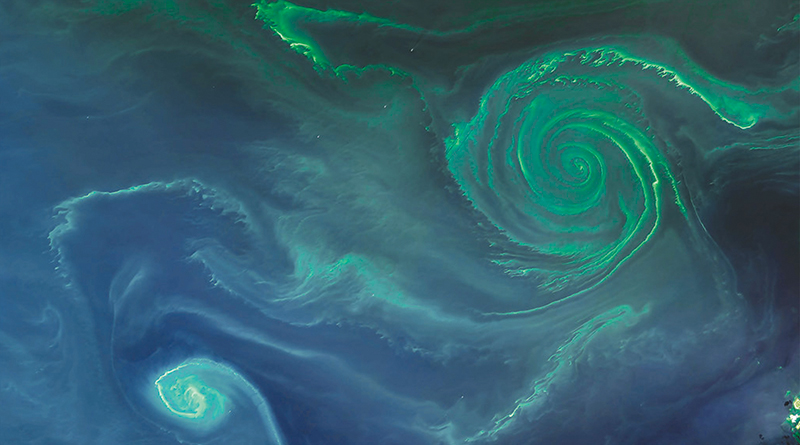
Blue-green algae, or cyanobacteria, is a type of bacteria that forms in bodies of water that has the potential to create toxins harmful to both humans and the broader ecosystem.
Given the potential for blue-green algae to develop in Pontiac waters, THE EQUITY contacted Katy Alambo, a biologist with Ottawa RiverKeeper, spoke with us about what blue-green algae is, what causes it, and whether or not it is a . . .
growing concern along the Ottawa River and in the Pontiac in general.
Blue-green algae typically grows in the mid-to-late-summer and becomes a concern when it accumulates together into a bloom visible on the surface, according to Alambo.
“The one thing with the Ottawa River is that we don’t tend to see as many blooms in the river itself,” said Alambo. “But in the Pontiac region, you might see them occurring in some of the bays. In order for a bloom of blue-green algae to form the water needs to be relatively calm.”
Alambo also mentioned in other bodies of water that minimal flowing water can also see algae blooms, like in lakes for example. “Anywhere where water doesn’t have a really heavy or rapid flow rate,” she added.
While blue-green algae are a natural occurrence, humans do contribute to conditions that help it proliferate.
The first of these conditions is the introduction of nutrients that support the creation of algae blooms into bodies of water by human activity.
“The nutrient that really is the driver when we’re talking about blue-green algae is phosphorus,’’ said Alambo. “Phosphorus and phosphates can be found in a number of different household projects. I know that there are a lot of soaps that contain phosphates, as well as things like agricultural fertilizers.”
The introduction of fertilizers into bodies of water is a human activity that can be a big contributor to the phenomenon.
“We often see a lot of blue-green algae forming in locations that are known to receive a lot of agricultural runoff because it’s so full of nutrients that really helps to promote the formation of these blooms,” said Alambo.
Alambo added that while septic tanks near bodies of water that aren’t sealed and maintained could be a concern, they typically don’t provide nearly as many nutrients that feed into algae blooms as phosphorus products and agricultural runoff.
Another human contribution to the increase in blue-green algae proliferation is warming temperatures.
“In-particular, elevated water temperatures,” said Alambo. “Blue-green algae do really well at higher temperatures. So, we’re looking at temperatures of about 25 degrees celsius and higher. Globally we have been seeing increases in the formation of algal blooms and blue-green algae largely attributed to changing climates.”
“So as the climate changes and average temperatures increase, we tend to see a lot more algae blooms forming more frequently in some cases,” said Alambo.
Alambo went on to say that when there is a combination of high temperatures and the presence of nutrients, blue-green algae are able to do quite well for themselves. When the conditions are right, they are able to outcompete and outgrow other algae species.
While public data from the Ottawa RiverKeeper don’t reflect a large increase in blue-green algae blooms in the Pontiac, they are occurring in the broader Ottawa Valley region.
Alambo also stressed that while blue-green algae can produce toxins, it doesn’t necessarily always do so.
Kari Richardson, Environment Coordinator at the MRC Pontiac said that blue-green algae is more of a concern in lakes than along the river shoreline, but she added that: “We’ve been fortunate in our MRC that we’ve had very few lakes that have been affected. “
The MRC doesn’t monitor or regulate blue-green algae in the area, but instead that is handled by the province and NGOs like the Ottawa RiverKeepers.
Both Alambo and Richardson recommended keeping a natural vegetation buffer about five to ten metres from the shoreline. Quebec regulations state that property owners can’t do any work within a certain distance of a river depending on the slope of the shoreline, according to Richardson.
Richardson also said that municipalities can make their own regulations if they’re stricter than the provincial ones, but as of now no municipality in the MRC Pontiac has done so. Municipalities are also responsible for releasing any water advisories if a blue-green algae bloom does occur in a public body of water within their jurisdiction.
Richardson advised that there is information on the MRC website providing educational information on how to prevent blue-green algae and recommended that residents ensure they perform proper septic tank maintenance. She also advised along with Alambo that residents be aware of the amount of phosphates they use on their property to reduce what goes into the Ottawa River and other bodies of water.
“If you live on a shoreline property or even anywhere near a shore, really try to reduce the amounts of phosphorus and phosphate containing products that you use so that we can minimize the amount of phosphorus that’s finding its way into the water,” said Alambo.
You can report a algae bloom sighting and learn more about the phenomenon here: https://ottawariverkeeper.ca/what-we-do-2/initiatives/watershed-health-assessment-and-monitoring/algal-bloom-monitoring/