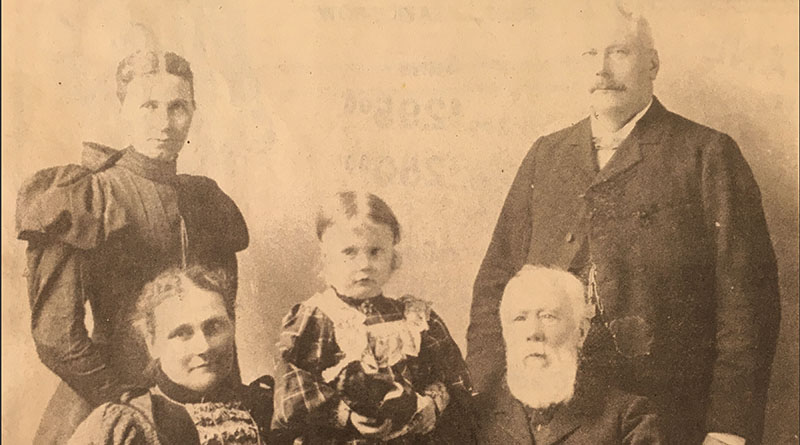






George Bryson, is widely known in the Pontiac for his contributions in building a major logging industry that dominated the local economic activity in the 19th and into the 20th century. Not only was he a savvy businessman and a major lumber baron in the region, but he was highly regarded and respected.
In honour of Bryson and his legacy, an installation and a permanent exhibition will be housed at the George Bryson Cultural House in Mansfield, a project spanning the course of two years.
Dominique Dufour, the project manager explained that the exhibit features . . .
12 different themes which includes, the Bryson family, the Bryson estate, George Bryson, the Marchand Bridge, life in the Pontiac, the history of the Pontiac, the people of the Pontiac, nature in the Pontiac, men of the woods, the Coulonge Falls, raftsmen and log drivers, and the beaver.
“It’s focused on George Bryson because it is in his estate, but also Bryson had a wide impact economically, politically and in all the other areas we cover,” said Dufour.
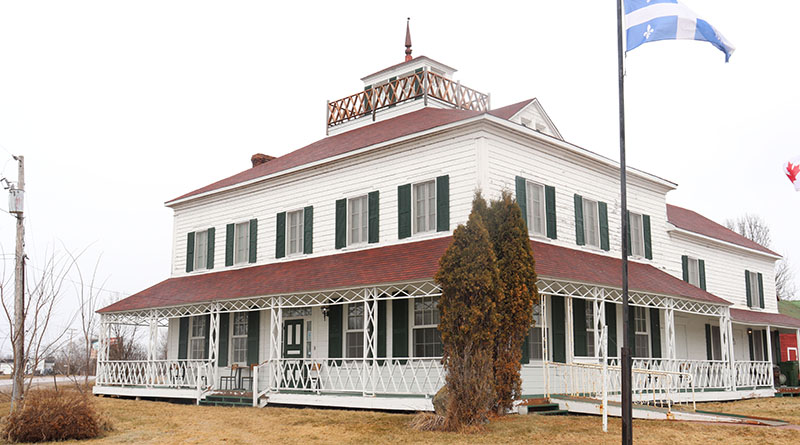
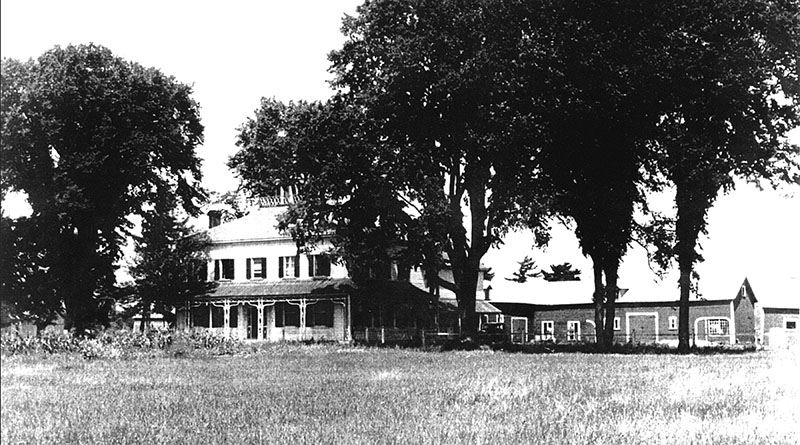
In 1854, Bryson had his house built which was unique to the Pontiac as it resembled those built by Scottish merchants in the years 1800-1830 in Lower and Upper Canada. The home is a group of buildings attached to the house and surrounding the courtyard, including a building for the blacksmith, one for the ice cream, stables, sheds and outbuildings for storing food. The complex stayed in the Bryson family until 1942, after that the Dagenais family occupied it.
At the exhibit, people can expect to see a range of artifacts, such as the original model of the red bridge, which was made in 1984, added Dufour. While collecting artifacts and doing some research Dufour discovered that there is a living descendant of the red bridge that still follows all the developments on it. He also added that the person who built the bridge did it in three months during the winter with very minimal equipment.
When asked if the Bryson family has any living descendants in the area, Dufour mentioned that Bryson is the great great grandfather of Warden Jane Toller.
Toller, who had also done some of her own research to better learn about her family, pointed out that her great great grandfather was well known for forestry, banking and governance.
One of the things he is known for is creating the first sawmill in the region, where he built a slide on the Coulonge falls for the transport of wood, in 1843.
She mentioned that Bryson senior was the warden of the Pontiac in 1862 and that his photo hangs at the MRC. “When I was in politics in Toronto, from 1998 to 2006, I had no idea that this was in my blood if I hadn’t done the research,” said Toller.
She believes it is important to protect history and to learn from that history, as the saying goes “you need to know where you’ve come from, to know where you’re going,” she said.
Working and living in the Pontiac, Toller said she feels like she has come back home and she sees herself devoting her attention to revitalizing the Pontiac. “I feel that it is my life’s purpose.”
Over the years the house was neglected and started to deteriorate, noted Dufour. It wasn’t until the 80s that the Bryson house was named a historical monument, which is when restoration efforts began on the house. After the CLSC du Pontiac moved locations around the 90s the municipality set up a library there and the rest of the space was dedicated to the George Bryson cultural house and the creation of a museum.
The goal was “to exhibit the rich heritage of the area,” said Dufour. It was also to showcase Brysons influence on the region as he was a well known figure in society, he added.
When community members come to see the exhibit, they can enjoy the tea room, a meal at the cafe, live music and theater. The hope is to create a cultural space for everyone in the community to enjoy, mentioned Dufour.
“It will be an evolving exhibition, it will start small in terms of artifacts, the museum has some collections but it is a mix and match. It was hard to develop the storyline around them so we started from scratch, we wrote the story we wanted and now we are looking to add more artifacts,” said Dufour.
One thing they are looking to borrow is a taxidermy beaver to add to their exhibit, as the beaver is nature’s engineer, noted Dufour.
Dufour highlighted that they plan to open the exhibit which is on the second floor of the building, once the lighting of the red bridge is announced.