





STEPHEN RICCIO
MUNICIPALITY OF PONTIAC Nov. 10, 2020
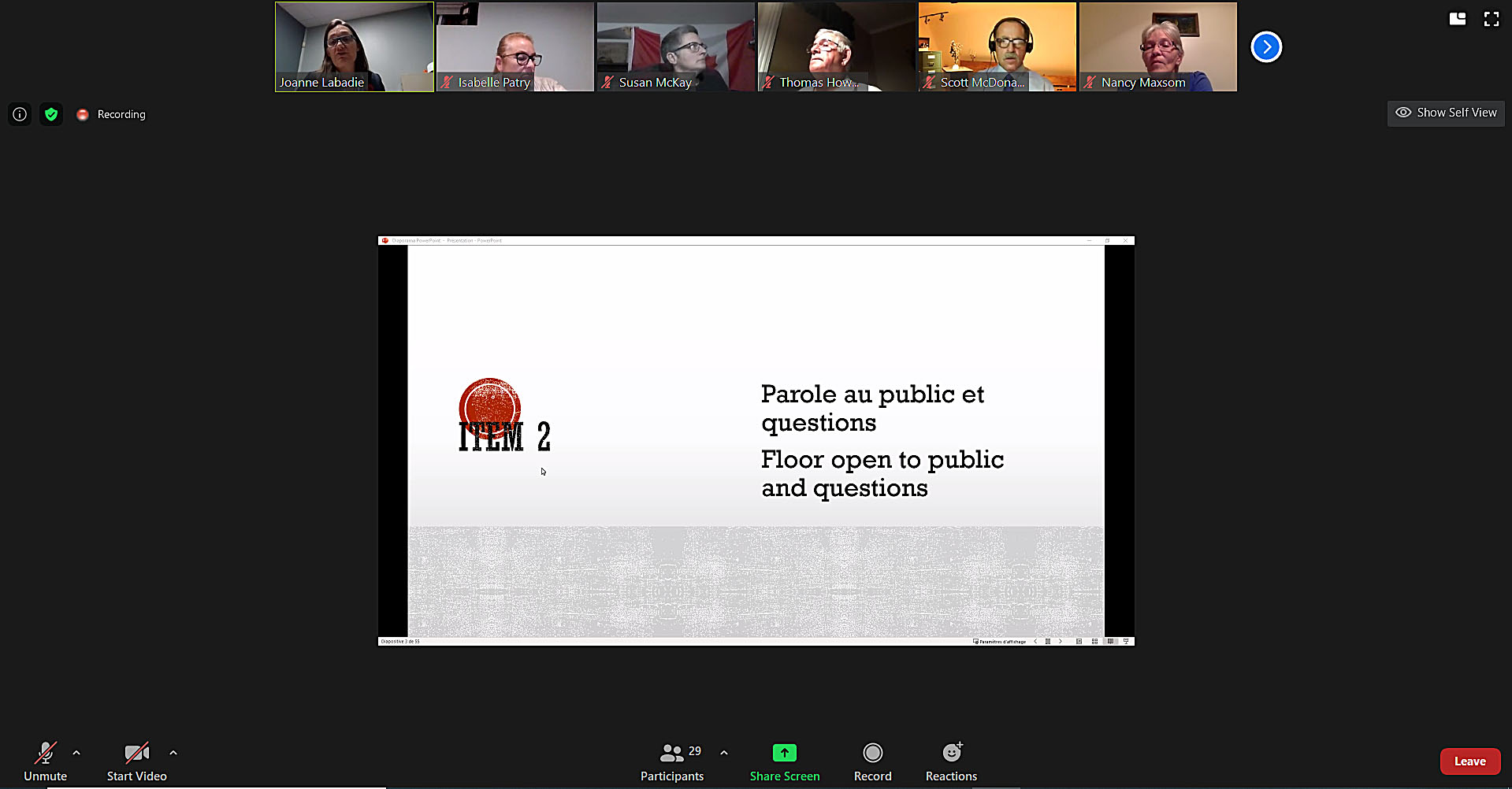
The Municipality of Pontiac (MoP) held their monthly council meeting on Nov. 10, via Zoom.
The meeting was virtually attended by the mayor and all six councillors. It also drew a large audience, with as many as 20 residents tuning in at one time during the opening-public question period.
Public question period
A substantial portion of the question period was characterized by discussion about . . .
the Facebook account that was blocked by the municipality and that has been the subject of further controversy.
Resident Joan Belsher kicked off the question period by asking members of council whether they intended on running again or not with municipal elections coming later next year.
Every member responded except for councillor Leslie Anne-Barber. While councillors Thomas Howard, Nancy Draper Maxsom and Isabelle Patry all said no, Mayor Joanne Labadie as well as councillors Scott McDonald and Susan McKay said that they had yet to make up their mind.
Blake Draper asked the council about why the municipality had been reaching out to agricultural producers for a survey, as there is already a provincial body that oversees agricultural affairs.
Labadie explained to Draper that the municipality is trying to get information that will inform future decisions on permits and bylaw affairs. The survey’s goal is to protect the agricultural industry, Labadie said.
Draper also asked about the status of ditches where culverts have been changed but the ditches were not cleaned despite machinery being on site.
Labadie explained that a 2016 survey found that over 100 culverts were identified as being needed to be changed within five years. Since 2017, approximately 100 culverts have been changed, 85 per cent of which were identified in the survey. Regarding cleaning, she said that the municipality will focus their efforts on extensive ditch cleanup in 2021.
A resident asked a question about what to expect from the municipality’s preparations for potential spring flooding in 2021, specifically with regard to funding. Labadie assured the resident that there is an emergency measures committee that is in consultation with all levels of government to maintain a sufficient disaster plan. She also explained that there would be an emergency fund approved during the meeting.
Emergency measures surplus & infrastructure surplus
One of the first resolutions passed by council was for the allocation of an emergency measures surplus to combat potential disasters.
Council agreed to start the fund with $250,000, which will come from the financial aid that the provincial government delivered to municipalities in October as relief for COVID-19 related expenses. The sum that the MoP received, $381,666, is set to be delivered in two payments, with the first coming in December.
“That would cover any disaster,” Labadie explained after the meeting. “It could be money that we use if we have any unforeseen expenses related to the pandemic … any type of natural disaster that occurs in our community from tornado, floods, forest fire, but it will be money that will be reserved specifically for disaster management.”
Included in the resolution is the ability for the municipality to add more funds to the surplus if necessary.
An additional surplus was resolved to be created, this one for unforeseen infrastructure related expenses. It was determined by council that this surplus be created so that the municipality can carry out necessary last-minute project work without having to take on loans.
The funding will come from the TECQ, the gas tax and contribution program for Quebec.
While the council did not discuss a specific amount during the meeting, it was resolved that any amount could be deposited into the surplus based on what is deemed necessary.
Miscellaneous expenses
Council authorized various expenses during the meeting, beginning with some unforeseen costs from the water main repair work done on rue Saint Andrew and rue Saint John during the summer.
It was agreed that the resulting expense of $49,672.48 would be taken from the TECQ program.
The municipality also agreed to allow for several purchases that were recommended by the municipal fire department to upgrade old equipment.
First, a new extrication tool tender offer was accepted by council, at a cost of $32,273.
Second, the council authorized the purchase and installation of an air exchanger and Co2 and No2 detectors for the Breckenridge first station. The supplier of the devices is Modern Niagara and the expenses to the municipality will be $11,746.33.
Lastly, a radio repeater system was agreed to be bought for the Breckenridge fire station to assist with the radio dead spots that exist within the sector. The municipality’s radio supplier will be selling and installing the equipment for a price of $9,250.
The baseball lighting system needs upgrading at the Luskville Recreation Park, and so the municipality agreed to accept a bid from Pro-Ballast to supply the poles and crossings needed. The project cost, $57,258.70, will be financed by a Toronto Blue Jays grant worth $150,00 and a Ministry of Education and Teaching grant worth $82,914.
Some disagreement surfaced when the council discussed the recommended upgrade cost for the rink boards at the Quyon recreational park rink, which are considered damaged. Three companies submitted project tenders to the municipality. Council agreed by majority to go with the lowest offer, from Agora, for the boards at a cost of $36,786.15.
Councillors Draper Maxsom and McDonald voiced their disapproval for different reasons. During the meeting, Draper Maxsom suggested that the problem is that the rink is sitting in a flood zone and this contributes to the damaging of boards.
Speaking after the meeting, McDonald explained his vote against the resolution.
“I do believe we’re spending way too much,” he said. “I was quite surprised that it came up that we needed to replace the boards down there.”
He said that he recently looked at the boards and believed them to be in similar condition to the existing boards at the Luskville Recreation Park.
Labadie explained after the meeting that while it’s true that the area is a flood zone, there was also a $1 million plus community centre built in that same area.
She explained that the boards did need replacing and that the price was fair.
“That’s what rink boards cost and we had that verified,” she said.
Bronson Bryant study
Since spring flooding in 2019 that washed out a culvert and a chunk of the road, Quyon’s chemin Bronson Bryant has been closed.
During the meeting, council resolved to go forward with gathering plans and specifications to determine the costs of a potential repair project. By submitting this information to the Ministry of Public Security, the municipality could possibly receive financial aid for future work.
“So this does not authorize the plans and specifications, but to go out and get submissions for plans and specifications, and to show the ministry of public security that we are intending on repairing the road and so that they can approve the financing,” Labadie explained after the meeting.
Further approval of repair work would have to go through council after a project price tag is identified.
Website revamp
Council also agreed that the municipality will be hiring a student intern from the Cégep de l’Outaouais to create a new website over a 16-week period.
The college reached out to the MoP offering to retain the cost of the project. The student will be paid $17/hour for 36 hours a week as he goes about upgrading the municipality’s primary online platform.