





On March 27, around 30 Pontiac business people and residents assembled at Pine Lodge hotel in Bristol for the Pontiac Tourism Association’s (ATP) annual general meeting.
During the presentation, Chantal Lair, Tourism Marketing Officer at the ATP, announced the launch of the new Tourism Promotional Map and noted that the ATP will no longer be assigning memberships to Pontiac businesses, as they’ll take everyone into account instead.
“Everybody’s going to be on the map,” said Lair. “Before everybody was on the map as well. It’s just that members of the tourism association were kind of highlighted. So now, everybody’s going to have the same listing. It’s going to be equal for everybody.”
Lair said the official map should be ready in the coming weeks and that there’s an ongoing list of specifically who will be displayed on the map, which is available on the ATP website.
The ATP also held elections for the remaining seats to its board of directors. Re-elected were Denis Lebrun, Robin Judd, Vince Accardi, Dennis Blaedow, David Gillespie, Jessica Forgues and Adam Thompson, while the newly elected director was Byron Sheppard from Otter Lake.
The ninth seat remains open for the taking.
Robin Judd, president of the ATP, outlined the association’s 2018 financial statements as well as a list of nine activities accomplished by the association in the last year, which included a partnership agreement signed with the MRC Pontiac to help facilitate tourism development in the region.
The objective of the partnership proposal between the MRC Pontiac and the ATP is to combine forces in the goal of creating consistent high quality tourism promotions for Pontiac businesses.
“It’s just four of our directors and three mayors with the MRC along with Chantal Lair,” said Judd. “We’re trying to team up and bounce ideas off each other to hopefully get things done more productively for tourism in the region.”
It outlines that they will hold four meetings per year, that the ATP will join the MRC advisory committee and that the committee will be assembled with an equal number of seats for both parties.
According to the proposal, the MRC is still fully accountable for human resource management as well as budget and project planning, whereas the ATP will be in charge of tourism events and activities.
Members of the Canadian Parks and Wilderness Society (CPAWS), were also invited to speak about an upcoming wildlife conservation project aiming to help tourism in the Pontiac with its appealing landscapes and recreational activity services.
The goal for CPAWS is to turn the three sisters (Coulonge, Dumoine and Black) rivers and the surrounding forests into a national park, thus eliminating any opportunity for industrial development in the area.
One resident in attendance alerted the speakers that the initiative may negatively affect certain outfitters that are located in that part of the region. However, Judd believes it won’t be a serious issue.
“Most of these changes are only affecting areas close to the watershed,” said Judd. “So, I think the only ones who are going to be affected by this in a negative way will be those doing activities in the water.”
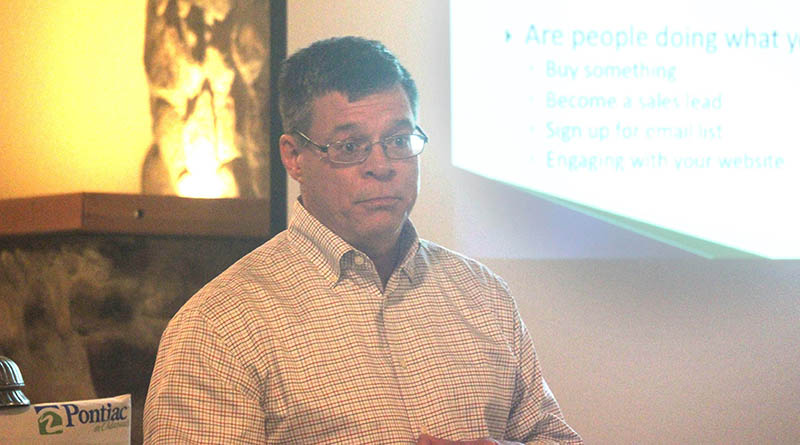
For the event, the association invited special guest David Bird, founder and owner of Bird’s Eye Marketing to teach attendees about the importance of Google Analytics for their businesses and how to use it to their benefit.
A software used to track internet traffic on specific websites, Google Analytics is a tool used by all types of businesses to find out information like what people are doing on their websites, how long they stay on them, how many pages they look at and how profitable they are.
“You build a website to make money,” said Bird. “You want to know if it’s helping you make money. This is how you find out, by following where they came from, to clicking certain buttons, to getting to the pages for what you want them to do.”
During the power-point presentation, attendees listened and asked questions as Bird explained the basic fundamentals of Google Analytics and how to put them to work to bolster tourism revenue.
Bird urged attendees that the software is only useful when used properly and that when it isn’t, it’s only good for one thing: a ton of interesting but useless information.
When starting out with the software, Bird recommends people set about three goals, and to check-in on their progress every week or two. Users can set a maximum of 20 goals, but Bird reminded them that it could be overwhelming to start things off with so many to keep track of.
“You want to go in looking for something specific,” said Bird. “Not just looking at it like ‘oh that’s interesting’. I call it interesting but useless info. To make it useful you need to tie it to a goal.”
Applicable to any business with a functioning website, Google Analytics is a vital tool for rural enterprises. It provides opportunities for more exposure and also indicates where customers are coming from, such as whether they’re from outside or within the community, what kind of ad led them to it and what they’re buying.
by J.D. Potié
BRISTOL March 27, 2019