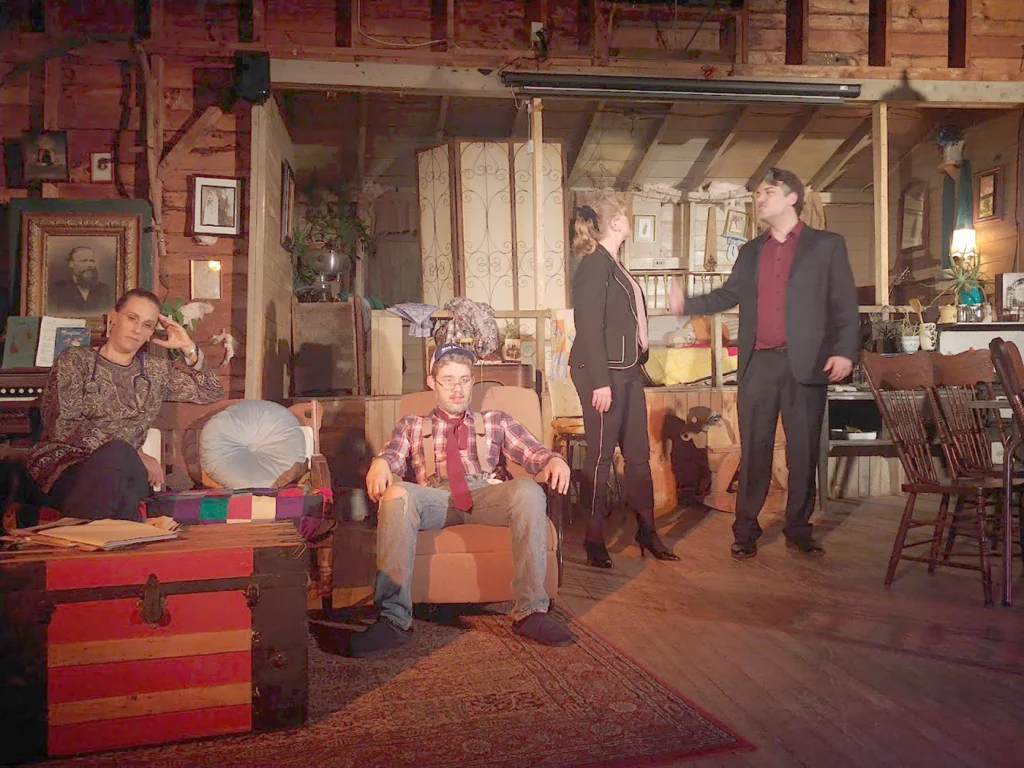







The Pontiac Community Players wrapped up the fourth performance of their summer show, David S. Craig’s Having Hope at Home, on Saturday night in front of a sold-out crowd.
For the four nights of the show’s run, Bristol’s Coronation Hall doubled as the home of the Bingham family, proprietors of a drafty old farmhouse in rural Ontario.
The plot centres around a young pregnant couple, Carolyn (played by Sydney Côté) and Michel (played by Grant Moore), who are set to welcome their new baby into the world with the help of a midwife, Dawn (played by Christine Rieux).
Tensions flare as Carolyn’s father Bill (played by Greg Goyette), himself an obstetrician, can’t seem to get on board with his daughter’s decision to have a home birth instead of going to the hospital.
Bill’s wife Jane (played by Jen Mielke) and father Russell (played by Gavin Murray) each chime in with their own two cents, while the erstwhile happy couple try to find peace amidst the familial chaos.
Along the way, the family is forced to confront some buried demons and actually talk about the festering resentment that kept them apart for three whole years.
The often-stubborn Carolyn finally accepts her mom’s help, who feels needed by her daughter for the first time in a while. Bill eventually respects his daughter’s wishes to have a home birth, and even begins to make amends with the midwife, opening his mind to the possibility that she might know what she’s doing, too.
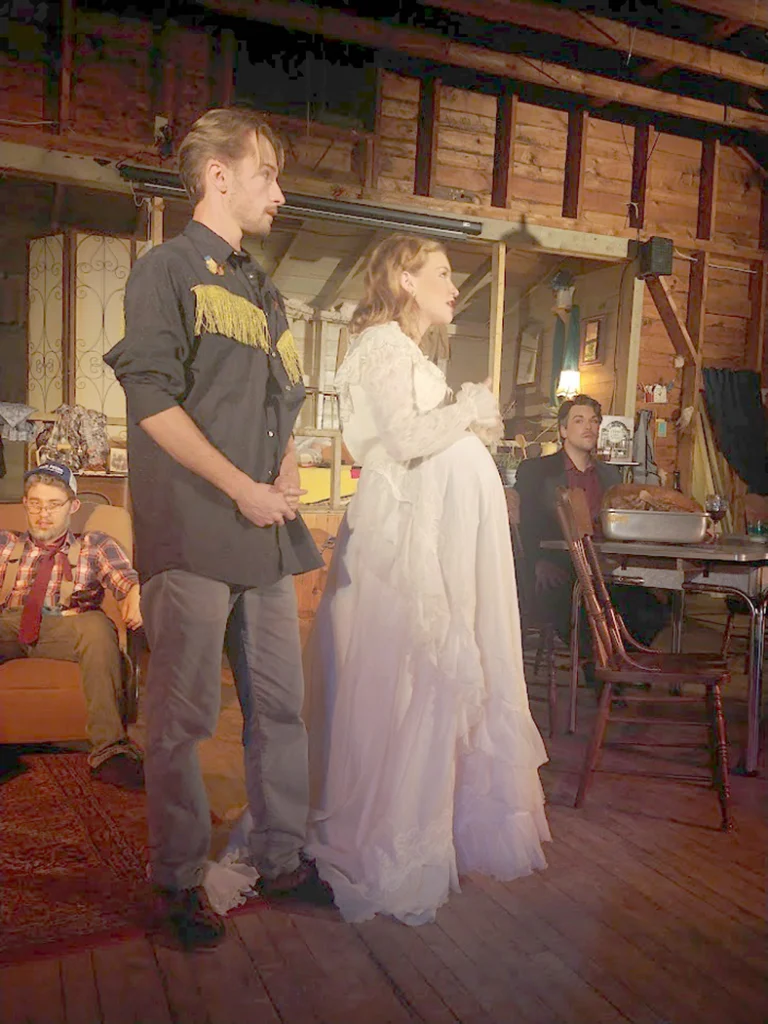
In the end, a baby girl, who is aptly named Hope, unites three generations in familial harmony for one night.
There were some standout performances from the cast. Moore showed his acting chops in the role of Michel, portraying an earnest, supportive and optimistic partner to Carolyn who wants nothing more than to have this child. With a strong stage presence and a full grasp on his character, he did it all in a flawless Quebecois accent to boot.
Michel is the perfect counterpoint to headstrong Carolyn, who invited her parents over for dinner in the hopes of impressing them with her independence, but just can’t seem to get anything right. The turkey is undercooked, and the apple pie is burnt, but Côté’s portrayal shows us that those things don’t matter.
The family never actually ends up eating dinner in the end, as Côté’s vulnerability as both a daughter in search of her father’s approval, and as a new mother trying to navigate young adulthood and new motherhood, steals the show.
Rieux delivered a masterful performance in the role of Dawn, the hired midwife who arrives at the farmhouse ostensibly to help Carolyn deliver her baby, but ends up playing mediator to a dysfunctional family. She deftly navigates outright attacks on her job by Bill the big-city doctor, using sarcasm and humour to parry them away. Calm and resolute, she helps Carolyn carry out her vision of a home birth in less-than-ideal circumstances.
Amidst the chaos of childbirth and intergenerational feuding, there are moments of raw emotion.
Carolyn sits her father Bill down to let him know she will be having this baby at home, but the conversation turns into an earnest chat about their relationship where their true feelings are laid bare.
The audience is surprised to learn that grandfather Russell, the calloused farm veteran whose off-colour jokes serve as the play’s comedic relief, is actually contemplating suicide because he no longer feels useful on the farm. When he walks out of the house, the audience is left to believe that he’s going to venture into the “great beyond.”
But in one of the play’s greatest scenes, Bill finds his father sitting in the snow, and they have a heartfelt conversation underneath a shared blanket where Russell tells Bill he’s proud of everything he’s accomplished as a doctor, possibly for the first time ever. Goyette unlocks the doctor’s hidden sensitive side, asking after his dad’s approval.
Murray’s portrayal of Russell is inspired, showcasing the character’s multivalence. From the hard work to the dad jokes to the subtle racism and microaggressions to the suicidal thoughts to, eventually, showing his true colours as a proud father and grandfather, Murray paints the entire picture of a farmer struggling with mental health.
Many of the play’s strongest moments are centred around food. Of utmost importance to Carolyn was the seating plan at the dinner table, which featured herself and Michel at the heads of the table – a position of dignity in any rural Canadian home, usually designated for the family matriarch and patriarch.
Jane doesn’t want to be dethroned from that position quite yet, and she rebuts that she and her husband should be at the heads of the table – for turkey-carving purposes, she says. But really, the seating plan reveals something even deeper about Jane’s character: she wants to feel respected, needed by her daughter. The dinner table is her domain, and she’s not giving up dominion. Mielke plays this role well.
The apple pie that Carolyn prepared for the dinner was the result of over 200 trials, which she and grandfather Russell undertook to recreate her late grandmother Lorna’s award-winning creation.
It was made with apples from the old family Macintosh tree, which acts as a connecting fabric during the play. In the midst of the yelling and screaming, all three generations reminisce about the good times had under that ancestral tree over the years.
The play is at once heartwarming and deeply funny, and takes on the messiness of family dynamics with a deft touch. It tackles themes that we can all relate to – family, food, birth, and death – with earnestness and, often, humour.
The play’s conclusion, the birth of baby Hope, leaves the audience feeling warm and fuzzy inside. It brings three generations of family together, for one night, to celebrate the arrival of a fourth. Will Carolyn’s temporary truce with her father last more than one night? We don’t know, but it doesn’t matter. The baby is the force that, in the end, suspends everyone’s resentment and hostility toward each other, and fleshes out the double-entendre of the play’s title, leaving the audience feeling hopeful of what is to come for the Bingham family.