


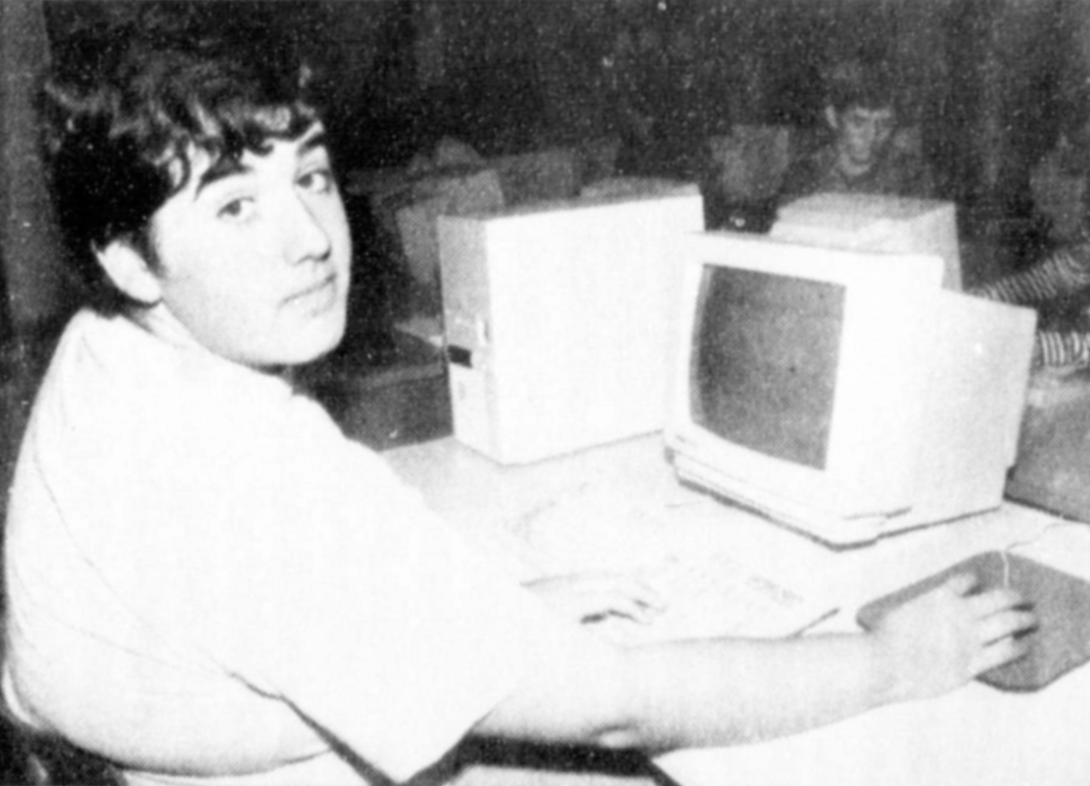



Some local schools now have all the necessary equipment to begin launching students into cyberspace.
When students at Pontiac Protestant High School and McDowell Elementary returned to classes this week, they had their first opportunity to make use of their schools’ new computer capabilities.
These schools had extra phone lines installed last month to allow them to be connected to computer networks. By using a modem, computers can talk to one another over telephone lines. Groups of computer users can set up networks, which opens a whole new world of communication.
Now that Shawville has local calling to Ottawa, the area has free access to the National Capital Free-Net, a regional non-profit network whose subscribers number more than 33,000 and are increasing by 100 every day.
Subscribers can exchange information or place messages on a “bulletin board” where they will be spotted by users with similar interests.
The Western Quebec School’s Board has its own internal bulletin board, which keeps schools up to date on what’s happening within their system.
Beyond that, Free-Net gives access to the larger Internet, a system that links more than 35 million computers worldwide.
For less than one would pay for cable TV, a computer operator can gain access to information from all over the world.
Don Stevens, who teaches computer classes at PPHS, says that on a recent Monday he found himself reading – via the Internet – newspapers published in China the previous Friday.
Several university students who are graduates of PPHS have been using these systems to talk to one another – across Canada or across the ocean – for free.
Awesome
For research purposes, students can use this technology to obtain information that is more up-to-date than what can be found in books or encyclopedias.
For personal uses, one can get up-to-date information from users who share their interests.
“There’s awesome information here,” said PPHS Grade 10 student Jonathon Stewart as he logged onto the Free-Net Monday morning.
So far, he has used it only to catch the latest comments on the previous night’s NFL football game or on the future of the Ottawa Rough Riders.
He hopes to soon be able to apply the school’s new capabilities to his studies.
“This is a whole new area,” says Don Stevens. “Information is hitting us from all over.”
Stevens says his aims in the classroom are to keep students abreast of developments in computers, to make them appreciate how fast the technology is developing.
“Most students are challenged by the technology,” he observes.
And it does help develop skills in logic and reading. In this way, “It’s a motivation that reinforces their other academics,” says Stevens.
How it works
When one logs onto the Free-Net, a list of 17 possible headings comes into view on the main menu. These choices include topics such as science, government, or social issues.
Under the science heading, one can find entries on everything from jobs of the future to the latest developments in space exploration.
Under the government heading, one can find comments from Free-Net users on topics ranging from gun control to same-sex benefits.
Members of associations as diverse as Scouts Canada and an inventors’ club have items listed under their heading.
Pontiac on-line
Under a heading for newspapers, one finds only seven publications from the region listed. One of them is The Equity.
Former Equity editor Rosaleen Dickson applauds PPHS for accomplishing what many Ottawa schools have been unable to achieve.
Mrs. Dickson has been a Free-Net enthusiast for years and began serving on the Free-Net board of directors a year ago.
She is moderator for a special interest group dedicated to seniors, seeing that information for them is entered into the Net. On the lighter side, she is a regular participant in an exchange of views among fans of TV’s Coronation Street.
She also enters selections from The Equity each week, including upcoming events, major headlines, and each week’s editorial.
“Our newspaper represents the county on Free-Net,” she says.
As part of her studies for her master’s degree in Communications at Carleton University, Mrs. Dickson is researching the impact of computer networks on journalism.
On the one hand, she describes the new technology in MacLuhanesque terms as creating “a new global community.”
On the other hand, the method of exchanging information is not entirely new. “It’s the biggest party line in the world,” she says.
With more local people on line, Free-Net can become a way of finding out what’s going on in one’s own community, and it can communicate with users from all around the world.
As a journalist, though, Mrs. Dickson is not worried that this new form of exchanging information will one day make newspapers obsolete.
“No more than TV made radio obsolete,” she says.
New role
McDowell Elementary Principal Anne McGowan says her students are getting organized to go on-line, though they’ll probably limit their explorations to the WQ Board’s own network.
“We’re at the intro level,” she says.
Most of the kids already have their own passwords ready, which allow them access to the network.
Don Stevens says the new technology has changed his role. “I’m becoming more of a facilitator and a technician than a teacher,” he says.
Still, the look in his eye reveals his own excitement about the learning possibilities opened up by this innovation.
“There are so many things to explore here,” he says.